Get Full Government Meeting Transcripts, Videos, & Alerts Forever!
Get email alerts on the Housing topic
No spam. Unsubscribe anytime.
Council approves Tract 7471 despite appeals citing air quality and endangered‑species concerns
Summary
The council denied appeals and approved Vesting Tentative Tract Map 7471, a proposal to subdivide about 83.97 acres into 363 single‑family lots, after extended public comment from environmental groups and developers.
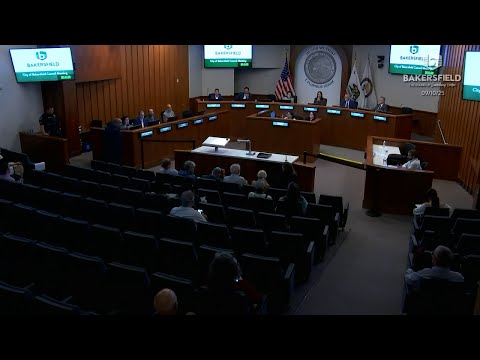
The Bakersfield City Council on Sept. 10 voted to deny appeals and approve Vesting Tentative Tract Map 7471, a proposal by LGI Homes to subdivide approximately 83.97 acres at the southwest corner of Morning Drive and Paladino Drive into 363 single‑family lots and associated streets and landscape lots.
The hearing drew extended comment from environmental organizations, scientists and residents who argued the project's mitigated negative declaration does not adequately analyze cumulative air quality, greenhouse gas and biological impacts — particularly potential effects on the San Joaquin kit fox, burrowing owl and other special‑status species. Multiple speakers urged the council to require an environmental impact report (EIR) rather than accept the MND.
Chase Preciado of Supporters Alliance for Environmental Responsibility (SAFER) told the council that expert surveys indicate potential significant impacts to special‑status species and that vehicle and building‑energy assumptions in the MND do not meet the state’s 2022 scoping plan guidance for electrification and decarbonization. "The MND does not disclose Bakersfield's already degraded air quality and resulting health risks and relies on thresholds not supported by substantial evidence," he said.
Sierra Club representatives reiterated concerns about cumulative impacts and about the expiration of the Metropolitan Bakersfield Habitat Conservation Plan (HCP), which they said previously collected development fees to preserve habitat. Antia Lauer, a biologist at CSUB and Sierra Club conservation chair, told the council the site "is almost certainly habitat of the San Joaquin kit fox" and noted the city study acknowledged potential cumulative effects.
City staff and the applicant's consultants defended the MND. Development Services Director Phil Burns said qualified air‑quality and biological consultants prepared the analysis and that mitigation measures were included. Burns said the project meets applicable state and local performance standards, including Title 24 energy requirements. Applicant representatives and counsel emphasized consistency with the general plan and zoning and said the administrative record contains technical studies and responses to comments.
LGI Homes representative Evan Light described the project as focused on first‑time homebuyers and highlighted on‑site amenities including 6.6 acres of parks and paseos. He said the company changed an earlier, lower‑amenity plan to add community spaces and more efficient lot layouts.
Council members discussed long‑term policy tools during deliberations. Several council members asked about an HCP; city staff said the council had identified an HCP as a priority and that staff has contracted a consultant to prepare a revised HCP framework and an associated EIR, with a development timeline of many months. Staff reiterated that, in the absence of an HCP, applicants are required to provide species‑specific studies and consult CDFW as part of permit review.
Council member Smith moved to deny the appeal and approve the tentative map; the motion passed with Council members Weir and Basheer Tash absent. Opponents signaled intent to continue advocacy on cumulative impact policies and to press for a local HCP and tighter local thresholds for air and greenhouse‑gas significance.
The approvals permit LGI Homes and other applicants to continue through subsequent permit and mitigation steps, including coordination with the California Department of Fish and Wildlife and compliance with San Joaquin Valley air regulations.