Get Full Government Meeting Transcripts, Videos, & Alerts Forever!
Get email alerts on the Economic Development topic
No spam. Unsubscribe anytime.
Bakersfield council receives economic development strategic plan update, discusses incentives criteria
Summary
City staff presented an update on the 2021 Economic Development Strategic Plan, reviewed programs (entrepreneurship grants, Opportunity Zones recertification, EIFD), and proposed a weighted scorecard for incentives; council voted to receive and file the report.
Bakersfield City Council on Sept. 10 received and filed an update on the city’s Economic Development Strategic Plan (EDSP) and a proposed criteria framework for economic incentives, staff said.
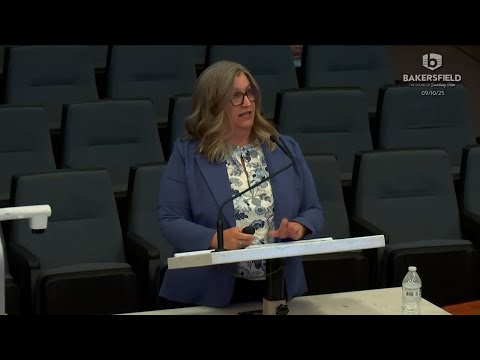
The report, presented by Jenny Byers of the Economic and Community Development Department, summarized work under three EDSP categories—industry targeting, umbrella programs and placemaking—and highlighted actions including entrepreneurship grants, business recruitment efforts, Opportunity Zones recertification and exploration of financing mechanisms such as an Enhanced Infrastructure Financing District (EIFD).
Why it matters: Council members said a clear, transparent incentives framework would help the city compete for large projects, direct limited public funds to priorities and track outcomes such as jobs created, sales-tax generation and private capital invested.
Byers told the council the EDSP, adopted in 2021, contains 17 strategies and that staff is now focusing on a next layer of programs and an economic development scorecard. She listed recent accomplishments including small-business and entrepreneurship programming funded with ARPA dollars, a reported entrepreneurship program that staff said has generated hundreds of jobs, and work to support large users such as CalDairies. Byers also noted external grants and awards the city is pursuing, including a Transformative Climate Communities grant for Southeast Strong (listed in the presentation as $22,100,000) and an EPA Brownfields grant to remediate contaminated sites.
"We are evaluating and refining economic development incentives," Byers said, describing a proposed weighted metric system that would guide staff recommendations for advocacy, business support or financial incentives subject to council approval. The draft criteria include alignment with the EDSP’s target industries, jobs (construction and permanent), capital invested, placemaking and investment in underinvested areas (using tools such as CalEnviroScreen).
Jason Clegg of the City Manager’s Office said incentives can be appropriate in two circumstances: when a project produces long-term fiscal benefits to the city and when market conditions leave projects just short of feasibility. "If it's going to create that long term benefit, there could be value in those public dollars making sure those projects happen here," Clegg said.
Council members asked for clarifications and additions to the scorecard. Council Member Gonzales sought assurances about metrics and outcome tracking; Clegg and Byers said staff will track community-level indicators (unemployment, new business licenses) and project-level outcomes (jobs, sales tax, capital investment). Council Member Arias asked for stronger emphasis on blighted properties and on measuring impacts from arts, culture and tourism projects. Several members recommended local-hiring preferences and connections to apprenticeship and workforce programs.
Byers described a two-tier approach to incentives: smaller Economic Opportunity Area (EOA) grants (she said there have been about 111 grant agreements with an average award under $25,000) and larger economic development subsidies for major projects. She said staff is preparing related outreach (marketing materials, RFPs for recruitment and a business/industrial recruiter) and that the city is reviewing new Opportunity Zones rules (referred to in the presentation as "Opportunity Zones 2") and plans to pursue recertification where appropriate.
Staff emphasized next steps: finalize the scorecard, return to council with recommended criteria and bring detailed incentive tools to the finance and economic development committee. After public comment was closed with no speakers on the item, a motion to receive and file the EDSP update was made and approved.
The motion was approved; the clerk recorded the outcome as approved with Council Members Weir and Bashir Tash recorded as absent at the time of the vote.
What remains open: staff will return with the finalized scorecard and proposed incentive tools, recertification work on Opportunity Zones, and verification of several program counts referenced during the presentation (for example, staff separately noted that the "122" figure for the youth jobs program referred specifically to city-hall placements and that broader program counts may be higher).