Get Full Government Meeting Transcripts, Videos, & Alerts Forever!
Get email alerts on the Land Use topic
No spam. Unsubscribe anytime.
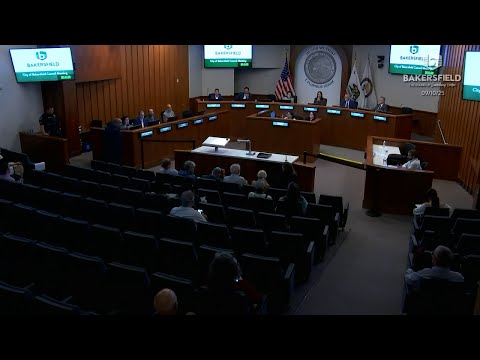
Bakersfield Council upholds approval of Vesting Tentative Tract Map 7450 over Sierra Club appeal
Summary
After public testimony from environmental groups and project proponents, the City Council denied an appeal and approved a 32.66‑acre subdivision (Tract 7450) that would create 176 single‑family lots, finding the project complies with CEQA and local zoning.
The Bakersfield City Council on Sept. 10 denied an appeal by the Sierra Club and approved Vesting Tentative Tract Map 7450, a proposal to subdivide roughly 32.66 acres at the southwest corner of Olive Drive and Rosedale Ranch Parkway into 176 single‑family lots.
The action came after about an hour of public comment and technical presentations. Council member Smith moved to deny the appeal and approve the subdivision; the motion carried with two council members absent, the clerk announced.
The project drew opposition from environmental advocates who argued the city's mitigated negative declaration (MND) did not adequately evaluate cumulative air quality, greenhouse gas and biological impacts. Babak Nafisi, an attorney representing the Sierra Club, told the council the document understates cumulative air impacts and that “you should rethink that because I think it's not fair to the residents,” citing regional air quality concerns and the lack of local thresholds for greenhouse gas significance.
Phil Burns, the city's development services director, summarized staff analysis, saying the site is zoned R‑2 and that the project is consistent with the general plan. Burns told the council that consultants prepared air quality and biological studies and that mitigation measures were included to reduce impacts to less‑than‑significant levels. Burns said, "CEQA doesn't require perfection, but instead, adequacy, completeness, and a good faith effort to full disclosure." He recommended the council uphold the planning commission's approval.
Project counsel Brian Winter said the technical record supports the MND and emphasized state law limiting lawful denial of housing projects that conform to objective zoning and general plan provisions. Winter told council members that the Housing Accountability Act constrains local authority to disapprove consistent housing projects except under narrow evidentiary circumstances.
Speakers for the project included representatives from the applicant team and the Home Builders Association of Kern County, which urged the council to approve the project to add housing supply. Opponents included Sierra Club members and environmental groups who urged the council to require an environmental impact report (EIR) instead.
Council discussion touched on the absence of a local habitat conservation plan (HCP). Vice Mayor Kaur asked how species protections proceed without a local HCP; staff replied that applicants must provide species‑specific studies and consult the California Department of Fish and Wildlife (CDFW) before the city issues building permits. City staff said a revised HCP framework is under development and an EIR for an HCP is anticipated to take many months.
The council approved the subdivision; the clerk announced the motion passed with Council members Weir and Basheer Tash absent. The approval leaves in place mitigation measures described in the planning record; opponents signaled continuing concern about cumulative air and biological impacts and urged further city policy work on local thresholds and an HCP.
The council also received public comment from residents and scientists who said Bakersfield's existing air quality and habitat losses require stricter, cumulative analysis before approving additional large subdivisions.
Looking ahead, staff indicated the HCP framework will be developed with stakeholder input and that any species findings required by CDFW would be addressed before grading or building permits are issued.