Get Full Government Meeting Transcripts, Videos, & Alerts Forever!
Get email alerts on the Land Development Process topic
No spam. Unsubscribe anytime.
Santa Barbara land development oversight committee reviews permitting dashboards, preapproved ADUs and stormwater updates
Summary
City staff reported progress on implementing the 2020 Novak report, launched a public building-permit dashboard and digital plan review, described a 10-design preapproved ADU program and outlined updated stormwater guidance; committee approved draft minutes unanimously.
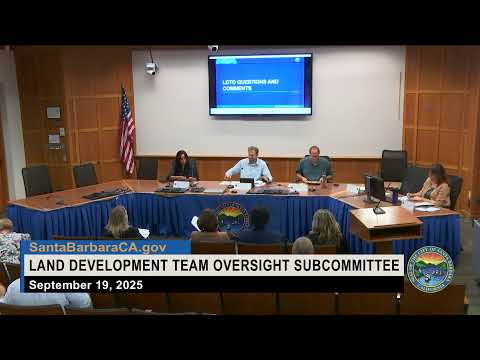
The Land Development Team Oversight Subcommittee met Sept. 19 to review progress on process improvements tied to the 2020 Novak report, including a new public building-permit dashboard, expanded on-demand permits, digital plan review and a preapproved accessory dwelling unit (ADU) program that now lists 10 designs for public selection.
The meeting provided implementation timelines and operational details and included a public comment on permitting delays. The subcommittee approved the draft minutes from an earlier meeting by unanimous vote at the end of the session.
The Novak report prompted the committee’s creation and includes 31 recommendations for improving the city’s permit and development review processes. “The land development team is the staff that review and manage all aspects of the land development process,” said Debusk, the staff lead introducing the presentation, and she summarized the committee’s role in advising on procedural changes and municipal-code amendments derived from the Novak recommendations.
Raven Rutledge, Business Analyst in Building and Safety, described the city’s new building permit dashboard, which the department launched on June 17, 2025 and built using Power BI. Rutledge said the dashboard connects to the city’s Accela permitting system and provides an interactive, public-facing timeline for each permit that displays the number of days a project spent in city review versus applicant response time. “Now we can see that,” Rutledge said, referring to claims that a permit “can take over a year” and noting the dashboard breaks down the city’s share of that timeline.
Rutledge also summarized new on-demand permits, including a free, city-supported permit option for heat pump water heater replacements launched in January (used in conjunction with rebate processing by the Sustainability and Resilience Department). She said the on-demand program expands as staff add permit types and that building and safety plans to pilot through-lateral replacement and combined HVAC/heat-pump water-heater on-demand permits.
The department has increased public plan-viewing capacity in the lobby from six to 12 stations after legal advice that plan viewing must occur on-site. Rutledge said plan-viewing appointments are available Tuesday through Thursday, with Monday reserved for records processing.
Chief Building Official Tina Dye previewed the 2025 triennial construction code adoption process. Dye said the International Code Council issues model codes and California adopts and amends them; the city will carry local amendments forward as needed. The ordinance committee will review the local adoption on Oct. 21, with city council introduction scheduled for Nov. 18 and potential adoption on Dec. 2; Dye said new codes would take effect Jan. 2, 2026, 30 days after adoption.
Staff described other digital improvements: auto-email notifications at milestones in the Accela workflow, the DigiPlan electronic plan-review system (launched Sept. 9, 2024), and an updated, consolidated user guide for applicants prepared by planning analyst Brenda Bell. Rutledge said DigiPlan restores the ability to mark up plans with redlines and has sped review turnaround for staff and applicants.
The preapproved ADU program, required by state law, opened in July for designer submissions and has moved to phase 2: the city posted 10 preapproved designs in May 2025. Rutledge said these designs are structural- and systems-reviewed so subsequent permit reviews focus on site-specific issues; the city reduced permitting fees for those ADUs by 25% and established an expedited 10-business-day permit review timeline. To date, staff reported no purchases of the posted designs.
Planning Division staff said much of their workload continues to be the housing element and related ordinance updates. The division completed objective design and development standards in March 2025 and is advancing a single-family streamlining project that has broadened in scope to include ordinance amendments. Staff said they plan to revisit the ADU ordinance to reference changing state law and will begin a fee study later this year to quantify the cost of LDT services for future policy decisions.
Erin Markey, Creeks Division manager, outlined stormwater-management responsibilities under the Clean Water Act and the city’s Municipal Separate Storm Sewer System (MS4) permit. Markey described new, shorter “quick reference” guides and a pictorial “stormwater solution guide” to help applicants understand post-construction stormwater requirements. She also gave an update on the Creek Buffer Ordinance process, noting a draft was released in January, public comments were summarized, and staff plan to issue a request for proposals for consultant services and return to council with a status update in November.
Public commenter Fred Sweeney handed out a detailed timeline of his permit experience and said his accessibility ramp project for the Old Mission took about two and a half years; he noted the permit was issued the day before the meeting but urged more accessible communication from the city about projects and permitting steps. “I’m handing out a lengthy, kind of a diary of the process to get the access for handicap ramp at the old mission. It’s taken 2 and a half years and we hit a milestone yesterday. The permit was actually issued,” Sweeney said.
Committee members praised staff work and recommended more proactive outreach and media engagement to publicize new tools, particularly the preapproved ADU designs and the dashboard. Member Santo Maria said, “I really just wanna thank our staff. This is my first time on this committee meeting. But it’s very obvious that you are all so incredibly diligent in improving our processes.” Member Jordan urged broader public outreach and suggested evaluating why the preapproved designs have not yet been used.
The subcommittee voted to approve the draft minutes (motion: approve draft minutes; mover: not specified; second: Chair Friedman) and recorded a unanimous vote in favor. The committee closed the meeting after the vote.
Staff identified a set of remaining Novak recommendations to prioritize, including quarterly internal LDT meetings, an LDT onboarding process for new staff and additional Accela reporting for planning operations similar to Building and Safety’s dashboard. Several items were described as near completion or ongoing process improvements rather than one-time tasks.
The subcommittee did not take legislative action on ordinances during the meeting; the triennial code adoption was previewed and will proceed through the ordinance committee and two city council meetings in the coming months.