Get Full Government Meeting Transcripts, Videos, & Alerts Forever!
Get email alerts on the Budget Peg Funding topic
No spam. Unsubscribe anytime.
Sacramento Metro Cable Commission pauses major PEG cuts, approves limited staffing to preserve records and operations
Summary
After hours of public testimony, the Sacramento Metropolitan Cable Television Commission voted to delay a contested final vote on its fiscal 2025–26 budgets and approved a narrow motion preserving records and limited administrative positions while the commission and licensees work toward alternative funding plans.
The Sacramento Metropolitan Cable Television Commission voted Sept. 17 to postpone a final decision on sweeping cuts to public, educational and government (PEG) funding and the commission’s general fund distribution, approving instead a narrower package that preserves a records-management hire and limited administrative staffing while stakeholders work on a transition plan.
The commission’s executive director, Sean Ayala, proposed a phased reduction in channel-licensee and PEG support—“Reduce channel licensee, general fund, and PEG funding by 25% per quarter, and carry commission vacancies to reduce administrative costs”—as revenues from franchise and PEG fees have declined. After more than three hours of public comment and discussion, Vice Chair Gatewood moved to adopt the general fund resolution with most elements stricken except those authorizing the records-management position and limited administrative changes; Member Middleton seconded the motion, and the clerk announced the motion passed with all members voting yes.
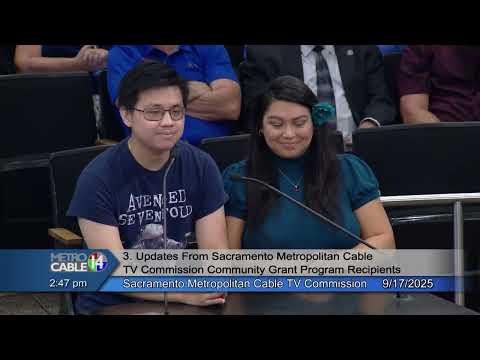
Supporters of the Sacramento Educational Cable Consortium (SCCC) and public-access organizations urged the commission to delay cuts and collaborate on alternatives, saying the proposed reductions would abruptly remove services that students and community members rely on. Aaron Heinrich, executive director of SCCC, told the commission “there are about a 110 media educators in Sacramento County teaching about 2,500 kids,” and warned that many classroom programs depend on SCCC’s technical support and production services. Joe Barr, board chair of Access Sacramento, said, “Cuts like these shouldn't be rushed without understanding the impact or exploring alternatives.”
Why it matters: The commission oversees Metro Cable 14 and distributes franchise and PEG fees collected from cable operators for local government, educational and community media uses. Ayala’s presentation showed a multi‑year decline in revenues and recommended quarter-by-quarter reductions intended to stretch limited reserves; he said recent receipts were below earlier projections, citing a 14.9% shortfall in anticipated revenue. The commission voted to preserve a small operational runway and to require a short, structured process with stakeholders to develop a sustainable plan.
What the motion did and did not do: The approved motion did not adopt the full fiscal-year budgets presented at the meeting. Instead the commission kept three narrow elements of the proposed general fund resolution: (1) authority to fund and reassign limited administrative positions to cover critical functions while vacancies are carried; (2) authorization to implement the commission’s previously adopted records retention policy and to hire a records-management coordinator to scan, categorize and reduce paper holdings; and (3) a general delegation to the executive director to carry out those limited actions. Item 6 (the PEG fund final budget) was continued by direction of the chair for additional stakeholder work and was not adopted.
Public comment and community concerns: More than 70 speakers signed up; dozens testified and submitted written comments. Speakers included parents, students, teachers and leaders from Access Sacramento, SCCC, KVIE and other licensees. Testimony described classroom programs, student competitions, graduation livestreams and community-oriented productions that would be affected by sudden funding cuts. Sunny Lee, a parent and SCCC supporter, said SCCC “provides a safe space where students learn practical skills” and asked the commission to delay any cuts. David Lowe, president of public broadcaster KVIE, cited a legal constraint he said the commission should consider: “California Public Utilities Code section 58 70 subdivision n requires that the 1% peg fee be used only for community media capital needs,” and urged a balanced policy that keeps PEG operators viable.
Next steps: The commission gave licensees and staff roughly a three‑month runway and directed staff and stakeholders to meet and develop alternatives to an abrupt shutdown of PEG and educational services. Commissioners and community leaders proposed options including consolidation of services, phased reductions tied to clear metrics, grant and sponsorship development, workforce-development partnerships with schools and districts, and technical assistance for grant-writing and revenue diversification. Several outside experts offered to assist; consultant Sue Buskey offered pro bono support to explore cooperative, sustainable models.
Votes at a glance: - Motion: Approve the fiscal year 2025–26 general fund final budget resolution with amendments (strike most provisions; retain authority to (a) authorize specified administrative staffing adjustments and (b) implement records-management actions; delegate to executive director to carry out those items). - Mover: Vice Chair Gatewood - Second: Member Middleton - Outcome: Approved - Tally: All members present voted yes (clerk announced "item passes with all members voting yes"). - Item 6 (PEG fund final budget): Continued by direction of the chair for additional stakeholder engagement; no final adoption at this meeting.
Background and context: Ayala’s presentation showed multi‑year declines in cable‑related revenue and proposed a quarterly reduction schedule for channel-licensee distributions (100% initial quarter; proposed reductions to 75%, 50% and 25% in subsequent quarters under one scenario). He said the commission held roughly $2.2 million in PEG reserves and that combined projected receipts and reserves could be exhausted if cuts are not managed. Many speakers urged a longer, transparent process and alternatives to outright defunding, noting that rebuilding community media capacity would be difficult if licensees lose staff, production facilities or institutional knowledge.
What the commission asked of licensees: Staff and licensees were directed to meet quickly with commissioners and with county and education partners (including Sacramento County Office of Education and school districts) to produce a transition plan and revenue/expense options for the commission’s next meeting. The commission authorized limited hires and records work so the office can continue to function and provide a three‑month runway for planning.
Closing note: Commissioners said they heard the community and agreed to a short postponement to allow collaborative work. The commission framed the pause as a limited opportunity to produce a realistic, multi‑stakeholder plan; members warned that if alternative funding or consolidation is not achieved in the coming months, deeper cuts may be required.