Get Full Government Meeting Transcripts, Videos, & Alerts Forever!
Get email alerts on the Police Pursuits topic
No spam. Unsubscribe anytime.
Milwaukee residents press Fire and Police Commission to address MPD pursuit policy; commissioners discuss changing public-comment practice
Summary
Dozens of residents urged the Milwaukee Fire and Police Commission to seek changes to Milwaukee Police Department pursuit rules after multiple recent fatal crashes. Commissioners discussed revising how the commission handles public comment and agreed to treat pursuit policy as a communication file for future agenda consideration.
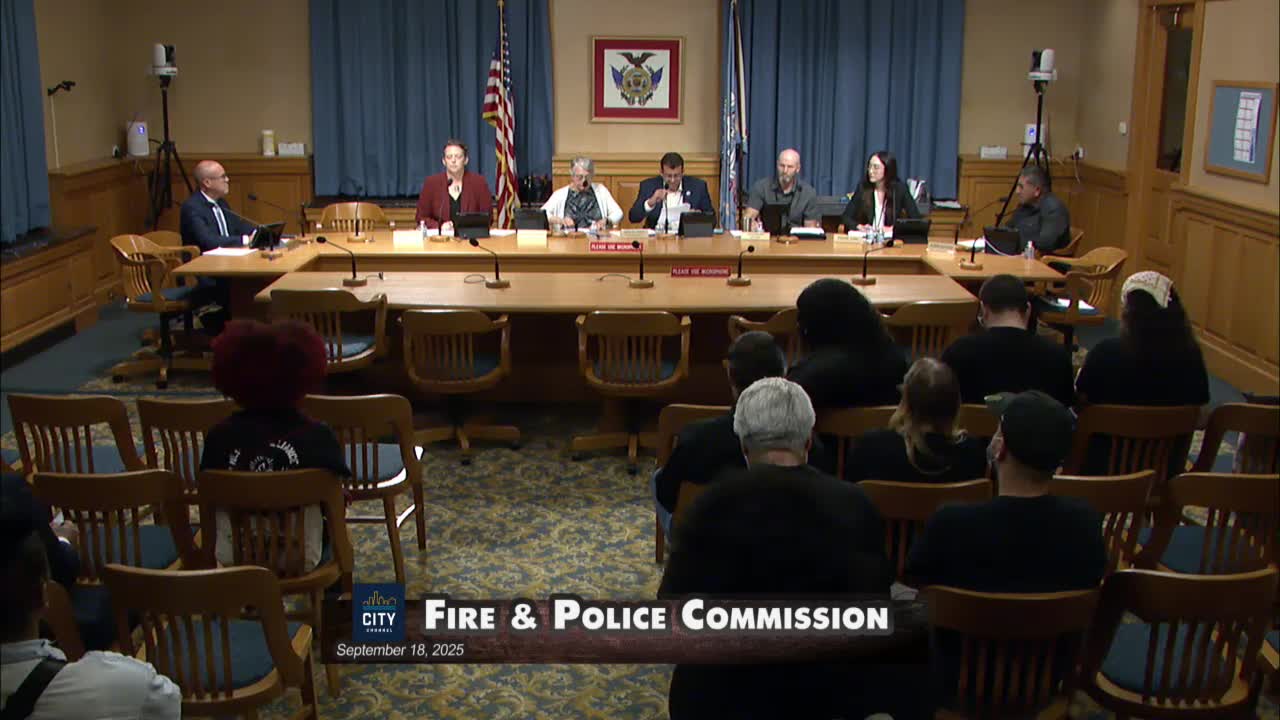
Dozens of Milwaukee residents told the Fire and Police Commission on Sept. 18 that the Milwaukee Police Department’s pursuit policy is endangering bystanders and should be tightened, and they urged the commission to change how it collects and responds to public comment.
The appeals came during the commission’s public-comment period, after Executive Director Leon Todd presented a communication file (FPC-212,211) on whether commissioners should engage with the public during comment. Todd noted that Wisconsin statutes 19.83 and 19.84 permit public bodies to discuss matters raised during a public-comment period so long as they do not take unannounced official action. Todd said the change of practice would be allowed, though boards commonly avoid interaction to reduce the risk of inadvertently acting on an unposted item.
The public’s requests centered on police high-speed pursuits and multiple recent crashes that speakers said are linked to MPD pursuit policy. Casey Serrano, reading a statement from Ethan Costello of the South Side, said: “This is the second police chase crash that has happened at 30 Fifth And Vliet in the last 2 months…And now, 3 dead.” Several other speakers said the city has seen seven fatal incidents this year that they tie to pursuit policy.
Why it matters: residents said pursuit-related crashes have killed and seriously injured innocent people, and they urged the commission to press for policy changes or oversight to prevent further deaths. Commissioners said they lack unilateral authority to rewrite MPD standard operating procedures (SOPs) but can put items on future agendas, make formal recommendations to the chief or common council, and request data.
Speakers urged specific policy changes. Brian Verdin and others cited recommendations from the Wisconsin Law Enforcement Accreditation Group and national best practices: restrict pursuits to violent felonies or immediate threats to life, establish mandatory disengagement triggers in high-risk conditions (dense pedestrian zones, major intersections, large speed differentials), require supervisory control, use noncontact alternatives (air support, GPS tagging, pursuit-termination technologies), and publish quarterly pursuit dashboards (initiation reasons, durations, top speeds, injuries, fatalities and termination reasons).
Multiple speakers cited the commission’s May pursuit data report and asked for further information. Alex Larson highlighted three items in that report: a 49% apprehension rate for pursuits, a notable increase in chases exceeding 75 mph, and a 2017 policy change that coincides with a near threefold rise in chases. Larson asked whether the city attorney or the commission could compile claims and settlements tied to pursuits; Director Todd said settlement and litigation data would reside with the city attorney and common council but agreed to look into adding more context to future reports if the records exist.
Commissioners and staff responses
Chair Commissioner Horowitz and others said the commission will treat this as a communication file and will work with the director to schedule a dedicated agenda item on pursuit policy. Horowitz said the FPC cannot unilaterally change SOPs because the state legislature has limited the city’s authority, but the board can “build a persuasive case” for the chief or request common-council action.
Executive Director Leon Todd summarized legal constraints and opportunities: he told the commission that state open-meetings statutes do allow discussion during public comment (citing Wis. Stat. 19.83 and 19.84) and that the board retains options short of direct rulemaking, including recommending changes to the chief, asking the common council to act by resolution or two-thirds vote, or adding a communication file for further hearing and public testimony.
Public comment procedure changes
Commissioners debated altering how public comment is organized. Several speakers and commissioners recommended allowing public comment after each agenda item — a model used in Milwaukee County committees — so community members can respond to the record and to testimony from MPD and other “experts” presented by the department. Supporters said the change would make comments more germane and reduce the risk of the public having their testimony rebutted later without ability to respond. Opponents raised concerns about meetings running long and the potential for the process to be “weaponized” by burying items late on the agenda; the chair also said practical limits on time and repetition must be enforced.
What the commission said it would do next
The FPC did not vote on any SOP change. Commissioners agreed to: - Treat pursuit policy as a communication file and place it on a future agenda for fuller discussion; - Explore whether the commission can add more context to its pursuit report (injuries, fatalities and financial settlements) subject to data availability and limits on automated retrieval; and - Consider formalizing public-comment procedures (online submissions, clearer written guidance and possibly public comment by agenda item) so the public understands what to expect before, during and after testimony.
Several community groups who spoke at the meeting — including Milwaukee Turners and the Milwaukee Alliance Against Racist and Political Repression — requested a codified public-comment procedure, routine public dashboards on pursuits and an opportunity to present follow-up materials to the commission.
Ending note: commissioners acknowledged the emotional weight of the testimony and the public’s frustration. No final policy action was taken Sept. 18; the commission said it will bring the item back for more evidence, recommendations and possible formal motions at a future meeting.