Get Full Government Meeting Transcripts, Videos, & Alerts Forever!
Get email alerts on the Reparations Commission Committees topic
No spam. Unsubscribe anytime.
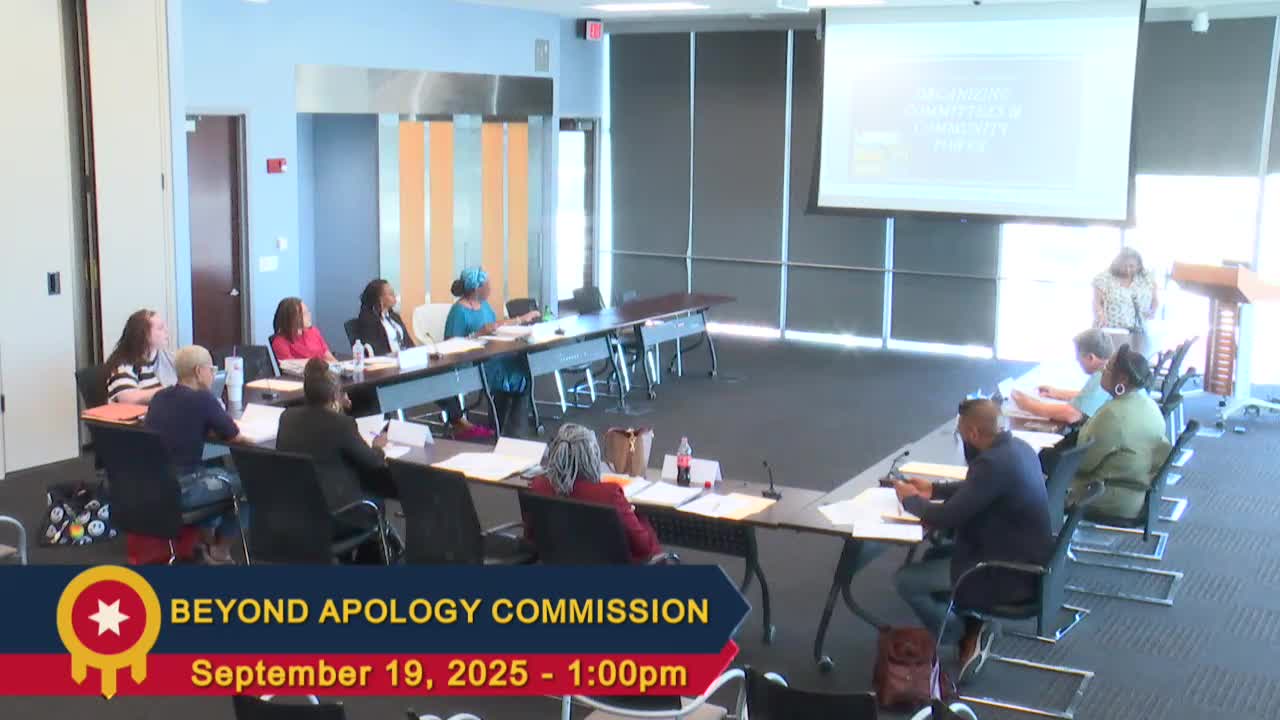
Tulsa’s Beyond Apology Commission sets committee work plan, asks commissioners to present drafts by Oct. 17
Summary
At a Sept. 19 meeting, the Beyond Apology Commission laid out committee rules, a schedule for commissioner prework and a planned public meeting in mid-November to seat community members. Chairwoman Williams emphasized that committees must be community-centered and that chairs will be chosen only after community members are seated.
The Beyond Apology Commission on Sept. 19 directed commissioners to complete committee “pre‑work” and present draft purpose statements at the commission’s next meeting on Oct. 17, setting a timeline for seating community members at a public meeting planned for a window in mid‑November.
Chairwoman Williams, speaking at the Tulsa meeting, said the body must center community members in every committee and that "shared power equals stronger outcomes." She instructed commissioners to review the Beyond Apology report, identify two to three priorities for their committee, and assemble suggested community partners and role descriptions ahead of the October meeting.
Why it matters: The commission is an advisory body created from community recommendations; its decisions about committee membership, roles and reporting will shape which community groups and individuals have a formal voice in drafting policy recommendations. Williams repeatedly cautioned commissioners not to “dominate” committee conversations and said chairs and co‑chairs should be elected by committee members only after community members are seated.
Key details
- Deliverables and deadlines: Commissioners were asked to complete assigned pre‑work (review the Beyond Apology report, gather relevant documents and identify partners) and present draft committee purpose statements, suggested partners and role descriptions at the Oct. 17 commission meeting. Williams requested committee reports one week prior to each regular commission meeting.
- Public/community meeting: Williams said she will schedule a public meeting to introduce committees and recruit community members, aiming for a date between Nov. 14 and Nov. 21 (she indicated she would provide specific dates by Oct. 17). Commissioners asked to expand possible dates if needed; Williams said she would offer multiple options but stressed the need to finalize timing so community members can plan to attend.
- Committee structure and rules: Williams reviewed the commission bylaws, noting committees may be standing or special; each standing committee must include at least two commissioners and meet at least once per month. She said committees may not cast votes on behalf of the commission; committees prepare recommendations that the full commission will consider and vote on. The chair recommended the first committee meeting be held in person to build rapport.
- Selection of committee leadership: The chair said committee chairs and co‑chairs should not be appointed by commissioners in advance; instead, committee members (including community members) must elect them after committees are seated. Williams said: "Chairs will not be selected until community members are seated." She also encouraged committees to define role descriptions (chair, co‑chair, note‑taker) in advance and said commissioners should steward the process rather than dominate it.
- Reporting and transparency: Committees are to submit progress reports (minutes or a brief report) at regular commission meetings and provide draft materials one week before the meeting. Williams asked commissioners to be accountable and contact her if they need support following up with community partners.
Other items discussed
- Outreach and partners: Commissioners discussed outreach to the Cherokee Nation and were advised to contact Amy McCarter (identified by a commissioner as the Cherokee Nation business contact) to explore partnership possibilities in areas that overlap North Tulsa. Councilwoman Hall Harper and others noted prior community meetings and town halls, including work with OSU‑Tulsa and Greenwood Rising.
- Funding and timeline questions: A commissioner asked whether the commission’s funding goal of distributing funds in 2026 was still current; Williams said that remains the goal but that administrative work is ongoing and she did not assert a finalized funding timeline.
- Additional topics to include: Williams said mass graves and cultural‑identity matters should be part of the commission’s work and that committees should be prepared to incorporate those topics where relevant.
Votes and formal actions
- Acceptance of minutes: The commission accepted the minutes from its August 2025 meeting by voice vote; no roll‑call tally was recorded in the transcript.
- Adjournment: The meeting was moved, seconded and approved by voice vote.
What’s next
Commissioners must finish the assigned pre‑work and present committee drafts at the Oct. 17 meeting. Williams said she will announce specific dates for the mid‑November public meeting by Oct. 17 and asked commissioners to be present and visually engaged at committee meetings so community members do not see lack of participation as disengagement. "If you need me immediately, text or call me so I can help," she said.
(Reporting based on the Sept. 19, 2025 Beyond Apology Commission meeting transcript.)