Get Full Government Meeting Transcripts, Videos, & Alerts Forever!
Get email alerts on the Mass Timber Construction topic
No spam. Unsubscribe anytime.
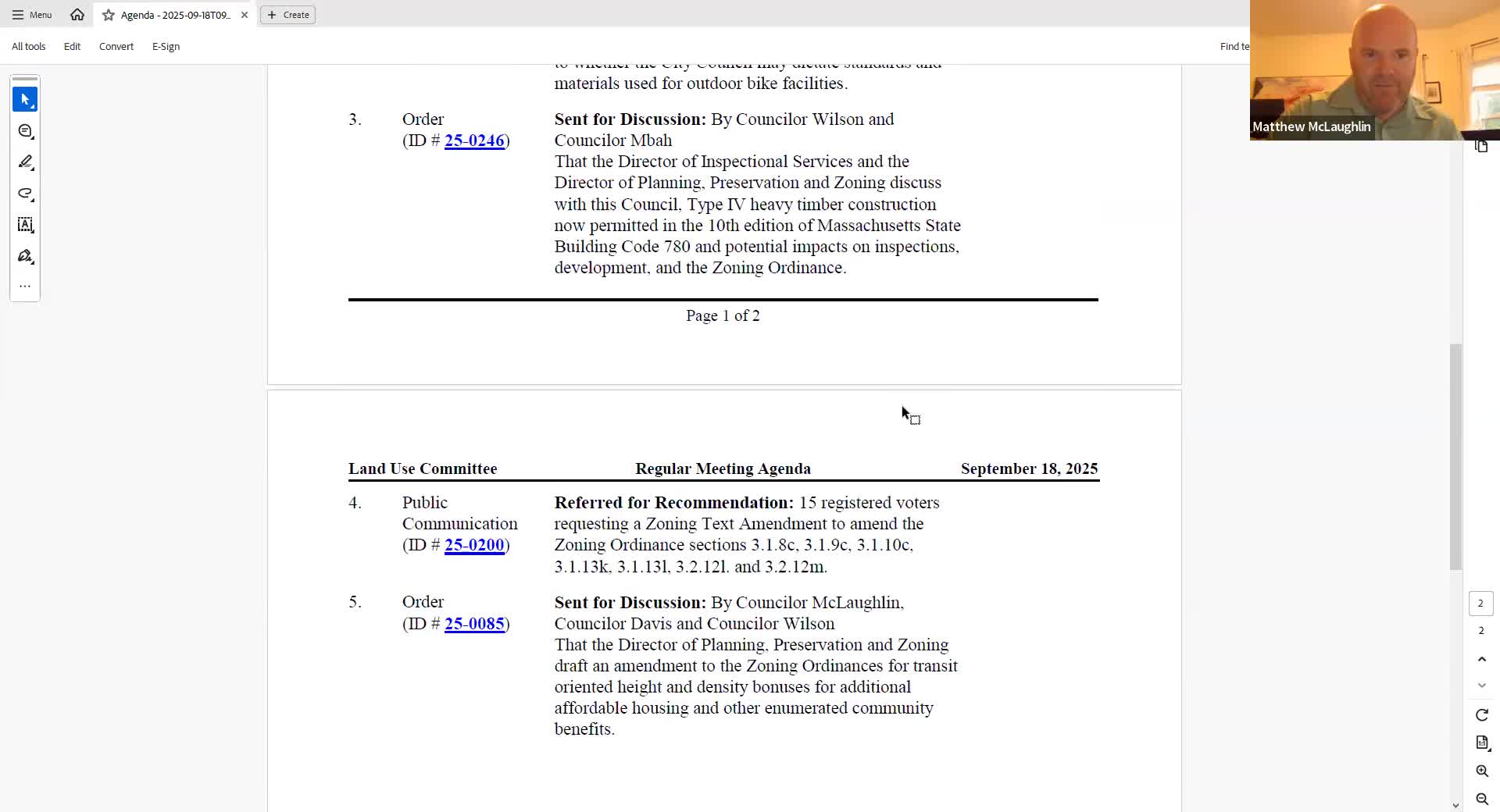
Somerville Land Use Committee hears case for taller, lower‑carbon “mass timber” housing
Summary
A Somerville resident presented mass timber and Type IV construction to the Land Use Committee, highlighting faster construction, lower embodied carbon and potential to fill a ‘missing middle’ of housing density; councilors asked staff to study zoning options and the committee marked the item work complete.
Somerville City Council’s Land Use Committee on Oct. 21 heard a presentation on “mass timber” (Type IV) construction and how recent changes to the Massachusetts building code could allow taller, denser wood‑based buildings that the presenter said reduce embodied carbon and speed construction.
Gavin Robb, a member of Somerville YIMBY, told the committee that Type IV describes a building‑code construction category for large engineered wood panels, beams and columns. “The structure is the finish, and as you can see, it’s a natural material, it’s a beautiful material,” Robb said, arguing the technology can produce high‑quality, dense infill housing with lower embodied carbon and faster onsite assembly.
Robb noted the 2021 International Building Code and Massachusetts’ recent code updates allow taller mass‑timber buildings in some configurations — examples he cited included 8‑, 12‑ and 18‑story limits that can apply depending on fire‑resistance strategies. He presented a case study he said showed roughly a 52% reduction in global‑warming impact for a comparable project built in timber versus steel, and framed mass timber as a tool to create “the missing middle” of mid‑density housing between low‑rise stick construction and high‑rise concrete towers.
The presentation drew supportive comments from several councilors who said they want staff analysis on whether and how zoning could be used to incentivize low‑carbon building typologies around transit nodes. Councilor Wilson said he was inclined to “mark this one as work completed” while asking planning staff and the land‑use analyst to explore zoning options; Councilor Davis and others urged staff review as part of the city’s transit‑oriented development discussions.
Somerville planning staff indicated earlier guidance from the Inspectional Services Department (ISD) has cautioned against using zoning to mandate construction materials because building materials and fire‑safety standards are governed by the state building code. At the meeting, ISD‑related staff reiterated that the department had prepared a memo responding to council questions from a prior session; the memo is attached to the committee record.
Planning staff and a committee member offered next steps focused on incentives rather than material mandates — for example, an overlay or incentives for embodied‑carbon performance, accelerated permitting, or additional height where a developer meets climate and community‑benefit criteria. Committee members asked staff to look into legal and zoning options and report back.
The committee recorded the item as work completed for the committee’s purposes and moved on to the rest of the agenda.