Get Full Government Meeting Transcripts, Videos, & Alerts Forever!
Get email alerts on the Data Centers topic
No spam. Unsubscribe anytime.
Planning commission continues deep dive on Industrial Research zoning and data center standards, focusing on water and power
Summary
Leesburg’s Planning Commission spent the bulk of a work session reviewing draft Article 2 district rules, focusing on the Industrial Research (IR) district and how the town’s zoning rewrite treats data centers.
Leesburg’s Planning Commission spent the bulk of a work session reviewing draft Article 2 district rules, focusing on the Industrial Research (IR) district and how the town’s zoning rewrite treats data centers.
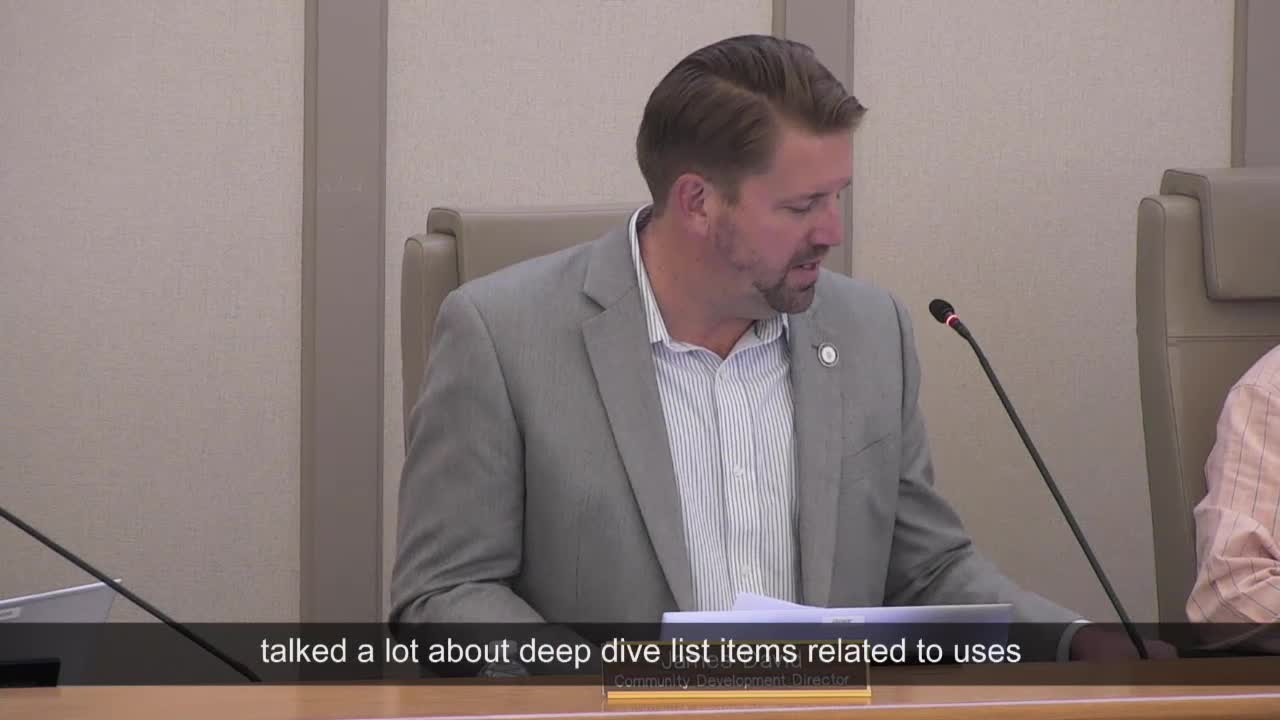
James David, Director, Department of Community Development, told the commission that data centers remain a specific use limited to the proposed IR district and that “As of today's staff is comfortable with those use standards as is since they were recently adopted” in August 2023. He said the use standards — addressing bulk, massing, screening and accessory structures — are located in Article 3 under use standards in the draft ordinance.
Commissioners and staff discussed multiple operational impacts that arise during project review. Brian Stone, Deputy Director, Department of Community Development, described the utility-review process: the applicant must provide projected water demand and system modeling, and utilities staff present those results to the Town Council when the project requests town water service. “We present information to them to to allow them to make an informed decision about water consumption or water use at the data centers,” Stone said.
Commissioners repeatedly pressed staff about capacity and risk. A commissioner cited an example that a previously approved data center near Wegmans uses about 9,000 gallons of water per day; staff said that approved projects go through the town’s hydraulic modeling and, for that project, “we can handle it.” Staff described regulatory triggers for system review: modeling shows the town watches thresholds (staff referenced a reporting table showing triggers around 80% for one plant and 95% for the wastewater plant) and that the town’s wastewater design capacity figure used for regulatory planning is 12.5 million gallons per day.
Staff told the commission that most data-center applicants now provide more detailed figures later in the review process — typically when they return to council to request water service after rezoning/special-exception approval — and that the utilities department uses those later, more concrete numbers to determine whether to recommend service or require mitigation or cost-sharing for system upgrades. Microsoft has already agreed to pay for a reinforcing water line from Sicklin Road to Compass Creek to improve supply in that area, staff said; the work is being escrow-funded by the company and is expected to cost “a couple million dollars,” staff added.
Power and substation siting also drew extensive discussion. Staff noted state law and utility practices limit a locality’s authority to refuse service; commissioners said Dominion and other utilities typically do not disclose how they will provide power until after land-use approvals. Commissioners explored whether to require applicants to reserve space on their parcels for substations or to condition special exceptions on on-site or on-parcel placement of substations, but legal counsel and staff urged caution. Staff described the better defensible approach as case-by-case review focused on neighborhood impacts and on whether the application demonstrates how power will be delivered and what the potential substation impacts could be.
Commissioners debated technical standards in the draft data center use standards. Differences discussed included setbacks for ground-mounted mechanical equipment (staff noted an existing 100-foot provision adjacent to residential and the commission asked whether to increase that to 300 or match Loudoun County’s 500-foot rule in some cases), noise limits (the town’s DCSM noise standard measures decibels at the property line and applies a more restrictive 55 dB standard where IR borders residential), rooftop equipment allowances (draft allows rooftop equipment to occupy up to 75% of roof area in some language), fenestration and curtain-wall options for aesthetic treatment, and landscaping and tree-preservation language.
On green-building and conservation items, staff and commissioners discussed a non-prescriptive list of sustainability measures (for example, reflective roofing, reclaimed-water use when available, LEED or similar measures). Staff said the draft currently asks for one item from the list but commissioners discussed increasing the required number and clarified that the town lacks incentives today that might otherwise be used to make green-building requirements mandatory.
Commissioners asked staff to add application checklist items that would be required or routinely requested up front: at a minimum, staff recommended applicants provide electrical and water demand estimates, peak-day water projections, and a clear statement whether the cooling system is closed-loop or evaporative/open-loop. Staff and counsel discussed how to make such submittal requirements clear while not usurping council authority that ultimately decides whether to provide water service.
Several commissioners asked staff to prepare a comparison of the town’s proposed standards and Loudoun County’s rules, highlighting where the county is more restrictive so the commission can consider aligning standards where appropriate. Staff agreed to produce that comparison and to return with revised language on setbacks, noise, and application materials at a future meeting.
The commission also asked staff to return with a revised draft addressing the Innovation Center and Mixed Use districts (differences in allowed densities, permitted residential mix, and maximum heights) and to bring data center items back for another meeting to finalize standards.