Get AI Briefings, Transcripts & Alerts on Local & National Government Meetings — Forever.
Austin Water reviews 2025 Texas legislative outcomes including proposed $1 billion annual water fund (HJ 7)
Loading...
Summary
Austin Water staff summarized key water-related outcomes from the 2025 Texas legislative session and two special sessions, including a proposed constitutional amendment (HJ 7) to dedicate $1 billion annually for water infrastructure pending voter approval.
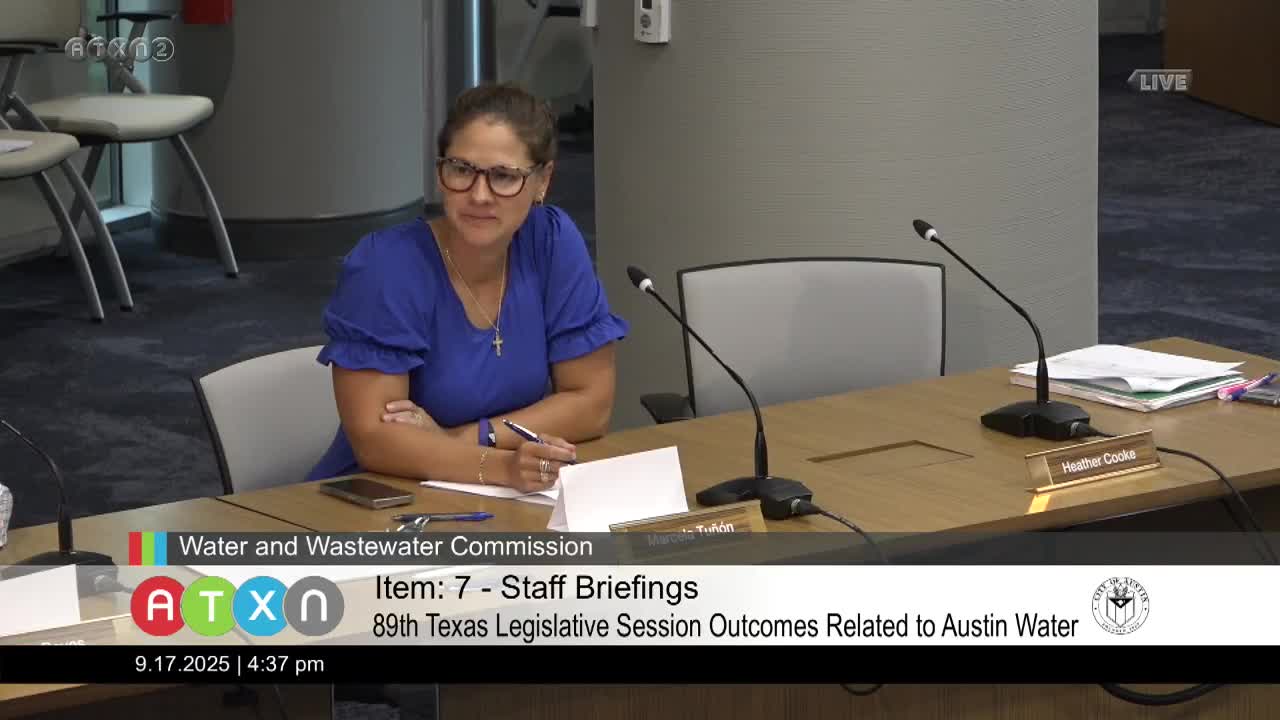
Austin Water briefed the commission on outcomes from the 2025 Texas legislative session and two subsequent special sessions that concluded this summer. Heather Cook, Chief Administrative Officer for Austin Water, reviewed more than a dozen bills and resolutions that staff expect will affect the utility’s finance, planning and operating programs.
Key items summarized by staff:
• House Joint Resolution 7 (HJ 7). Cook said HJ 7 is a constitutional amendment that will require voter approval in November. If approved, the resolution would dedicate $1,000,000,000 annually — once a sales-tax threshold is reached — to the Texas Water Development Board for water infrastructure from 2027 through 2047. The law would not raise the sales-tax rate; half of the annual allocation would be required to go to the state’s water-supply funds. Cook said the governor can suspend the funding in a disaster year and that the language allows restoration when practicable; staff noted the final effect will depend on voter approval and implementation details. (Cook offered to provide the commission with the specific bill language on request.)
• Senate Bill 7. Cook said SB 7 expands the Texas Water Development Board’s role to study and potentially facilitate large-scale water conveyance projects and to study adding wastewater projects to state water planning. The bill also authorizes the state water-supply fund to support certain reuse projects and out-of-state water purchases.
• SB 1261. The bill extends state loan terms (SWIFT loans) in limited circumstances, permitting up to 40-year terms for very large projects (over $750 million), giving utilities another financing option for very large capital projects.
• Flood and infrastructure financing. Cook reviewed SB 1967 (expanding the state flood fund to include certain stormwater capture and reuse projects) and HB 500 (one-time infusions to the Water Development Board and related programs). Cook said Austin Water has a pending application for flood-infrastructure funding.
• Impact-fee bills. Cook summarized several bills that change impact-fee rules, including SB 840 and SB 2477 (related measures that will be reconciled at the Legislature), SB 1883 (which limits how often governing bodies can raise impact fees to every three years and requires a two-thirds council vote for increases), and SB 14 (passed during a special session) requiring jurisdictions to adopt impact-fee credits to incentivize conservation or reuse. Staff said the city’s law department is reviewing implementation details and that the utility has not yet quantified revenue impacts.
• Water loss and drought planning. Cook said new law requires annual third-party validation of water-loss audits for large utilities, followed by a water-loss mitigation plan with 1-, 3- and 5-year goals. Another bill (SB 2662) incorporates the Texas Public Utility Commission into the drought-contingency planning process alongside existing state agencies; Cook said it does not change Austin Water’s current plan but adds PHMSA/PUC involvement and a five-year update cadence.
• Other bills. Cook noted SB 482 (increased penalties for harassment of utility workers during emergencies) and HB 1237 (extends license-renewal grace periods for licensed water/wastewater operators to 180 days and permits operators to continue working while renewal is in process). She also mentioned SB 1967 and other funding measures and emphasized that many bills will require follow-up to define implementation details.
Commission questions and staff responses: Commissioners asked whether the new laws create any negative impacts for Austin Water. Cook said impact-fee limitations are the principal items of concern because they curtail local control over revenue tied to new development; staff are assessing the magnitude of those impacts. Director Raulston (Austin Water director) and Cook also said the $1 billion-per-year proposal is a major positive for statewide water infrastructure funding if voters approve HJ 7, but that the bill’s disaster-suspension language and final details merit further review. For the water-loss validation requirement, staff said current in-house audit staff could not perform the validation under the new law (validation cannot be done by the same staff who perform the original audit), so Austin Water will need third-party validation or to train other staff and obtain required credentials.
Ending: Staff said they will continue to work with the City’s law department and government-relations staff to evaluate impacts, comply with new timelines or reporting requirements, and bring additional briefings as implementation details solidify. Commissioners asked staff to provide bill language and follow-up analyses as available.