Get Full Government Meeting Transcripts, Videos, & Alerts Forever!
Get email alerts on the Land Use topic
No spam. Unsubscribe anytime.
Council tables mobile-home waiver overhaul after heated debate; separate hardship waiver denied
Summary
The Livingston Parish Council on Aug. 28 tabled consideration of an ordinance to remove a parish ‘waiver list’ that has allowed mobile homes in named subdivisions, and separately heard — but did not approve — a hardship waiver request for an accessory dwelling placed in a Beachwood Ridge lot.
The Livingston Parish Council on Aug. 28 agreed to delay action on a proposed zoning amendment that would remove a longstanding parish waiver list allowing mobile homes in certain named subdivisions, responding to extensive public comment and legal questions that council members said required more study.
The ordinance under consideration would delete the section of parish code that automatically exempts certain named subdivisions from the parish’s prohibition on mobile homes in those subdivisions; proponents said removing the list would let the zoning code govern uniformly, while opponents — including several residents and staff members — said removal would funnel numerous individual waiver requests to the council and could create legal and enforcement issues.
Councilwoman Sandifer moved to table the proposal; Sandifer said staff and council needed time to work through implementation and liability questions with the parish attorney and planning staff. “We come back with something that is a lockdown and got all our answers… and make sure we don't get in any kind of a legal situation,” Sandifer said as she asked that the item be deferred. The council voted to table the ordinance; the public hearing was rescheduled for Sept. 11.
Why it matters: The parish still has a conflict between the land-development zoning code (which allows accessory dwelling units, or ADUs, under some residential zones) and a separate ordinance that prohibits mobile homes in named subdivisions. Planning staff told the council the separate prohibition was adopted after the 2016 floods and has been the basis for frequent waiver requests. Removing the waiver list would change how cases are routed and decided, staff said, and could increase the number of individual waiver requests that come to the council.
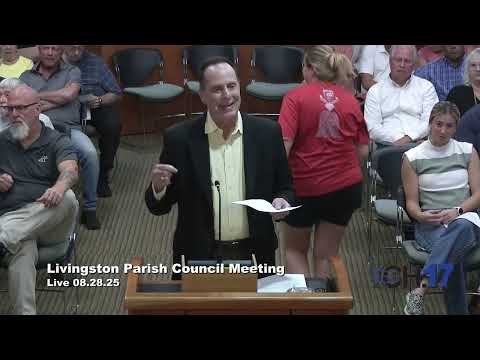
Public comment and legal concerns: More than a dozen residents — primarily from Beachwood Ridge subdivision — attended and urged the council not to delete the waiver list, citing restrictive subdivision covenants, sewer and drainage capacity, and property-value concerns. Resident Carla Morris told the council she did not see a hardship in the present waiver request and warned that approving a waiver after work had already been done would set a precedent: “If we forgive this, then we set precedent for any and all work being done and then handing out a waiver,” Morris said.
Planning staff and the parish attorney described the legal mechanics: if the council removes the waiver list, named-subdivision requests would no longer be automatically cleared administratively; instead residents seeking an exception could each come before the council. Planning staff told the council this could increase workload and litigation risk. “If you do away with the list, then anyone who was in a named subdivision has the option to come to y'all for a waiver,” a planning official told the council during public discussion.
Hardship waiver appeal: Separately, the council heard a hardship waiver request from resident Asa Faulkner of Beachwood Ridge, who requested permission to keep a small accessory dwelling (described by the applicant as a sub‑800‑square‑foot unit) on his lot to house an elderly relative. Neighbors opposed the waiver and raised concerns about subdivision covenants, impacts on septic/sewer capacity and the character of the neighborhood.
Faulkner told the council he had purchased and installed the unit after interpreting the parish zoning to allow an ADU under the R‑1 zoning on his lot and said he had attempted to follow the permitting process. “I'm here asking for the hardship waiver,” Faulkner said. Neighbors said the structure was effectively a manufactured home and urged the council not to approve an after‑the‑fact waiver that would set a precedent.
After debate and an attempted motion to grant a temporary 90‑day hardship waiver to allow staff time to craft enforcement language, the council conducted multiple votes and a reconsideration motion. The final result was that the council did not grant the individual hardship waiver; council members said they would return to the issue after drafting clearer enforcement language and possible fines or other mechanisms to ensure compliance when temporary waivers expire.
Next steps: Council members asked staff and the parish attorney to draft clarifying language and enforcement options and to bring the mobile‑home/waiver ordinance back after legal review. The council scheduled the public hearing on the waiver‑list ordinance for Sept. 11.
Ending: Council members characterized the tabling as a step to avoid unintended consequences and to give staff and the attorney time to work with stakeholders on a path that protects covenants, zoning clarity and public health concerns (sewer/drainage) while giving the council a workable process for hardship requests.