Get Full Government Meeting Transcripts, Videos, & Alerts Forever!
Get email alerts on the I 10 Calcasieu Bridge topic
No spam. Unsubscribe anytime.
DOTD and developer outline timeline, tolling and local impacts for I‑10 Calcasieu River bridge project
Summary
State and private partners presented plans and timelines for the I‑10 Calcasieu River Bridge corridor, including staged construction beginning in early 2026, a traffic shift to the new alignment in February 2030, tolling beginning August 2031 and a 50‑year concession for operations and maintenance.
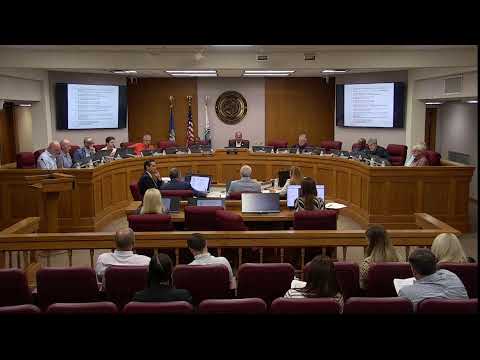
Calcasieu Parish Police Jurors heard a presentation Sept. 4 from Jonathan S. Hill, public information manager for the I‑10 Calcasieu River Bridge project, outlining the project scope, schedule, and local impacts. The Department of Transportation and Development (DOTD) remains the owner of the corridor; the developer is Calcasieu Bridge Partners, which holds a 50‑year concession to operate and maintain the corridor after construction.
Hill said the project will replace the existing 1952 bridge with a new 5.5‑mile corridor between the I‑210 interchange in Westlake and Ryan Street in Lake Charles, widen I‑10 to six travel lanes plus two auxiliary lanes, and add an elevated Sampson Street overpass to avoid train delays. He said traffic will be maintained on I‑10 throughout construction. "No. I‑10 will remain open throughout construction," Hill said during the presentation.
The presentation included a project visualization video and renderings showing enhanced bridge lighting that echoes the current bridge arch, lowered bridge elevation (estimated 75–95 feet), and a new electronic tolling system called GoPass. Hill said tolling will be electronic (transponder or license‑plate billing) and that there will be a roughly 13‑month window between the traffic shift and tolling: traffic is scheduled to shift to the new alignment in February 2030 while tolling will not commence until August 2031.
Hill gave a project timeline and status update: interim design is about 60% complete; utility relocations are being coordinated with utilities placed in a common duct bank; geotechnical work is in its second phase; and right‑of‑way advanced acquisition (full takings) is underway. He said the developer began operation and maintenance responsibilities for the corridor (excluding the existing bridge) in February; DOTD will continue to operate and maintain the current bridge until the new structure is accepted.
Seth Woods, DOTD district engineer administrator, addressed recent simultaneous lane restrictions on I‑10 and I‑210 that disrupted traffic. "It was a concern... Closing those both bridges at the same time is a last resort for DOTD because we know the impacts it has on our area," Woods said, adding that safety is the department's top priority and that the I‑210 lighting work would be completed next week.
Hill and DOTD staff described early‑works activity beginning immediately, including an overnight westbound ramp closure in Westlake to relocate an overhead pipe rack and the construction of a temporary access road. The Sampson Street overpass will require a closure beginning in August 2028 lasting about 18 months; officials said they are still evaluating final detour routing. Hill said the temporary detour route will provide about 12 feet of vertical clearance and will require some vehicles in affected movements to use PPG Drive and make U‑turns. Ramp Exit 27 westbound was noted as expected to close the night of the presentation to allow work on the temporary access.
Hill said right‑of‑way impacts are being managed in phases: roughly 19 parcels require full acquisition under phase 1 and about 10 parcels may have partial takings in phase 2 once final ROW maps are approved. He said required permits have been submitted to the U.S. Coast Guard and the U.S. Army Corps of Engineers.
Hill described the contract structure: DOTD is the owner; an Owners Verification Company (a compliance firm) will check contractor conformance; Calcasieu Bridge Partners is the special purpose vehicle developer; design‑build responsibilities sit with a joint venture called Louisiana Bridge Builders; and the project team includes designers Calcasieu Design Partners and others. Hill said the project represents a $2,300,000,000 investment in southwest Louisiana and that construction of the corridor is expected to begin in early 2026. Partial acceptance and demolition of the existing bridge will follow partial acceptance after tolling commences, with the concession period running 50 years to August 2081.
Jurors asked questions about local traffic impacts and business access. When a juror asked whether access to the Horseshoe Casino and businesses on Sampson Street would be maintained, Hill said the project team is obligated to maintain business access during construction and will take steps to preserve access; he could not predict whether changes would affect customers' travel choices. One juror raised concern that the project would negatively affect businesses along Sampson Street during construction.
Hill said salvaged decorative elements from the existing bridge (referred to in the presentation as "pistols") that are recoverable after demolition will be turned over to DOTD, which will determine their disposition. He encouraged local vendors to register on the project procurement portal and directed residents to i10calcasieubridge.com for project videos, updates and a monthly newsletter.
The presentation concluded with DOTD and developer representatives standing by to answer further questions and with jurors thanking the presenters.
Ending: Jurors received a detailed project update and a public schedule that sets major milestones through tolling and partial acceptance. Officials repeatedly emphasized traffic will remain open during construction and that final detour routing, property acquisitions and some utility relocations remain subject to further design and permitting.