Get Full Government Meeting Transcripts, Videos, & Alerts Forever!
Get email alerts on the Land Use Subdivision Regulation topic
No spam. Unsubscribe anytime.
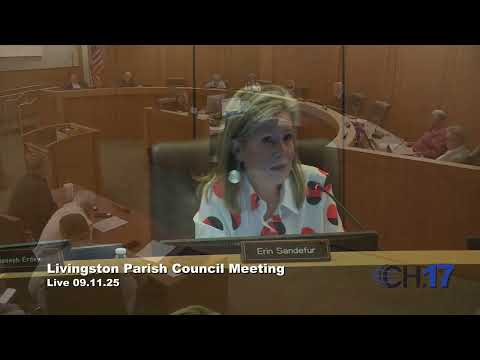
Livingston Parish council introduces subdivision regulation amendment after debate over drainage and ‘parent tract’ language
Summary
The Livingston Parish Council introduced proposed ordinance LP 25-19 on Sept. 11, directing staff to hold a public hearing at 6 p.m. on Sept. 25 to consider changes to minor-subdivision requirements in Chapter 125 of the parish code.
The Livingston Parish Council introduced proposed ordinance LP 25-19 on Sept. 11, directing staff to hold a public hearing at 6 p.m. on Sept. 25 to consider changes to minor-subdivision requirements in Chapter 125 of the parish code.
The measure would amend Chapter 125, section 125-37, to require subdivision applicants to comply with underlying zoning and to provide drainage- and traffic-impact studies for certain lot splits. Council members and residents debated whether to remove language referring to the “parent tract,” with several members saying the ordinance needs further refinement before final adoption.
The ordinance was read into the record as a reintroduction and a motion to introduce it carried. Councilman Coates moved to introduce the ordinance; Councilwoman Sandiford seconded. During the roll call for introduction, Coates, Taylor, Erde, Wascomb, Sandifer and Mancos voted yes; Councilman Watts cast a no vote. Councilman Waskom voiced conditional support: “I’m voting yes for the introduction, but I’m telling you, if I don’t get some of these other things questions answered, I’m not voting to adopt it,” Waskom said, asking that the final measure focus on floodplain management and FEMA Community Rating System (CRS) requirements.
Residents and drainage officials urged the council to tighten enforcement around unpermitted fill and small-lot changes that impede drainage. James Sealy, who spoke during the public-comment portion of the ordinance item, said many smaller lots have been filled and have removed informal drainage channels: “That’s the reason the drainage district pushed to have something done,” Sealy said. He urged enforcement of the parish’s fill mitigation and floodplain rules to address the problem.
Scooter Keane, a planning staff speaker, explained how the proposed language ties subdivision approvals to existing zoning and to the parish’s flood and mitigation ordinances, referencing provisions that require compliance with section 1-15 (the parish flood ordinance) and section 1-17 (underlying zoning requirements). Several council members said the two versions under consideration contain useful provisions but also contradictory language that needs reconciling.
Council members debated whether to remove the “parent tract” phrase at introduction. Councilman Mangus offered a motion to remove that language; members discussed waiting until a later meeting to amend language when more council members were present. Council President Randy DeLay and other members urged introduction so staff and stakeholders would have time to work on revisions before adoption.
Council staff and the parish president’s office offered to meet with council members and planning staff the week before adoption to reconcile competing versions and resolve technical inconsistencies. The council left the item at introduction and set a public hearing and adoption consideration for 6 p.m. on Sept. 25.
Why it matters: The ordinance would change how small subdivisions are reviewed in Livingston Parish, potentially expanding requirements for drainage and traffic studies and tying approvals more explicitly to the parish’s floodplain and fill-mitigation rules. Council members and drainage officials said the changes could close loopholes that allow unpermitted fill on small lots to worsen neighborhood flooding.
What’s next: The council scheduled a public hearing for Sept. 25, and staff said they will continue drafting and circulating revised language to address concerns raised on Sept. 11.