Get Full Government Meeting Transcripts, Videos, & Alerts Forever!
Get email alerts on the Parking Enforcement topic
No spam. Unsubscribe anytime.
Police brief planning board on limits, procedures for removing derelict and commercial vehicles from rights of way
Summary
Riviera Beach police explained enforcement processes for derelict, inoperable and improperly parked vehicles, including a 60‑hour no‑move standard, marking/inspection practices, and limits created by tow contractor response times and commerce exemptions.
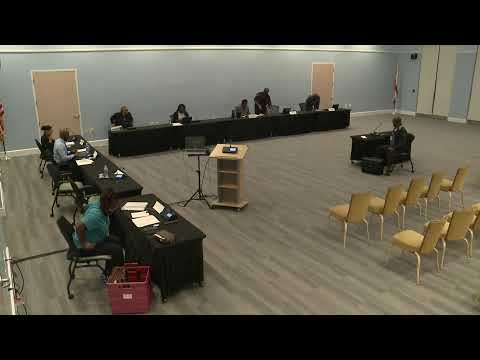
Sgt. Brian DeSantis of the Riviera Beach Police Department told the Planning and Zoning Board on Sept. 11 that the department and code enforcement investigate reports of derelict, inoperable and improperly parked vehicles on city rights of way and sidewalks, and outlined the legal and operational limits of enforcement.
DeSantis said municipal ordinances and Florida statutes guide enforcement. Officers typically determine a vehicle is inoperable when it shows crash damage, flat tires, broken windows, foliage growing under it, or other visible evidence that it has not moved. He described the department’s investigative practice of marking a tire with spray paint, returning in 24 hours, and, if appropriate, issuing a sticker for a violation tied to a local ordinance that prohibits a vehicle from remaining parked in the same position for more than 60 hours.
DeSantis said the city uses three contracted tow companies (Sheehan’s Towing, Gardens Towing and Cost Towing) for removals. Under those contracts, tow companies have a 30‑minute response window from when dispatch requests service. That delay, and the fact heavy‑duty tow rigs for 18‑wheelers often come from yards and take longer to arrive, constrains immediate removals and can increase costs when an operator returns and drives away after a wrecker has been dispatched.
He told the board that nonmoving violations such as expired registration or lack of insurance are treated as evidence that a vehicle is not roadworthy and may support removal. He also described exemptions when a commercial vehicle is “in commerce” — for example, making a delivery or actively loading or unloading — and thus may lawfully stop in a roadway or median. DeSantis said drivers and businesses commonly use cones or hazard flashers to indicate active work; when a vehicle is unattended and used as a staging area, that crosses into unlawful parking.
Board members raised neighborhood safety concerns, particularly in Federal Gardens and along West Thirteenth Street, where large trucks and tractor‑trailers have entered residential areas. DeSantis said the chief of police had met with UPS and arranged for state troopers to provide routing enforcement at times, but the department cannot direct state troopers. He said weight‑limit signs and posted restrictions exist on some streets (North Ocean Drive and the Federal Gardens approaches were cited), but enforcement is limited when a specific ordinance is not codified for neighborhood‑wide rules such as alternating‑side parking.
DeSantis explained additional enforcement limits: the city does not have its own tow truck fleet, so it must rely on contractors; that reliance affects how officers stage removals and pursue citations; and the department prefers to work with local businesses and issue warnings where appropriate. He said officers will run plates, contact owners, and attempt voluntary compliance before removal when possible.
Board members asked staff to place the documentation provided by DeSantis on the city website and to consider presenting the information to City Council so residents can comment. The board also indicated interest in exploring whether ordinance changes (for example, formalizing alternate‑side parking or targeted no‑parking zones) or additional traffic‑calming measures are appropriate, but no formal action was taken at the meeting on those policy options.