Get Full Government Meeting Transcripts, Videos, & Alerts Forever!
Get email alerts on the Transmission Line Modification Comar topic
No spam. Unsubscribe anytime.
Public Service Commission debates narrowing definition of transmission‑line "modification" in COMAR
Summary
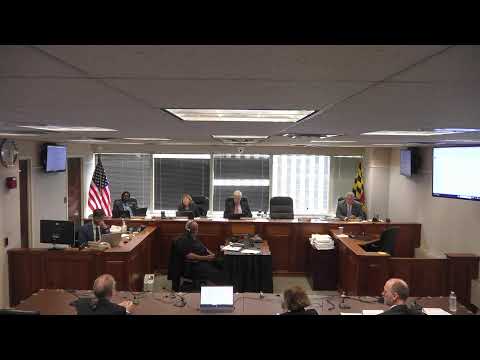
The Public Service Commission held a rulemaking hearing on staff’s proposed revisions to the COMAR definition of a transmission‑line “modification,” a change that would affect when utilities must seek a certificate of public convenience and necessity (CPCN) or can obtain a waiver.
The Public Service Commission held a rulemaking hearing on staff’s proposed revisions to the COMAR definition of a transmission‑line “modification,” a change that would affect when utilities must seek a certificate of public convenience and necessity (CPCN) or can obtain a waiver.
Staff attorney Michael Dean, representing commission staff, said the rulemaking (RM 91) grew out of Order No. 90684 in Case No. 9669 and asked the commission to reconsider COMAR 20.79.01.02(B)(28) to clarify cases that would not be treated as modifications. Dean described a redrafting that reorders the regulation and adds a new Part (d) listing activities staff believes should be excluded from the definition of modification so they could be handled via waiver rather than a full CPCN.
The staff draft lists several exclusions, drawn from prior CPCN and waiver filings, including: rebuilding any portion of an existing transmission line consistent with an approved CPCN; replacing a transmission structure with a different‑type or slightly larger structure when replacement height does not exceed adjacent structures; replacement to meet current design standards; increases in foundation size during rebuilds; adding structures to interconnect a substation or switchyard if heights do not exceed adjacent structures; limited increases in conductor diameter (staff cited a 15% example from a prior case); and routine maintenance or repairs. Dean told commissioners staff added shield‑wire replacement or installation to the list after reviewing utility comments.
Several commissioners voiced concern that the proposed regulatory language could curtail the commission’s ability to review alternatives and to require utilities to consider non‑wire options. “The more you put the actions that the utilities are taking in a category of mandatory waivers, it's less on us to be able to actually look at what they're proposing,” Commissioner Suchman said, arguing the commission’s statutory duty to consider alternatives could be undermined if too many activities fall into a mandatory waiver category.
Brock Miller of the Office of People's Counsel recommended the commission not publish staff’s proposed revisions in their current form. “Staff's proposed revisions actually inject more uncertainty into the CPCN process for transmission lines, and it also seems to be at least somewhat an attempt to remove the commission's authority to review transmission line projects,” Miller said in his comments.
The Power Plant Research Program (PPRP) echoed those concerns. PPRP’s Ginny Rogers said staff’s draft conflates “modification” with the waiver provisions and warned that broadening the waiver category would reduce the commission’s ability to attach conditions and to oversee environmental and technical compliance. Rogers noted the commission cannot place conditions on mandatory waivers, which she said could weaken oversight.
Utilities argued for clearer, more flexible rules that would allow reconductoring and modest equipment changes to proceed without a full CPCN in many cases. Daniel Hurston, representing Baltimore Gas and Electric and speaking for multiple Exelon utilities, said the utilities supported changes that permit reconductoring, shield‑wire upgrades and limited increases in conductor size while preserving the ability to bring matters to the commission when appropriate. On the specific percentage threshold for increasing conductor diameter, Hurston said his engineers advised that "25% would probably cover most of that" set of useful upgrades, and staff indicated it would not object to using 25% instead of the 15% example staff initially cited.
Staff acknowledged it did not consult all parties extensively before filing the draft and said it would not oppose a stakeholder work group if the commission sought one, but only if the commission intended to consider regulatory changes. “If the commission is not looking for any changes in the definition, we shouldn't have a work group,” Dean said.
Commissioners asked procedural and statutory questions about the relationship between the COMAR definition of modification and the Public Utilities Article (PUA) waiver provisions (cited in the hearing as sections of the PUA). Several commissioners warned that revising COMAR to broaden the set of excluded activities could create tension with the PUA language that governs mandatory waivers.
The commission heard varied proposals about next steps: utilities and some staff urged clearer regulatory language or a work group to craft a coordinated proposal; OPC and PPRP asked for broader stakeholder discussion before publishing any proposed rule. Chairman Hoover said the commission would issue a notice setting out whether it will pursue publication of proposed regulations or take other action.
The rulemaking’s central tradeoff described in the hearing is procedural efficiency versus preservation of the commission’s substantive review authority: staff and utilities stressed that narrower, clearer exclusions would reduce the time and cost of routine upgrades, while OPC, PPRP and at least one commissioner said overly broad exclusions would prevent the commission from requiring and reviewing alternatives that could benefit ratepayers.
The commission did not adopt final changes at the hearing; it indicated it will issue an order or notice next laying out whether to publish proposed COMAR revisions or to open a work group or other collaborative process.