Get Full Government Meeting Transcripts, Videos, & Alerts Forever!
Get email alerts on the Public Safety Fee Dispute topic
No spam. Unsubscribe anytime.
Josephine and Magnolia MUD to negotiate new public‑safety contract after fee jump to $77.40
Summary
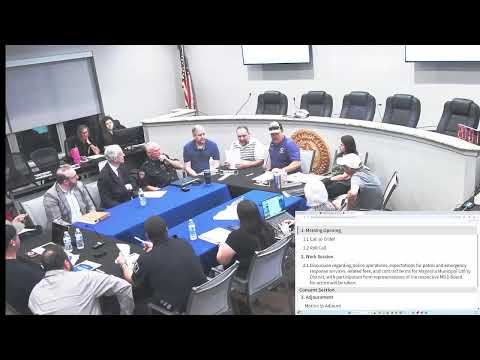
City of Josephine leaders and representatives of the Magnolia Municipal Utility District (MUD) met in a special work session on Sept. 15 to address a disputed increase in the monthly public‑safety charge and the scope of police enforcement for properties outside Josephine’s corporate limits.
City of Josephine leaders and representatives of the Magnolia Municipal Utility District (MUD) met in a special work session on Sept. 15 to address a disputed increase in the monthly public‑safety charge for MUD residents, the scope of police enforcement outside city limits, and the terms of the contract that governs those services.
The city has set a new public‑safety fee, which will appear on utility bills starting Oct. 1, raising the MUD portion to roughly $77.40 per household. Mike Phelps, president of the Magnolia MUD, said the district and many residents are struggling to understand both the size of the increase and what they will receive in exchange. “Cost for service is kind of the number 1 bucket that we're looking at — we would like a better explanation around the cost for service,” Phelps said.
Why it matters: the charge is billed to thousands of households in the MUD and is intended to recover police, fire and related public‑safety costs. MUD leaders said they are paying a large share of the service burden while lacking some enforcement powers inside the district because it lies outside Josephine’s corporate limits.
City staff traced the increases to a combination of factors including personnel, dispatch and equipment. City attorney Rob Mildred explained legal limits on municipal authority outside the city: “The city does not have any ability to make it a crime outside the city limits,” he said. That legal boundary helps explain why certain ordinance violations — for example, some noise or fireworks rules created by a city — are not directly enforceable in the MUD unless the board creates an enforceable rule that state law permits.
City administrators also described items that changed the budget picture. City administrator Lisa Palumbo said the public‑safety building cost roughly $9,000,000 and the MUD paid the majority of its share up front under an advanced funding agreement; she also said the police/public safety budget the city is managing is about $3.5 million. Palumbo and other city staff said a recent consultant study expanded the city’s cost model to include dispatch, jail and radio fees, and that some radio costs rose substantially after a county audit, from about $60,000 to more than $100,000 a year.
The MUD board raised several concrete complaints: they said they had not seen breakdowns showing that the MUD actually generates a majority of calls for service; they questioned whether some calls counted in the city’s tally were self‑initiated (for building checks or patrols) rather than dispatched citizen requests; and they described recurring quality concerns — such as slow response times for loud‑noise or fireworks complaints and inconsistent enforcement of ATV and golf‑cart rules.
Chief Jeff Graham described how the department responds within legal limits and said officers try to engage even when citations are not available. He also explained internal staffing changes, including promotions in the criminal investigations division. “We do have a sergeant in CID because he is, he has a more of a workload that he's able to handle,” Graham said, describing why some positions are graded as supervisory roles.
City and MUD lawyers and officials discussed options other jurisdictions use, including a contract model that funds dedicated officers paid by a district but hired and supervised by a city. An outside attorney noted examples in other North Texas communities where a city provided a stated number of officers assigned to a special‑purpose district, with the district paying for those positions and hours.
On next steps the group reached a working consensus: MUD representatives will draft a short term sheet — a bulleted list of requested contract terms and service expectations — and the city will respond. The city said it plans an annual review cadence tied to the budget process (the city’s fiscal year begins in October) and indicated it can commit to the current staffing and fees through the next budget year while both sides negotiate contract language. The city also confirmed the recently approved fee change will be billed starting Oct. 1 as previously scheduled.
The session included discussion of communications and resident education (disclosure at sale, billing explanations and outreach about what the charge pays for) and several operational clarifications the MUD asked the city to produce — including call‑type accounting (separating dispatched citizen calls from self‑initiated activity) and clearer documentation of incident follow‑ups the MUD board has cited as inadequate.
No formal council action was taken at the meeting; officials described the session as a work session and said it was intended to produce a negotiation starting point rather than immediate policy changes.
What comes next: city staff and the MUD agreed to exchange a short term sheet of proposed contract language and a draft schedule for annual fee review and implementation details. Both sides said they wanted to maintain regular communication as budget and service questions are resolved.