Get Full Government Meeting Transcripts, Videos, & Alerts Forever!
Get email alerts on the Flood Insurance Policy topic
No spam. Unsubscribe anytime.
Clatsop County staff urge FEMA to correct errors in draft EIS for BiOp 'no‑net‑loss' proposal; comments due Oct. 6
Summary
County planning staff told commissioners the FEMA draft environmental impact statement contains significant data errors for Clatsop County, warned of economic and permitting impacts for local projects, and said staff will prepare draft comments for board review ahead of the Oct. 6 deadline.
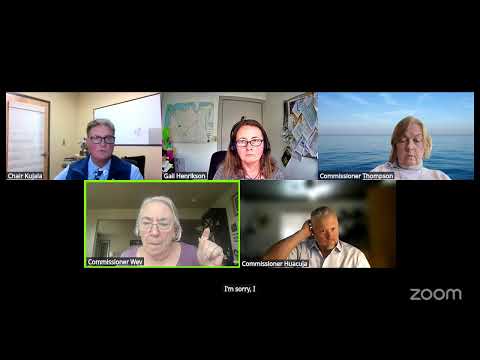
Gail Henriksen, Clatsop County community development director, told the Board of Commissioners that the Federal Emergency Management Agency’s draft environmental impact statement (DEIS) for a proposed “no‑net‑loss” requirement tied to the FEMA Biological Opinion (BiOp) contains major inaccuracies for Clatsop County and underestimates the local impacts of the rule alternatives.
Henriksen said FEMA released the draft EIS Aug. 22 and that county comments are due Oct. 6. She said the DEIS examines three alternatives: no action, an alternative that retains no‑net‑loss but exempts projects that already completed ESA (Endangered Species Act) compliance, and a third alternative that removes that exemption. “The information that we have in appendix F … is inaccurate, it’s incomplete, or it’s contradicting. And not by small amounts,” Henriksen told the board.
Henriksen gave specific examples the county will challenge. She said FEMA’s DEIS overestimated Clatsop County’s population by roughly 12,000 people, overstated county acreage by about 690,000 acres, and underestimated the county’s contribution to state gross domestic product by roughly $25 billion when compared with Oregon Employment Department figures. She said GIS staff is compiling corrected local figures for the county’s draft comment letter.
Henriksen described project‑level effects the county believes FEMA did not adequately analyze. Between 2020 and 2025 Clatsop County issued 118 floodplain development permits (about 5.5% of all planning permits), including 21 new dwelling units and 16 commercial or industrial projects totaling about 53,000 square feet with roughly $2.2 million in building value. She gave three local examples of how no‑net‑loss mitigation would increase costs: a proposed mini‑warehouse project that would have required roughly 152,000 cubic feet of compensatory storage; a coffee kiosk expansion (Divine Grounds) that would have required roughly 640 cubic feet of compensatory storage because it lies in the floodway; and a duplex whose footprint of about 2,300 square feet would require over 20,000 cubic feet of mitigation plus 2,000 square feet of pervious area.
Henriksen told the board that some DEIS assumptions are not well explained, such as a claim that property values and tax revenues could increase under the proposal. She said a lack of transparent sources and omission of available state data produced misleading conclusions. She warned that implementation will impose unfunded mandates; require increased local staff time for mandatory tracking and reporting; and could cause applicants to abandon projects or incur much higher design and mitigation costs.
County staff said they will finish their review this week, forward a draft comment letter to the county manager’s office and seek board direction to submit comments to FEMA by Oct. 6. Henriksen summarized the post‑comment schedule: after Oct. 6 FEMA may issue a final EIS and record of decision, at which point local jurisdictions would have eight months to select one of four ordinance pathways and 18 months to adopt required changes.
Commissioners uniformly praised Henriksen’s review and urged strong, public comments. Commissioner Wakua said the local examples illustrate real impacts on small businesses and rural communities; Commissioner Thompson called for coordinated public information so residents understand tradeoffs between climate‑adaptation goals and local economic impacts. Henriksen said she would circulate slides and the draft letter to the board and will send finalized comments to FEMA if the board approves.
No formal vote was taken at the work session; staff said a draft comment letter will be brought forward for board approval before submission.