Get Full Government Meeting Transcripts, Videos, & Alerts Forever!
Get email alerts on the Sales Tax topic
No spam. Unsubscribe anytime.
Winnebago County hears public opposition to proposed half‑percent sales tax as board moves resolution forward with no recorded final vote
Summary
Winnebago County Board of Supervisors members heard more than a dozen public comments opposing a proposed half‑percent county sales and use tax during the public‑comment period of the meeting; Vice Chairman Farley moved to approve Resolution 0179 to submit an ordinance establishing the tax, but the transcript does not record a final roll‑call vote on that resolution.
Winnebago County Board of Supervisors members heard more than a dozen public comments opposing a proposed half‑percent county sales and use tax during the public‑comment period of the meeting; Vice Chairman Farley moved to approve Resolution 0179 to submit an ordinance establishing the tax, but the transcript does not record a final roll‑call vote on that resolution.
The question matters because supporters say a local sales tax could supply money for long‑term capital needs and provide property‑tax relief, while multiple residents said the levy would hit renters, seniors and lower‑income households hardest. County Executive Hintz told the board any consideration of a sales tax should be “thoughtful, detailed, transparent, and follow a plan” that balances infrastructure needs and possible property‑tax relief.
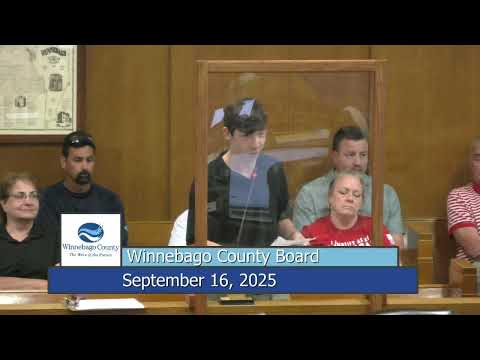
Public commenters who identified themselves as Winnebago County residents repeatedly urged supervisors to reject the measure. Jay Schrader, who gave his address as 1295 North Lake Street in Neenah and said he worked for Turning Point, called the proposal “a 17 to $20,000,000 tax grab of the taxpayers.” Jordan Hansen of Oshkosh said, “adding another half percent sales tax might only be $50, $60 a person per year, but that's still money in our pockets,” and asked the board to pursue consolidation or other cost‑savings before raising revenue. Steve Goodman of Neenah said he was unclear how additional revenue would be used and warned the increase would “hurt the poorest people the most.”
Multiple commenters questioned whether the sales tax revenue would be dedicated entirely to property‑tax relief. Joan Patterson, who gave county demographic figures during her remarks, said that in 2024 only 28% of county residents would benefit from a property‑tax cut tied to the sales tax, and urged supervisors to “vote no tonight.” Several speakers also warned against using revenues for new large building projects; Jennifer Koser said the county executive mentioned a potential $80 million courthouse during earlier presentations and said she opposed that use.
County Executive Hintz addressed the board during the meeting and framed the tax as one possible tool among others. He said the county faces significant deferred maintenance and capital needs — noting “we currently have 67,000,000 in deferred maintenance” — and that some long‑term consolidation or replacement of buildings could reduce operations costs. He said redevelopment and funding proposals require time and a clear plan: “consideration of any sales tax option should be done holistically to consider the county's costly infrastructure needs and long term budget shortfalls, as well as, the potential delivery of property tax relief to residents of Winnebago County.” Hintz said he has reservations about municipal revenue sharing and the lack of a detailed plan the public can follow.
Several supervisors and staff described parallel work on facilities and budgeting. Supervisor Hintz (committee chair) announced a Facilities and Property Management Committee meeting scheduled the following week to continue master‑plan implementation discussions and to review proposals for county‑run custodial services for several departments as a potential cost‑saving measure. The county executive said the 2026 proposed budget includes campus expenses and that committees will have opportunities to review and amend department budgets before final passage.
Votes and motions recorded in the meeting transcript related to other items included passage of an ordinance amending county speed limits (Ordinance 01830-09-2025) after a clerical correction was moved, and a commendation for retiring employee Terry Schrader (Resolution 0184092025) passed by voice vote. The transcript shows Vice Chairman Farley moved approval of Resolution 0179 but does not contain a completed roll‑call or recorded tally for that resolution before the meeting adjourned.
What happened next: the board did not record a final vote on the sales‑tax ordinance in the provided transcript. County staff and supervisors signaled additional committee review and public engagement on budget and facilities planning in coming weeks; County Executive Hintz said he will propose a “phase 1” plan for county buildings for the facilities committee to consider.