Get Full Government Meeting Transcripts, Videos, & Alerts Forever!
Get email alerts on the Health Professions Building topic
No spam. Unsubscribe anytime.
Austin Peay deans outline new Health Professions Building, clinical training and community clinics
Summary
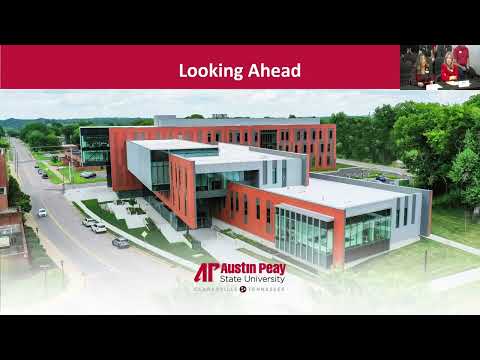
At the September 2025 meeting of the Austin Peay State University Board of Trustees, university leaders described the new Health Professions Building, saying the facility will expand interdisciplinary clinical training, increase program capacity and provide community-facing clinics that serve immediate care needs while building a long-term regional health workforce.
At the September 2025 meeting of the Austin Peay State University Board of Trustees, university leaders described the new Health Professions Building, saying the facility will expand interdisciplinary clinical training, increase program capacity and provide community-facing clinics that serve immediate care needs while building a long-term regional health workforce.
The presentation was given by President Michael Licari and the two deans introduced for the spotlight: Dr. Dylann Armstrong Williams, dean of the College of Behavioral and Health Sciences, and Dr. Karen Meisch, dean of the College of Science, Technology, Engineering, and Mathematics. The deans detailed the building’s simulation-centered design, new lab space, clinical services and several workforce metrics.
Why it matters: University leaders said the building addresses regional shortages in nursing, speech-language pathology, radiologic sciences and medical laboratory science by expanding student enrollment capacity and giving students hands-on interdisciplinary training that the deans said translates into high placement rates.
The deans described the building as “designed with simulation at its core,” with replication of clinical settings from emergency rooms to home visits to allow interdisciplinary exercises involving nursing, medical laboratory science, social work and psychology. The presentation said simulation training helps students practice “communication, teamwork, and decision making” before entering clinical placements or jobs.
Leaders cited recent program outcomes and demand: the nursing program’s NCLEX pass rates were said to be “more than 98 percent,” the speech-language pathology program reported a 100% employment rate for graduates (predominantly in Tennessee school systems, clinics and rural communities), and radiologic and medical laboratory science programs reported multi-year placement rates near 100 percent. The presentation stated that the medical laboratory science program has a three-year average placement rate of 100 percent and that radiologic sciences showed a five-year average placement rate of 100 percent.
The new facility also houses a diagnostic laboratory and expanded clinics. The speech-language and swallowing clinic was described as able to provide diagnostic sessions for about “30 to 40 clients a week,” and it includes specialized labs for swallowing, voice and cognitive-communication disorders plus in-room recording technology for instructional feedback.
The deans told the board the building’s dual mission is immediate clinical service and workforce development: students provide counseling and therapy in on-campus clinics as part of training while the university works to increase the pipeline of licensed practitioners across the region. The transcript notes a recent $1.5 million grant from the Tennessee Higher Education Commission that will support education pathways and expansion of outreach programs, and a Clarksville Montgomery County Health Foundation grant that funded a high-school “aspiring nurses” summer camp attended by about 60 students.
Board members asked whether the university has hospital affiliations for clinical rotations and whether community clinic services would carry fees. University staff said Austin Peay uses affiliation agreements and memoranda of understanding (MOUs) with hospitals across the region, sometimes hundreds of miles away depending on placement needs, and said the university is still developing a sustainable fee model for laboratory tests and diagnostic services while aiming not to charge those who cannot afford care. Leaders also said nursing students carry liability insurance as part of their fee structure for clinical placements.
Trustees praised the facility and its potential impact on regional staffing shortages. The board noted the building will allow program expansions that could “double students” in certain cohorts and said the facility’s expanded capacity should help decrease regional staffing shortages and improve patient outcomes.
The presentation included examples of specific program features (simulation spaces, a diagnostic lab, specialized speech therapy labs and a newly accredited PsyD program) and concluded with an invitation for questions from trustees.
Board materials and the presentation supplied the program and placement statistics that the deans cited; the presentation described several figures as program averages or results from THEC and internal tracking, not as state-wide totals.