Get Full Government Meeting Transcripts, Videos, & Alerts Forever!
Get email alerts on the Commercial Waste Zones topic
No spam. Unsubscribe anytime.
Council hearing on bill to exempt medical-waste generators from commercial waste zones draws broad opposition
Summary
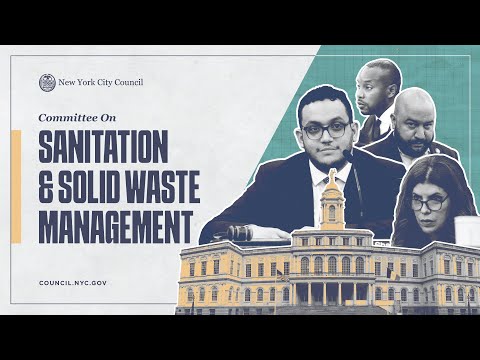
A New York City Council sanitation committee hearing on Intro 13-49 centered on whether businesses that generate regulated medical waste should be exempt from the city's commercial waste zone (CWZ) program established by Local Law 199 of 2019.
A New York City Council sanitation committee hearing on Intro 13-49 centered on whether businesses that generate regulated medical waste should be exempt from the city's commercial waste zone (CWZ) program established by Local Law 199 of 2019.
Several advocacy groups, environmental organizations, unions and private haulers urged the committee to reject the bill, arguing it would create a large loophole that undermines CWZ goals of reducing truck traffic, cutting emissions, improving worker safety, and stabilizing rates. Supporters from the health care sector and some specialized haulers said hospitals and other health facilities face unique, tightly regulated waste streams and need contracting flexibility to manage those streams safely and affordably.
The debate drew repeated references to the text and intent of Local Law 199 (2019). Janille Scott, climate director at Align and a representative of the Transform, Don't Trash coalition, testified she opposed Intro 13-49 because "it would provide a broad exemption to health care care facilities and other generators of medical waste by redefining the definition of commercial establishment," and that exempting those facilities would "further hinder the full benefits that we would see from the commercial waste zone program." Scott also said the DSNY selection criteria included price to help maximize affordability for customers under CWZ.
Eric Goldstein, New York City environment director at the Natural Resources Defense Council, said, "NRDC strongly opposes intro 13 49," calling it "inconsistent with the objectives of the waste zone statute." He told the committee the bill "would increase truck traffic. It would increase congestion. It would increase air pollution, and it would undercut the economic model of the waste zone statute."
Speakers representing private haulers and industry trade groups also opposed the exemption. Josh Harriff, market vice president for Action Carting (a subsidiary of Interstate Waste Services), characterized the bill as "an overcorrection to a non existent problem" and warned it would allow non‑awardee haulers to collect nonmedical commercial refuse and recycling from exempted establishments, fracturing the enforceability of CWZ.
Labor representatives pressed the committee on worker and street safety. A business‑manager‑level witness for Local 108 said the CWZ "has delivered real wins for sanitation workers" and that exempting health facilities would "undermine the CWZ program by allowing big institutions to bypass safety and labor standards."
Industry safety trainers and DSNY contractors raised similar concerns. David Bitterman, president of Biederman Consulting, urged rejection of Intro 13-49 on safety grounds, noting that CWZ regulations include training, incident reporting and telematics reporting that he said have contributed to a reduction in fatal collisions involving commercial garbage trucks.
Several witnesses representing hospitals and health systems asked the committee to preserve contracting flexibility for health care providers. Andrew Dahl, vice president for emergency preparedness and response at the Greater New York Hospital Association, said hospitals "navigate a very complex system of over a dozen different waste streams" and often use a single health‑care waste management service that can handle multiple regulated streams across zones. He said hospitals are facing financial pressure and therefore need opportunities to control costs.
Justin Wood, director of policy at New York Lawyers for the Public Interest, urged caution about exempting the entire health care industry and noted studies indicating that "about 85% of waste generated by hospitals is actually non medical waste," arguing that exempting hospitals would remove large generators from a system designed to track and reduce nonmedical waste.
Not all witnesses shared one conclusion. Charles Diplido Jr., owner of Approved Storage and Waste Falling, testified in favor of Intro 13-49, arguing the bill would provide needed flexibility to health care networks that operate across multiple zones and that some health care providers prefer a single contractor with the necessary permits and expertise.
The committee hearing comprised extended public testimony, with multiple stakeholders urging either preservation of CWZ's comprehensive coverage or relief for health care institutions that manage regulated medical waste. No formal vote on Intro 13-49 was recorded at the hearing.
The committee adjourned after testimony concluded; councilmembers did not announce further steps during the portion of the transcript provided.