Get Full Government Meeting Transcripts, Videos, & Alerts Forever!
Get email alerts on the Public Transit topic
No spam. Unsubscribe anytime.
Metro Transit seeks 1.1‑mill urban millage on Nov. 4 to sustain bus service and new on‑demand zones
Summary
Metro Transit asked the Kalamazoo County Board of Commissioners for support as it prepares a Nov. 4 ballot request for a five‑year, 1.1‑mill urban millage to fund fixed‑route buses and the MetroLink pilot; agency officials stressed ridership growth, rising vehicle costs and declining state transit funding as reasons for the increase.
Metro Transit officials returned to the Kalamazoo County Board of Commissioners on Sept. 16 to explain services and the rationale for a Nov. 4 urban millage request that would fund fixed‑route buses and the agency’s MetroLink on‑demand zones.
The agency’s executive director, Sean McBride, told commissioners Metro provided almost 2 million rides last year across its services — fixed‑route buses, Metro Connect on‑demand, and a new MetroLink pilot launched in April 2024 — and that its fixed‑route system averaged about 4,760 trips a day. Kurt Artema, chair of the Central County Transportation Authority and Kalamazoo County Transportation Authority boards, encouraged the commission’s support for the ballot measure.
McBride said the proposed millage would be for five years (2026–2030) at 1.1 mills in the urban area that covers the cities of Kalamazoo, Portage and Parchment plus parts of Kalamazoo, Oshtemo and Comstock townships. The current millage is 0.9 mills; the request reflects a rise in costs, continued investment in the MetroLink pilot and decreases in state funding tied to road dollars.
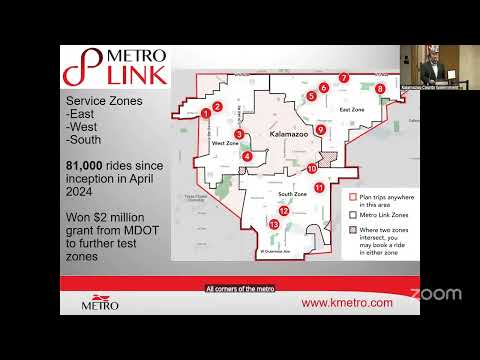
“Pre‑pandemic a fixed‑route bus cost us about $525,000,” McBride said. “Today we’re paying $775,000 for the same bus.” He described MetroLink as a dollar‑fifty per trip service that works like a ride‑hail app inside three zones and connects to fixed routes and said MetroLink has done roughly 81,000 rides since April 2024.
McBride said Metro’s funding mix includes fares, federal grants, state revenue and two voter‑approved “villages” (millages) that support countywide on‑demand service and the urban fixed‑route system. He said Metro had won a competitive state grant to expand MetroLink zones and that ridership growth — about 5,700 rides per month on MetroLink recently, and roughly 6,500 unique riders — justified continued support.
Commissioners asked about precinct changes and timing. McBride said the urban millage boundary is largely the same as the earlier vote (one added precinct in Comstock Township) and that if the millage fails Nov. 4 the next earliest opportunity to ask voters would be spring 2026 or the next general election allowed under state rules.
Why it matters: Metro leaders framed the millage as necessary to maintain service levels amid inflation, to sustain a successful on‑demand pilot many riders rely on, and to offset continuing declines in state transit funding that are tied to highway dollars.
What’s next: Metro staff said they will continue public outreach and offered to make presentations to community groups ahead of the Nov. 4 election. The commission did not vote on the millage at the Sept. 16 meeting; McBride asked for the board’s support for outreach and information sharing.