Get Full Government Meeting Transcripts, Videos, & Alerts Forever!
Get email alerts on the Banking Regulation topic
No spam. Unsubscribe anytime.
House Financial Services Committee advances package of banking, market and anti‑corruption bills
Summary
The House Committee on Financial Services advanced a slate of bills on May 20 meant to expand liquidity options for community banks, strengthen tools to recover assets stolen by foreign kleptocrats, and give financial firms limited new authorities — while drawing sharp debate over regulatory rollbacks and the scope of stress testing.
The House Committee on Financial Services advanced a slate of bills on May 20 meant to expand liquidity options for community banks, strengthen tools to recover assets stolen by foreign kleptocrats, and give financial firms limited new authorities — while drawing sharp debate over regulatory rollbacks and the scope of stress testing.
The committee’s chair opened the session saying, “We're going to advance a series of bills aimed at strengthening our banking system and making our capital markets more efficient.” The markup included bipartisan measures to extend a whistleblower rewards pilot for foreign‑government corruption, adjust how reciprocal and custodial deposits are treated for smaller banks, create limited legal protections for financial firms who pause suspected senior fraud transactions, and repeal certain unused Securities and Exchange Commission authorities created under Dodd‑Frank.
Why it matters: The bundle of bills touches deposit insurance and liquidity tools that state and community banks say they need to compete with larger institutions; it also includes national‑security‑adjacent measures aimed at economic pressure on foreign adversaries and proposals that would constrain some SEC and Federal Reserve authorities. Committee action puts the measures on a path to the House floor but does not make them law.
What the committee did and debated
• Protect Taiwan Act (H.R. 1531): Representative Frank Lucas (R‑Okla.) and cosponsors argued the bill would bar representatives of the People’s Republic of China from certain international banking organizations if the president notifies Congress of a threat to Taiwan. Lucas said, “If China intends to engage in conflict with Taiwan, then China should be prepared to withstand the consequences.” The committee adopted an amendment in the nature of a substitute and ordered the bill favorably reported by a roll call of 49‑0.
• Kleptocracy Asset Recovery Rewards Act (H.R. 5344): Representative Stephen F. Lynch (D‑Mass.) described reauthorizing and expanding a Treasury‑administered whistleblower rewards pilot to a seven‑year program to help identify, seize and repatriate assets stolen by foreign governments. Lynch noted the pilot lapsed in 2024 and said the program is self‑funded from seized assets. The committee adopted the measure and ordered it reported, 50‑0.
• Financial Exploitation Prevention Act (H.R. 2478): Representative Ann Wagner (R‑Mo.) framed the bill as a tool to allow open‑end investment companies (mutual funds) to temporarily delay redemptions when they reasonably suspect financial exploitation of older adults or adults with impairments. Wagner said the pause—up to 15 days with a possible 10‑day extension—gives firms time to investigate and notify supportive authorities. The committee adopted the bill and ordered it reported, 50‑0.
• Business Owners Protection Act (H.R. 3484): The bill would repeal several SEC authorities created by Dodd‑Frank that critics say have remained unused and create legal uncertainty for businesses. Sponsor Representative Andy Barr (R‑Ky.) argued the SEC’s dormant authorities should expire after 15 years; opponents warned the repeal would remove investor protections such as the SEC’s ability to harmonize fiduciary standards and to address mandatory arbitration clauses. The bill moved forward after committee vote, 26‑24.
• Custodial and reciprocal deposit reforms (H.R. 5317, H.R. 3234, and related amendments): The committee considered multiple measures to clarify that custodial deposits and reciprocal deposits—tools community banks use to provide FDIC coverage above $250,000—should not automatically be treated as brokered deposits for certain well‑capitalized community banks. Sponsors emphasized the changes would help Minority Depository Institutions (MDIs), community development financial institutions (CDFIs), and other community banks access stable funding to support local lending. The Community Bank Deposit Access Act (H.R. 5317) was ordered reported, 48‑2; the Keeping Deposits Local Act (H.R. 3234) was ordered reported, 51‑0.
• Financial Stability Oversight Council (FSOC) Improvement Act (H.R. 3682): Representative Bill Foster (D‑Ill.) said his bill would require FSOC to consider alternative, activity‑based mitigations and coordinate with primary regulators before designating a nonbank as systemically important. Supporters argued the change brings transparency and due process; proponents said it preserves FSOC’s emergency authority. The committee ordered the measure reported, 47‑4.
• Bank Competition Modernization Act (H.R. 5262): Representative Scott Fitzgerald (R‑Wis.) proposed a safe harbor allowing banking regulators not to request a Department of Justice competitive analysis for mergers that would leave the combined institution under a statutory asset threshold. Supporters said it would speed routine, small‑bank mergers; critics warned it would roll back antitrust scrutiny and accelerate consolidation. The committee ordered the bill reported, 28‑24.
• Community Bank Lift Act and CBLR adjustments (H.R. 5276): Representative Young Kim (R‑Calif.) and others sought to adjust the community bank leverage ratio (CBLR) to encourage smaller banks to opt into a simpler leverage standard. Supporters said the change would let community banks deploy more capital locally; opponents urged caution, saying broader study is needed. The committee ordered the bill reported, 33‑19.
• Merchant Banking Modernization (H.R. 5291): Representative Roger Williams (R‑Texas) proposed increasing the permissible holding period for merchant banking investments from 10 to 15 years to give longer‑term capital to businesses and projects. The committee ordered the bill reported, 35‑17.
• Stress Testing Accountability and Transparency Act (H.R. 5270): Representative Bill Huizenga (R‑Mich.) sponsored legislation to require the Federal Reserve to use notice‑and‑comment rulemaking for the models, scenarios and assumptions used for stress testing and to prohibit climate‑related stress tests for nonbank financial companies. Supporters argued for predictability and to avoid “double counting” capital requirements; opponents said publishing test methodologies would let firms “game” exams and that climate risk is financial risk that warrants study. The committee ordered the bill reported, 28‑24.
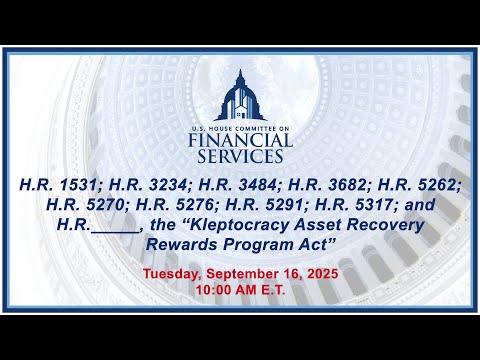
Votes at a glance (committee recorded roll calls): H.R. 1531, Protect Taiwan Act — ordered reported favorably (49‑0) H.R. 5344, Kleptocracy Asset Recovery Rewards Act — ordered reported favorably (50‑0) H.R. 2478, Financial Exploitation Prevention Act — ordered reported favorably (50‑0) H.R. 3484, Business Owners Protection Act — ordered reported favorably (26‑24) H.R. 5317, Community Bank Deposit Access Act — ordered reported favorably (48‑2) H.R. 3682, FSOC Improvement Act — ordered reported favorably (47‑4) H.R. 3234, Keeping Deposits Local Act — ordered reported favorably (51‑0) H.R. 5262, Bank Competition Modernization Act — ordered reported favorably (28‑24) H.R. 5276, Community Bank Lift Act — ordered reported favorably (33‑19) H.R. 5291, Merchant Banking Modernization Act — ordered reported favorably (35‑17) H.R. 5270, Stress Testing Accountability and Transparency Act — ordered reported favorably (28‑24)
What’s next: Committee passage sends each bill to the full House for consideration; many measures will face further debate, amendments, or opposition on the floor. Several items—particularly the SEC authority repeal, stress‑testing and merger‑review changes, and deposit‑insurance reform proposals—were points of partisan disagreement in committee and may draw additional scrutiny in subsequent stages.
Ending note: Committee members on both sides reiterated support for community banks and for fighting foreign corruption, but they diverged sharply on whether rolling back or clarifying existing agency authorities would strengthen or weaken investor protections and financial stability.