Get Full Government Meeting Transcripts, Videos, & Alerts Forever!
Get email alerts on the Fed Independence topic
No spam. Unsubscribe anytime.
Former Fed Vice Chair Lael Brainard tells House panel attacks on Fed independence could raise inflation and hurt workers
Summary
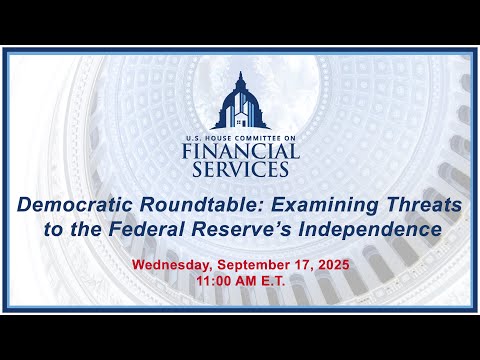
Lael Brainard, former vice chair of the Federal Reserve, told the House Financial Services Committee on a hearing date not specified that efforts by the White House to influence or replace Federal Reserve officials risk undermining the central bank’s independence and could lead to higher inflation, higher long-term interest rates and weaker employment outcomes.
Lael Brainard, former vice chair of the Federal Reserve, told the House Financial Services Committee on a hearing date not specified that efforts by the White House to influence or replace Federal Reserve officials risk undermining the central bank’s independence and could lead to higher inflation, higher long-term interest rates and weaker employment outcomes.
Brainard told members the Federal Reserve’s independence matters because “when there's not an independent central bank, it leads to higher inflation,” and she cited historical episodes and recent policy actions as reasons for concern. She also said two court rulings so far have sided with Governor Lisa Cook, who has filed suit after being summarily removed, and warned the legal fight could continue to the Supreme Court.
Why it matters: Central-bank credibility affects mortgage rates, Treasury yields and the dollar’s global role. Brainard said sustained political pressure on the Fed could raise inflation expectations and thereby increase real borrowing costs for households and governments.
Brainard described several specific developments she said threaten independence: public attacks on Fed officials, efforts to install an appointee who would remain linked to the White House, and the sudden departure of at least one governor before the end of her term. She noted that years ending in 1 and 6 require reappointments of the 12 Reserve Bank presidents under section 4 of the Federal Reserve Act, and that control of the seven-member Board of Governors could influence those approvals.
"It is very, very dangerous to have an institution like the Fed, a central bank, not be independent," Brainard said during questioning. She warned that countries whose central banks follow political direction — she pointed to Turkey and earlier U.S. experience in the 1970s — have seen inflation and interest rates rise and long-term economic harm.
Committee members pressed Brainard on consequences for workers and specific demographic groups. Members cited rising unemployment for Black women — figures given in the hearing included 6.7% and 5.7% in separate exchanges — and asked how a politicized Fed might affect labor-market outcomes. Brainard said the Fed’s dual mandate — price stability and maximum employment — requires attention to subgroup data because early deterioration often appears first for groups such as Black men and women.
Several members asked about possible responses. Brainard said courts, Congress and market reactions are the principal guardrails. She suggested legislative clarifications could be considered — for example, rules preventing a sitting White House staffer from serving on the Board of Governors — and urged outreach to bipartisan, business and retirement-sector voices that traditionally defend Fed independence.
On immediate policy, Brainard said she did not have inside information about Federal Open Market Committee deliberations but expected the committee to lower the federal funds rate by 25 basis points at its meeting that day. "I do anticipate that they will lower rates today," she said, adding that market watchers would look for dissents and any changed projections from the committee, including whether the newest board member would submit a forecast.
The hearing included broader warnings about international consequences. Brainard said the dollar’s preeminence depends on credible institutions and high-quality statistics; politicizing those institutions could erode the U.S. borrowing advantage and national-security tools that rely on dollar dominance.
The committee did not record formal votes or adopt binding measures at the hearing. Members indicated they would continue oversight, and Brainard urged sustained public and private pushback to preserve the Fed’s independence.
Brainard’s testimony and members’ questions combined historical context, legal developments and near-term market implications, and the hearing ended with members continuing to consider legislative and nonlegislative steps to protect central-bank independence.