House task force debates replacing Fed’s dual mandate with price-stability focus
Get AI-powered insights, summaries, and transcripts
SubscribeSummary
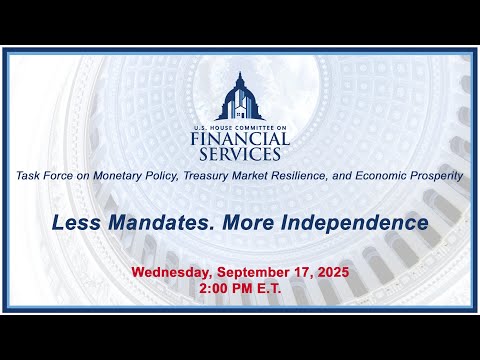
The House Financial Services Committee task force on monetary policy heard competing proposals Thursday on whether the Federal Reserve should abandon its dual mandate — price stability and maximum employment — in favor of a single, price‑stability mandate.
Members and witnesses said the debate matters because it would reshape how the Fed sets interest rates and communicates with markets. Proponents argued a single mandate would strengthen the Fed’s independence and make its objectives more measurable; opponents said the dual mandate provides necessary trade‑offs and democratic legitimacy when monetary policy affects jobs and incomes.
Chairman Lucas opened the hearing describing its purpose as an examination of “the Federal Reserve’s mission of price stability, maximum employment, and moderate long term interest rates.” Representative Juan Vargas, the task force’s ranking member, framed independence as essential and warned about political pressure on the Fed.
Douglas Holtz‑Eakin, president of the American Action Forum, told members he favored moving “to a single mandate on price stability” and recommended a price‑level target he said would improve accountability and forward guidance. “With a single mandate, you eliminate that [dual‑mandate] confusion,” he said, adding that the shift would anchor expectations and strengthen independence.
Alex Pollock, appearing as a senior fellow associated in testimony with an academic institute, urged Congress to review the Fed’s existing objectives and to clarify what “stable prices” means in statute. “The statute says stable prices, not stable inflation,” Pollock said, questioning the Fed’s long‑standing 2 percent inflation target and urging congressional approval for any long‑term inflation commitment.
Curtis Dubé, chief economist at the U.S. Chamber of Commerce, told the task force that small and midsize businesses would benefit from clearer, more predictable price stability. “To ensure that businesses and our economy can thrive, the Fed needs fewer mandates and more independence,” Dubé said, and added that if the dual mandate remains, Congress should specify that price stability takes precedence in conflicts.
Witnesses and several members warned that a single mandate is not without costs. Skanda Amarnath of Employ America and other witnesses argued the dual mandate helps make trade‑offs transparent and has at times guided policy that avoided harmful outcomes for employment. “The multiple objectives in section 2(a) of the Federal Reserve Act support credible and independent monetary policy precisely because they make trade offs in monetary transmission more transparent,” Amarnath said.
Members pressed witnesses on specifics. Some suggested legislative alternatives short of scrapping the dual mandate — for example, adopting a statutory “sound money” statement or requiring congressional approval for any long‑term inflation target. Pollock proposed regular congressional review of the Fed’s financial statements and called for a public re‑examination of the 2 percent target.
No legislative action was taken at the hearing. Members will submit additional questions for the record and witnesses were asked to respond by Oct. 22, 2025.
Less formal disagreements at the hearing highlighted the political sensitivities: several members said voters feel the effects of both inflation and jobs in household budgets and urged careful consideration before any statutory change.