Get Full Government Meeting Transcripts, Videos, & Alerts Forever!
Get email alerts on the Stormwater Funding topic
No spam. Unsubscribe anytime.
Douglas County outlines stormwater program shortfall, weighs utility fee, sales tax and other options
Summary
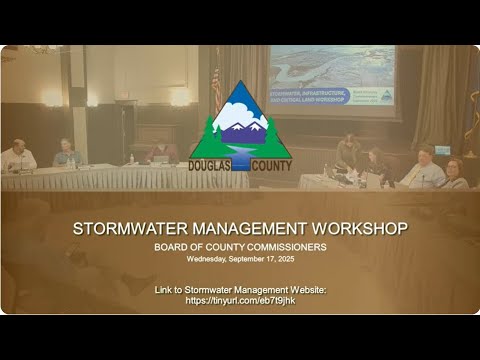
Douglas County commissioners heard a detailed progress report and funding options for the county’s stormwater program at a public workshop, where staff said existing funding covers day-to-day operations but is not sufficient for long-term repair, capital projects or critical-land purchases.
Douglas County commissioners heard a detailed progress report and funding options for the county’s stormwater program at a public workshop, where staff said existing funding covers day-to-day operations but is not sufficient for long-term repair, capital projects or critical-land purchases.
Courtney Walker, the county’s stormwater program manager, told the Board of County Commissioners that the division’s maintenance and inspection work has improved the condition of county storm infrastructure but that program operating costs and future needs have outpaced available funding. “We have made a lot of progress,” Walker said, summarizing years of inspections and maintenance, “but we don't have a savings account for replacing [underground] pipes.”
The presentation outlined three distinct watershed areas in the county (Carson River, Lake Tahoe/Truckee River and Walker River), recent flood events and roughly $141 million in capital projects identified in the county’s 2024 stormwater master plan. Staff said they currently transfer $1 million a year from the general fund to the stormwater program, the program’s operating budget recently reached about $1.3 million, and projections put realistic program needs closer to $4 million a year when repair-and-replacement reserves, capital project funding and critical-land management are included.
Why it matters
County staff and residents said the county faces recurring flood risk that has periodically damaged roads, homes and public facilities. Staff noted recent high-flow and alluvial-fan events in 2017 and 2023 that overwhelmed local drainages and that some historic conveyances and levees in the Carson Valley have broken repeatedly over decades. “This problem impacts our whole community,” said a county official during opening remarks, and several residents described repeated property and infrastructure damage.
What staff reported
- Maintenance and inventories: Walker said the stormwater team has logged more than 5,300 inspections since the program was created, removed an estimated 34,000 cubic yards of sediment and is tracking roughly 1,400 assets (culverts, basins, etc.) in GIS. She credited the maintenance crew — including Supervisor Jason Symansky and technicians Katie Hay, Cody Whirley, Jesse Parra and Brad Lyons — for day-to-day work.
- Condition improvement: Walker said the share of county storm assets rated “good” rose from under 50% at program formation to over 90% in recent inspections.
- Regulatory obligations at Lake Tahoe: Walker and staff noted an ongoing obligation under the Lake Tahoe TMDL (total maximum daily load) program administered by the Nevada Division of Environmental Protection on the Nevada side and the California Lahontan Water Quality Control Board on the California side. Staff said the county must obtain and maintain increasing “credits” each year for fine-sediment reduction and that these compliance obligations are not optional.
- Grants and unfunded needs: Staff reported about $10 million in active grant applications with an estimated $2 million in local matching funds not yet identified. The master plan’s total list of capital needs approaches $141 million, and staff estimated roughly $69 million in priority unfunded capital projects.
Funding options presented
Staff presented three primary revenue options and the status-quo alternative:
- Stormwater utility fee (ERU-based): Many U.S. jurisdictions use an equivalent-residential-unit (ERU) charge tied to impervious area. Staff estimated roughly 56,000 ERUs in Douglas County and said a national-average utility fee of about $6 per month could generate the approximately $4 million annual revenue the program needs to be sustainable. Staff noted rate design choices (exemptions, credits, agricultural treatment) would be policy questions for the Board and require public hearings.
- Quarter-cent (0.25%) sales-tax increase: Staff estimated a quarter-cent increase would generate about $2.99 million a year for stormwater and open-space purposes in Douglas County, a significant sum but short of the full $4 million goal. Staff also noted sales tax revenue is more economically sensitive than a dedicated utility fee and that some portion of sales tax revenue is paid by visitors.
- Special assessment districts: Staff described assessment districts as practical when infrastructure benefits a clearly bounded area. They cautioned that Douglas County’s irrigation and conveyance network often moves water across drainage boundaries, which complicates drawing benefit districts and assigning assessments.
- Status quo: Continue the current general-fund transfer (historically $1 million annually) and pursue grants; staff warned this is not fiscally sustainable long-term.
Staff recommended continued public engagement and that the Board consider a consolidated approach rather than multiple separate utilities (for example, a single countywide rate that covers Lake Tahoe and the valley). They also emphasized the need to set aside funds for equipment replacement, major repair-and-replacement, capital projects, and critical-land acquisition/management.
Public comment and board response
More than a dozen residents who live in flood-prone communities — including Johnson Lane, Fish Springs and Genoa — urged the county to secure a dedicated funding source. Karen Peternell, a Douglas County resident who now manages Carson City’s stormwater program, urged the board: “I urge you to not kick this can down the road, but to, but to pass a stormwater utility or some other funding mechanism.”
Alice Gingrich, a long-time resident, said rising flood-insurance costs make local mitigation urgent: “I think it's time we buy the hamburger because it's not fair for the county to be issuing permits in areas that they know are flood prone.”
Don Ryan, who lives on Jackie Lane in Johnson Lane, asked for more consistent maintenance: “We need maintenance, not just new infrastructure.”
Other commenters with water-management experience backed new revenue options and emphasized community outreach. Retired hydrologist John Coburn said the county has long had flash floods on alluvial fans and urged funding for capital projects, describing the subject as “serious business.” Dan Saint John, a former public-works official, said the county has “solid plans” and that additional revenue will be required to carry them out. Doug Ritchie, a county legal official, said that because development creates the need for storm infrastructure, “whether structures or impervious surfaces…where man has changed nature” makes a user-fee approach defensible.
Board direction and next steps
The board did not adopt a specific funding measure at the workshop. Commissioners asked staff to return with more detailed options and recommended additional community outreach. Jennifer Davidson, county manager, told commissioners staff would bring the stormwater funding options back within the county’s broader fiscal discussion: “We will bring something back to the county commission to discuss this matter further and also in the context of the overall fiscal health of this organization.”
A procedural motion to approve the meeting agenda was moved by Commissioner Gardner, seconded by Commissioner Tarkanian and carried unanimously at the start of the meeting.
The county’s staff presentation, the stormwater master plan adopted in 2024, and the public comments make clear the county faces long-term choices about revenue and priorities. Staff said grants remain an important tool but are competitive and typically require local matching funds. Commissioners and residents said any decision will require substantial public outreach before voters or ratepayers are asked to fund a long-term program.