Get Full Government Meeting Transcripts, Videos, & Alerts Forever!
Get email alerts on the School Wellness Policy topic
No spam. Unsubscribe anytime.
Perkiomen Valley wellness committee begins crosswalk after triennial assessment finds gaps in nutrition promotion and physical activity
Summary
Perkiomen Valley School District committee reviewed results of a federally required triennial assessment of its wellness policy, identified data-collection and communication gaps (n=12), and agreed to begin a building-level crosswalk and targeted follow-up rather than immediate policy changes.
Perkiomen Valley School District wellness committee members reviewed the district’s triennial assessment of its local school wellness policy on Oct. 25, 2025, and agreed to begin a crosswalk of the assessment results against the written policy to identify priorities for action. The review found lower scores in nutrition promotion and physical activity, and staff described the district’s sample (12 respondents) as too small and potentially skewed by who completed the survey.
The committee said the triennial assessment is required by federal regulations and aims to “evaluate how well our district is implementing our wellness policy, with the goal of ensuring that the policy is improving student health and aligning with USDA standards,” as Kelsey Gardner, co-chair of the wellness committee, told members. Gardner and other staff emphasized that the assessment tool covers seven focus areas and contains about 75 questions.
Why it matters: the assessment and any resulting changes to the written wellness policy affect classroom practices, food-service operations and communications to families across the district. Committee members framed the next step as improving the quality of the data and clarifying which items must remain in policy versus those that are optional, rather than immediately rewriting large portions of the policy.
Committee discussion and findings
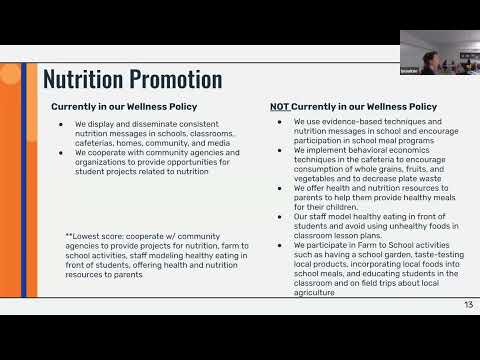
Kelsey Gardner, co-chair, said the district used a widely used assessment tool and that respondents marked whether each line item was “fully in place,” “partially in place,” or “not at all in place.” She summarized the group’s findings: "We're doing really well in physical education. We're doing pretty well in public involvement, notification, and assessment. What can we see as areas of growth? Clearly, nutrition promotion ... is one of the biggest ones that we would say is partially in place." Gardner noted the tool produces average scores across respondents.
Joan Aduchi, director of special education and co-chair of the committee, said the district’s sample included 12 respondents representing principals, health/wellness staff, nurses, special education and food services staff, and noted that respondents may not always have the specific knowledge to answer every item. Aduchi described how answers can be skewed when a principal fills out questions that would better be answered by a PE teacher or food-service manager: "Do we form in each building so the principal's answering this, they might not have an answer to something... why not bring everybody together, to kind of come together and answer for that building in general to kind of take some of the skew out?"
Staff presented an internal scoring spreadsheet that highlighted items with average scores equal to or below an arbitrary cutoff of 1.3 (where 2 = fully in place, 1 = partially in place, 0 = not in place). The presentation notes that bolded items in the assessment indicate elements that must appear in the district’s written policy; staff identified one required-policy item with a low score as an early candidate for attention.
Suggestions and next steps
Committee members agreed on several nonbinding next steps: disaggregate results by school level (elementary, middle, high), convene building-level teams (for example principals, nurses, PE teachers and food-service staff) to answer assessment items together, and run a formal crosswalk to map assessment questions to current policy language. Staff also proposed sharing the crosswalk document as an editable Google Doc and dividing the policy into sections for committee members to review as a homework assignment before the next meeting.
The committee distinguished between two kinds of gaps revealed by the assessment: (1) that a required procedure or program may not actually exist, and (2) that a program exists but staff and stakeholders are unaware of it. Members repeatedly recommended that the committee prioritize clarifying communication and documentation before proposing broad policy revisions. As Joan Aduchi put it, the group did not want the policy work to be “a check-in the box” exercise but rather purposeful and focused on areas where change would have impact.
Topics raised for targeted follow-up included: nutrition-promotion efforts in cafeterias (behavioral-economics techniques, placement, signage, pricing), physical-activity opportunities outside of scheduled PE, and differences among buildings (examples cited: farm-to-school work more common in some elementary schools than at the high school). Staff also noted COVID-era interruptions had delayed some wellness activities and that the district may wish to “slim down” the written policy to focus resources on a narrower set of priorities.
No formal vote or policy adoption occurred during the meeting. Committee members asked staff to prepare disaggregated results, share the crosswalk document, and propose a timeline and responsible staff for action items so the committee can prioritize work at future meetings.