Get Full Government Meeting Transcripts, Videos, & Alerts Forever!
Get email alerts on the Bridge Repair topic
No spam. Unsubscribe anytime.
Brookfield selectmen move to get engineering estimates for failing Nose Mount bridge and nearby culvert
Summary
The Brookfield Board of Selectmen met with Beta Group engineers to review repair options for the Nose Mount bridge and a nearby culvert, and agreed to pursue refined engineering estimates, permitting guidance and funding options to bring back at the October meeting.
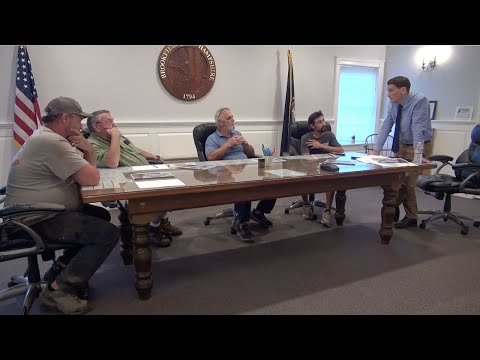
The Brookfield Board of Selectmen met with John Bia of Beta Group to review repair options for the failing Nose Mount bridge and a nearby culvert and to consider whether to commission engineering through to a bid package.
Beta Group engineer John Bia described options ranging from temporary repairs — grout bags, riprap and small wing walls — to a full replacement with a buried box culvert or a new bridge frame. "We are a 170 person company and we are based in Lincoln, Rhode Island. I'm out of the Manchester, New Hampshire office," Bia said, describing his firm's municipal bridge, roadway and stormwater experience.
The discussion centered on trade-offs between lower-cost short-term fixes and longer-term replacements. Bia said a full replacement would likely require a large, buried box culvert or bridge sized to follow stream‑crossing rules; he estimated design and permitting work in the order of $175,000 and warned construction costs would be substantially higher. He also noted an earlier engineering estimate for full replacement of about $800,000 from roughly eight years ago.
Bia recommended the town consider both a lower-cost stabilization (riprap, tow walls, localized concrete fill around abutments and prefabricated wing walls) and a full replacement. He said the state typically requires substantial hydraulic and streambed survey (HEC‑RAS level analysis) for full‑scale work but may accept a modified or alternate design to reduce survey demands on small roads. He cautioned that wetland and stream permits can take months to review, and that permits may have expiration windows that affect timing.
Officials noted service impacts and exposure: Bia said the Nose Mount road carries about 500 vehicles in a 24‑hour period in summer, and board members said the bridge crossing provides the only reasonable egress for roughly 50 houses upstream; the nearby culvert serves fewer houses, perhaps 20–25. Selectmen expressed concern about scour under abutments, recurring washouts and heavy vehicles accelerating deterioration.
Funding and timing were a major focus. Bia said the New Hampshire state aid bridge program can cover a large portion of construction but can place projects in a multiyear queue; FEMA hazard‑mitigation grants are another possible source but require significant up‑front analysis to document relative costs and benefits. Board members reported the town's Moose Mountain Bridge trust contains roughly $150,000 and that $200,000–$300,000 more would be needed to cover initial steps; they discussed options including bonding, staged annual deposits and use of unexpended fund balance to soften tax impacts.
On a timetable, Bia described a typical sequence of survey, preliminary permit submission, final design and bidding that often takes about a year for design and permitting and roughly another year to schedule and build the work. He stressed seasonal constraints for survey and wetland delineation and recommended staging work so contractors can fabricate large prefabricated pieces over winter for summer installation.
Next steps the board recorded in discussion were to obtain more precise cost estimates for the preferred options (precast wing walls, riprap, full replacement), confirm permitting requirements with DES, evaluate funding options including bonding and grants, and place the engineering‑contract decision on the October agenda so members can decide whether to engage Beta Group to proceed to final design and a bid package.
The Selectmen did not adopt a formal vote during the meeting. The board's discussion emphasized weighing near‑term stabilization against long‑term replacement, the permitting timeline, likely construction costs, and potential external funding such as state aid or FEMA grants.