Get Full Government Meeting Transcripts, Videos, & Alerts Forever!
Get email alerts on the Infrastructure Electric topic
No spam. Unsubscribe anytime.
Norwich council authorizes $150 million in electric revenue bonds to fund utility upgrades
Summary
The Norwich City Council unanimously approved an ordinance allowing Norwich Public Utilities to issue $150 million in revenue bonds, secured solely by electric revenues, to finance substations, transmission upgrades and other electric infrastructure improvements.
The Norwich City Council voted 7-0 on Sept. 15 to adopt an ordinance authorizing Norwich Public Utilities (NPU) to issue up to $150 million in tax-exempt revenue bonds, to be repaid solely from electric revenue, to fund a package of electric infrastructure projects.
NPU General Manager Chris LaRose said the borrowing will allow the utility to phase large capital projects over time rather than rely on annual capital budgets, reducing short-term rate volatility. “Paying for important projects over time rather than through annual expenditures from our capital budgets will significantly reduce the short term impact on rates and reduce rate volatility,” LaRose said.
The bond program is intended to finance multiple upgrades, LaRose said, including relocating the Bean Hill substation out of the Yantic River floodway, repairs and upgrades to the Tenth Street and Dudley substations and their transmission feeds, replacing older distribution lines (from 4.8 kV to a 13.8 kV system where needed), a 34.5 kV sub-transmission “ring” to connect substations for improved backfeed capability, and targeted upgrades to maintenance and hydroelectric facilities. LaRose added that any expenditures from these bonds would require approval by the NPU board as well as applicable city, state and federal agencies.
Council members pressed NPU staff on future rate impacts. “Were not getting something for nothing here. It will likely result in some kind of rate increases down the road,” Alderman Betancourt said. LaRose agreed that financing will have a cost but described several mechanisms that can mitigate long-term impacts: spreading major projects over 30 years, potential ISO New England cost recovery for certain substation work, remarketing unused capacity and growth in load from electrification. He estimated a 10-year, accelerated approach could have produced roughly a 3% annual increase for 10 years in a worst-case scenario, but said the utilitys plan is to pace projects so the impact on customer bills is minimized.
Councilors also discussed flood vulnerability: NPU staff said the Bean Hill substation was within six inches of flooding during the January storm and options to raise or dike the existing site were infeasible; relocation to higher ground was presented as the preferred solution. LaRose said the 34.5 kV sub-transmission connection would enable faster, more automated backfeeding between substations to limit outage size and duration.
The ordinance passed on a roll-call vote of 7-0. Council members earlier moved to bring the ordinance to the floor (motion by Alderman Gould; second by President Pro Tem DeLucia). The council recorded the final vote as Yes: Nash, Hayes, Betancourt, Gould, Singh, DeLucia, Nystrom.
The ordinance authorizes the city and NPU to issue revenue bonds and to apply for grants to finance any portion of the appropriation; the ordinance text specifies the bonds would be secured solely by electric revenue and that city- and agency-level approvals will be required before expenditures are made.
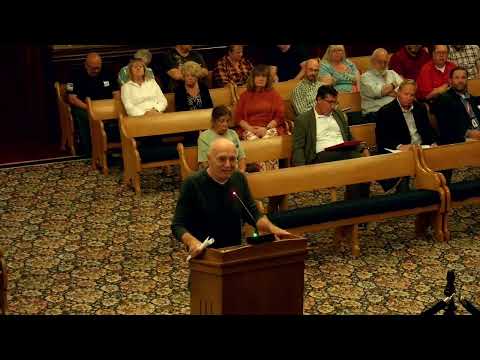
Members of the public and councilors who asked questions during the public hearing included residents and several aldermen; no public speaker opposed the bond ordinance during the hearing. NPU staff and bond counsel remained available to answer follow-up questions as the projects move through permitting and design.
Looking ahead, LaRose and staff said major steps such as permitting, design and long lead-time procurement (transformer lead times were described as roughly two years) mean construction for the largest items would be phased and could take many years to complete.