Get Full Government Meeting Transcripts, Videos, & Alerts Forever!
Get email alerts on the Transportation Ev Infrastructure topic
No spam. Unsubscribe anytime.
Energy committee recommends two Level 2 chargers; Select Board motion to seek non-tax funding recorded
Summary
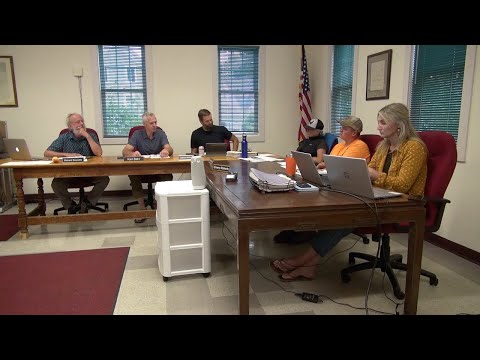
The Tamworth Energy Committee recommended a two-space Level 2 electric vehicle (EV) charging installation and a preferred vendor; the Select Board heard the recommendation and a motion was made to seek 100% non-tax funding for the project, though the transcript does not record a definitive final roll-call outcome.
The Tamworth Energy Committee presented results of an EV charging station bid process and urged the Select Board to authorize seeking 100% non-tax funding for two Level 2 charging spaces in the town office parking lot.
The committee’s presentation, given by Gabrielle Watson, summarized three bids that ranged roughly from $15,000 to $35,000. Watson said the committee favored a mid-range bid because that vendor had local experience (installation at Loon Mountain), offered a turnkey solution (site preparation, installation and commissioning), and proposed hardware the committee characterized as having a “97-plus percent” uptime record. The plan the committee described was for two destination-style Level 2 chargers intended for visitors who spend an hour or more in the village (library, farmers market, theater, bakery).
Watson said the committee’s goal is that all electricity and routine maintenance costs be paid from user fees tied to the chargers. “The EV chargers will be the price will be pegged at a place that’s gonna allow us to recoup all of our electricity and operations and maintenance costs,” Watson said. She told the board the chosen vendor would provide a dashboard for the town to manage billing and site monitoring.
Board members asked about alternatives and trade-offs. A Select Board member asked whether a fast (Level 3) charger would be preferable for travelers; Watson replied that fast chargers and the electrical service upgrades they require would likely cost on the order of $100,000 and are not appropriate for Tamworth’s village location. Watson told the board Level 2 “destination” chargers better match local use patterns.
Questions also covered warranties and ongoing uptime. A Select Board member noted some bids included longer warranties and asked whether paying more for a longer warranty would be prudent. Watson said higher-cost bids offered more coverage but the committee balanced cost, vendor reputation and hardware uptime in its recommendation.
Board members discussed operations: Watson said snow removal for the parking spaces would remain the town’s responsibility and that protective bollards would be installed to reduce the chance of plow damage to the charging equipment. Watson also said the vendor’s maintenance and operations contract would cover repairs and monitoring; the town would typically receive monthly remittances from user revenue after the vendor collected usage fees. Watson noted a possible federal tax or rebate program (a direct-pay provision was mentioned during discussion) but said she would research eligibility and timing.
A board member raised a statutory question about parking enforcement for charging spaces and cited a state RSA number during discussion; the board did not record a separate legal opinion during the meeting.
The transcript records that a Select Board member moved to accept the Energy Committee recommendation and seek private (non-tax) funding for the preferred bid. The transcript does not clearly record a definitive roll-call result. During the exchange one board member explicitly said their vote was no and another comment in the transcript summarized the standing count as “Looks like 3 3 2,” but a formal, unambiguous outcome is not present in the record.
The Energy Committee said it would continue pursuing funding and work with town staff on next steps, including final vendor selection, grant/rebate research and the operational contract.
Why it matters: installing public EV chargers would add infrastructure where the committee described the region as a “charging desert,” could increase visitor dwell time in the village and provide a revenue stream to cover operations, but it would also require the town to manage parking, snow removal and site readiness.