Get Full Government Meeting Transcripts, Videos, & Alerts Forever!
Get email alerts on the Addressing topic
No spam. Unsubscribe anytime.
City staff present AMS-compatible street-address prototype to improve emergency response and utility findability
Summary
City staff and consultants outlined a prototype addressing scheme designed to make Carmel-by-the-Sea addresses compatible with the U.S. Postal Service Address Management System (AMS), saying the change would improve emergency response, utility serviceability and online delivery while preserving PO boxes.
City staff presented a prototype street-address system they say would be compatible with the U.S. Postal Service Address Management System (AMS) and could be implemented without forcing postal home delivery, staff said at a public meeting on the topic.
Staff leaders said the primary aims of the proposal are to bring Carmel-by-the-Sea into alignment with AMS so mapping, emergency response and utilities can reliably locate properties, while preserving the town’s longstanding PO-box mail practice.
The need and the nut graf
Officials said AMS compatibility matters because banks, mapping services and utilities use the postal system as the authoritative source for street-address verification. Emily, a staff member working on the project, told the meeting that “mail delivery and at-home mail delivery and an address system are two different things,” and that implementing AMS-compatible addresses would not itself compel USPS to start curbside delivery. The proposal is intended to reduce delays for first responders and private carriers and to bring the city into compliance with state fire and building-code requirements that require visible street numbers for emergency response.
What staff reviewed and why it matters
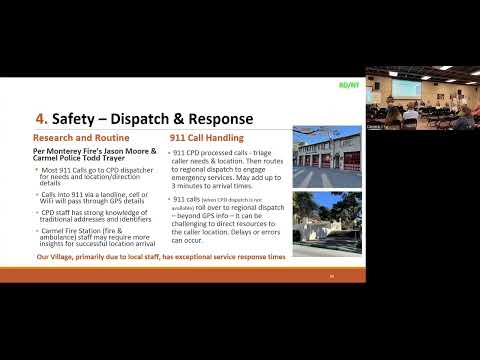
Presenters said Carmel currently uses a nonstandard house-numbering convention that is not compatible with the Address Management System maintained by USPS. That incompatibility, staff said, makes it harder for outside emergency crews, private carriers and online services to find some properties; Carmel is unique in the county for also operating its own 911 dispatch, which requires extra translation to county dispatch and sometimes adds seconds to response before a fire truck or ambulance departs.
Monterey Fire Department provides fire service under contract, staff said, and has committed to staffing a paramedic firefighter on every truck. Staff also said the city is preparing to contract with Monterey Fire Department to operate the city’s ambulance service; currently the city still owns and operates its ambulance, while other county ambulances are provided by AMR under county contract. Staff emphasized that reported response-time metrics begin when a unit leaves the station and therefore do not include local dispatch/translation delays.
Prototypes considered
Consultant Kevin reviewed four AMS-compliant addressing models: a quadrant model (compass quadrants), a continuous numbering within the city, continuous numbering aligned with county numbering, and a “logical-positional” model. Staff said the working preference is the logical-positional model because it: - preserves references to numbered avenues (First–Thirteenth) that many residents use to describe location; - keeps address numbers to four digits or fewer for most parcels; - retains cross-street proximity indicators (so a number conveys how far a property is from the nearest numbered avenue); - and received a preliminary OK from both USPS address-management staff and Monterey County GIS staff.
Under the logical-positional prototype described at the meeting, numbering would originate at the ocean (the beach edge as 0), carry north–south in blocks that reflect the numbered avenues, use even/odd sides consistently, and reserve gaps between assigned numbers to allow future infill, per USPS rules. Kevin presented examples showing how lots, corner parcels and grouped parcels would be handled and noted exceptions for diagonal and noncontinuous streets.
Key technical and legal constraints
Staff relayed USPS addressing conventions they said apply: the primary numeral can be up to five digits, addresses should include only one street name, odd and even numbers must be consistently placed on opposite sides of the street, and supplemental unit designations (suite/unit) must be numeric or alphanumeric. Staff also cited California code requirements discussed at the meeting: numbers must be legible from the street, each character must be roughly 4 inches high with a minimum stroke width of one-half inch, and when a structure cannot be viewed from the public way, a monument, pole or sign should identify the structure for emergency responders.
ADUs, multiunit buildings and legacy mailbox addresses
Staff said accessory dwelling units (ADUs) may be eligible to receive an individual USPS-recognized address, but the preliminary recommendation is not to issue new addresses for existing ADUs automatically; instead, an individual property owner could request an address. For multi-unit structures, staff explained the standard postal practice: a structure receives a single street address and subunits are identified with suites, units or apartment labels.
Staff also said legacy addresses tied to physical mailboxes and legacy five-digit addresses on annexed parcels would be preserved; the county and USPS both indicated those legacy addresses should not be changed automatically.
Utilities and county interaction
Representatives of utilities (PG&E, AT&T, Comcast and Cal Am) met with staff and told them they could accept a batch update of new AMS-compatible service or premise addresses. Staff said utilities expressed a preference for standardized AMS addresses and indicated they would work to update customer records if the county publishes the new addresses. Monterey County staff likewise reviewed the prototype and gave a preliminary thumbs-up, but county approval and GIS incorporation would be required before publishing the address list. Staff emphasized that county approval (step 4 in the plan) depends on having the USPS preliminary sign-off (step 2).
Process and timeline
Staff outlined a five-step process: (1) research and safety/technical review; (2) preliminary USPS review of a numbering scheme; (3) full development of an address list for every parcel; (4) county review and incorporation into county GIS and systems; and (5) mass distribution of the updated data to utilities, USPS, emergency systems and service providers. Staff said they will return to the City Council in October with an update; if the council directs staff to proceed, staff said a resolution could be prepared for a November first reading and a December second reading, with implementation work beginning thereafter. Based on utility and county comments, staff estimated implementation could take roughly three to six months after council direction, though costs remain to be quantified.
Community concerns and public comment
Staff reported receiving more than 100 emails and many public comments, with common themes including: (1) concerns about emergency-service delays and callers having to describe complex locations; (2) worries about processing online transactions, prescription deliveries and insurance or financial verifications; (3) potential impacts on town character and historic homes; and (4) requests for more detail about costs and enforcement. Several residents described personal emergency experiences; one commenter said they waited about five and a half minutes for an ambulance call because of location confusion.
On historic appearance, staff noted the legal minimum for numbers (roughly 4 inches tall) and said enforcement details would be up to the City Council. Staff also showed examples of varied, period-appropriate number plaques and said owners could combine a number with a house name to preserve character.
Quotes from the meeting
Emily (project staff) summarized a core point: “Implementation of an address system and at-home mail delivery are two different things.”
Kevin (consultant) described the preferred prototype as one that “honors the current tradition of knowing your position within a block.”
Next steps
Staff invited further public feedback and said printed slides and materials would be available online. They will return to the City Council in October with the workgroup’s update and a recommendation on whether to proceed to a formal adoption process.
Ending
If the council directs staff to proceed, county and USPS approvals would follow; staff stressed the city cannot change county or postal policy unilaterally and that many details — including exact costs, final enforcement policy and whether certain ADUs receive standalone addresses — would be settled during the county and utility coordination and the council decision process.