Get Full Government Meeting Transcripts, Videos, & Alerts Forever!
Get email alerts on the Emergency Preparedness Firefighters Health topic
No spam. Unsubscribe anytime.
Portland firefighters mark 9/11, stress preparedness, long-term health and staffing needs
Summary
At a Labor and Workforce Committee meeting, Portland Fire & Rescue leaders and the Portland Firefighters Association commemorated 9/11, outlined long-term health risks for first responders and urged continued investment in stations, staffing and federal health funding for responders.
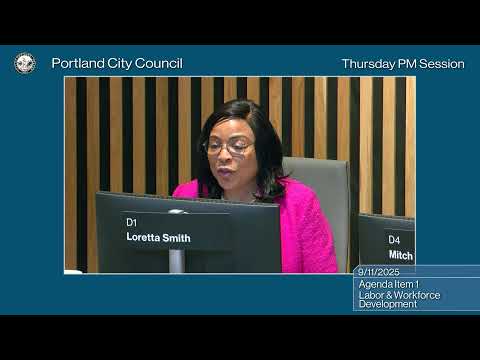
Chair Loretta Smith convened the Labor and Workforce Committee of the Portland City Council on Sept. 11 to mark the anniversary of the 2001 terrorist attacks, highlight emergency preparedness and hear from Portland Fire & Rescue and the Portland Firefighters Association about responder health, mutual aid and local readiness.
The committee heard that remembering 9/11 remains part of Portland’s public-safety calendar and that lessons from the attacks — including improved radio interoperability and an increased focus on behavioral health — have reshaped local emergency response.
"There is roughly a 35% chance that in the next 50 years, a Cascadia Subduction Zone earthquake will come to Portland," Chair Loretta Smith said, urging residents and officials to prepare. "Global warming and climate change are causing greater and greater risk of severe drought and other extreme weather events." She opened the meeting by thanking firefighters for their service and noted a citywide emphasis on emergency preparedness.
Isaac McClendon, president of the Portland Firefighters Association, recounted how four Portland firefighters traveled to New York immediately after the 2001 attacks to assist at Ground Zero and described enduring health and behavioral impacts across the fire service. "The long-term health impacts — cancer, lung disease, heart disease — continue to affect firefighters," McClendon said, and he urged continued attention to cancer prevention and behavioral-health services.
McClendon and Chief Lauren Johnson described several local changes aimed at reducing occupational exposures. McClendon said firefighters now have a second set of turnout gear, protective hoods are laundered or replaced after every fire, and stations are equipped with extractors to clean gear. "We replaced the hood that goes right near our face and our mouth after every single fire," McClendon said. Division Chief Andy Ponce said crews are encouraged to return to the station within an hour to shower after incidents to reduce skin exposure to carcinogens.
Chief Johnson, who recently joined Portland Fire & Rescue from Dallas, said the department continues to learn and adapt. "September 11 for us really is a story that we should never stop telling," Johnson said, adding that Portland uses lessons from large incidents to review procedures and inform city leaders about resource needs.
Committee members pressed department leaders on capacity and staffing. McClendon noted Portland still operates 31 fire stations and said that on-duty strength has changed little over decades even as call volume has increased. "We're doing much more with just about the same group," Division Chief Andy Ponce said, adding the department has added three on-duty positions since 1998 while responses rose by more than 48,000.
Councilor Steve Novick and other committee members praised the department’s cancer-reduction steps and asked how the city can better protect firefighters as wildfires, earthquakes and other large events become more frequent. Novick asked for more ideas on what the council could do to guard against long-term health effects; McClendon invited written requests and said the association would work with council offices on federal advocacy.
McClendon urged congressional action on a federal measure he described as the 9/11 responder and survivor health funding corrections act, asking the council to send a letter of support to Oregon’s congressional delegation. He named Reps. Andrew Garbarino and Jerrold Nadler and Sen. Kirsten Gillibrand as sponsors in Congress and said advocates sought bipartisan co-sponsors in both chambers.
Several council members and department leaders emphasized mutual aid and community partnerships. McClendon and Chief Johnson said neighbors and nonfire public-safety personnel will be crucial in the first hours of a large disaster and highlighted efforts to expand community preparedness training. Council members also raised plans for commemorations on the 25th anniversary next year and offered to help coordinate.
The meeting included personal remembrances of the 2001 response and an appeal for sustained funding and staffing to maintain readiness. Chair Smith closed the item by tabling a separate agenda item for follow-up and thanking the fire department for its presentation and public service.