Get Full Government Meeting Transcripts, Videos, & Alerts Forever!
Get email alerts on the State Legislation topic
No spam. Unsubscribe anytime.
Lake Oswego staff brief council on 2025 legislative session, housing bills and ongoing transportation special session
Summary
City staff summarized the 2025 Oregon legislative session, highlighted housing bills that will require local implementation and described a narrowed transportation package now moving through a special session.
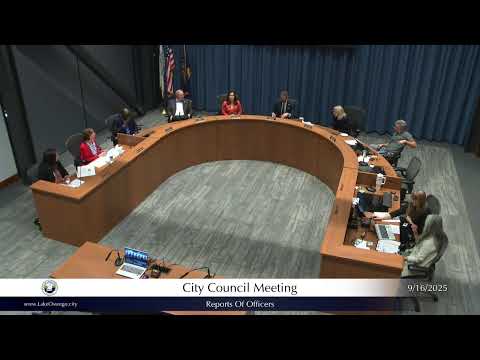
City staff gave a wide-ranging legislative update on Sept. 16, reviewing major outcomes of the 2025 Oregon legislative session and identifying bills that will require Lake Oswego policy and code work over the next two years.
Deputy City Manager Madison Thiesing and Community Development Director Noma Numanalou summarized bills of greatest local interest. Items passed during the long session included a restoration of recreational immunity for public lands, funding for wildfire programs linked to nicotine-related taxes, targeted housing infrastructure funding (House Bill 3031) and a technical fix that allowed Habitat for Humanity to use an existing $1.7 million appropriation on an alternate nearby project. Other measures — including several climate rebate programs and ebike safety regulations — failed to pass and remain active issues.
Housing bills and local impacts Staff presented four housing-related bills expected to have the largest effects locally: Senate Bill 974 (an “engineering review shot clock” requiring time limits for plan review of public improvement plans), House Bill 2658 (limits on frontage improvements for certain residential renovations), House Bill 2258 (Oregon homes bill, including permit‑ready plans) and House Bill 2138 (the governor’s middle‑housing bill).
Key points staff highlighted: - SB 974 creates a 30‑day completeness review and a 120‑day final decision deadline for engineering plan review, with limited extensions and potential penalties (refunds of plan review fees) if deadlines are missed. It also requires some residential applications that increase density to proceed as staff decisions without an initial public hearing. Implementation is slated for July 1, 2026. - HB 2658 constrains local authority to require frontage improvements for some residential renovations, with a long implementation timeline (2031) and carve-outs for rights‑of‑way dedication, system development charges and ADA requirements. - HB 2258 adds a permit‑ready plans program to the state building code (preapproved plans that can proceed directly to inspection) and creates a streamlined land‑use review path for certain middle‑housing and small multiunit projects; DLCD rulemaking will determine details. - HB 2138 (middle housing) contains many provisions that take effect at different times through 2027–2028. Staff warned the council that DLCD rulemaking will define details such as “small footprint” for cottage clusters, permitted design standards and how bonus units or accessibility incentives translate to local code changes.
Staff cautioned that several implementation deadlines precede DLCD rulemaking, creating uncertainty about how to draft local code updates. Director Numanalou said the city will attempt to align code updates with the annual CDC amendments and the planned code audit, but stressed several provisions — such as clear-and-objective tree removal standards tied to housing — are already effective and will require prompt action.
Transportation The city’s legislative briefing also covered transportation. Staff said the transportation package the legislature initially pursued did not pass and a narrowed package (LC 2 / House Bill 3991) is now the subject of a special session focused on short‑term fixes for ODOT’s budget and to stop layoffs and service cuts. Staff noted the short‑term bill is not a comprehensive funding solution for major capital projects and that a larger debate is expected in the 2026 short session.
Council reaction Councilors asked for clarity on timing, local impacts and staff workload. Staff said they will return with a fuller analysis and recommended next steps, and that the city’s legislative team will monitor DLCD rulemaking and report back as rules are finalized.