Get Full Government Meeting Transcripts, Videos, & Alerts Forever!
Get email alerts on the Urban Forest Plan topic
No spam. Unsubscribe anytime.
Committee delays final action on Portland Urban Forest Plan amid proposed amendments and public support
Summary
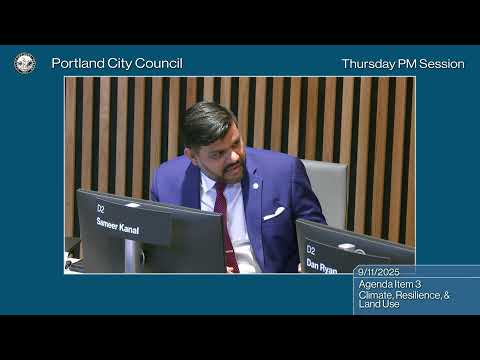
Portland Parks and Recreation returned Sept. 11 with a recommended draft of the Portland Urban Forest Plan; after extensive discussion and strong public testimony, the committee agreed to continue consideration to Sept. 25 so councilors and staff can review proposed amendments and implementation timelines.
Portland Parks and Recreation returned to the Climate Resilience and Land Use Committee Sept. 11 with a recommended draft of the Portland Urban Forest Plan and a resolution asking the committee to move the plan to the full council for adoption.
Sonia Szymanski, interim director of Portland Parks and Recreation, and Belinda Eudelman, the plan’s project manager, described the plan as a community‑driven, action‑oriented document that sets neighborhood and pattern‑area canopy targets, establishes more than 50 implementation actions, and identifies bureau leads and performance measures. “This plan was developed with input from dozens of staff and thousands of community members,” Eudelman said. She emphasized the plan is a high‑level guiding document distinct from the city’s tree code and noted staff intend the plan to direct investments, programs and future code updates.
Staff highlighted several actions they said would be central to implementation: a citywide street‑tree maintenance program, expanded tree‑planting partnerships (including a near‑term contract with Friends of Trees), coordination with the Bureau of Transportation to create additional space in streets for trees, and work with the Bureau of Planning and Sustainability to provide guidance for integrating trees into development projects. Urban Forestry Commissioner Melinda McMillan told the committee the Urban Forestry Commission voted unanimously to recommend the plan to council, citing climate‑related risks to public health and the role of trees in mitigation and adaptation.
Public testimony was strongly supportive: residents, advocacy groups and nonprofit partners urged adoption and pressed for faster timelines and stronger funding commitments for street‑tree maintenance and for the city to assume legal and financial responsibility for maintaining right‑of‑way trees in priority areas. Testifiers included representatives of 350PDX’s Shade Equity Coalition, Trees for Life Oregon, the Portland Audubon/urban conservation organizations and community volunteers; speakers stressed equity and the need to target tree canopy increases in North and East Portland.
Committee members asked detailed questions about canopy targets (for example, a citywide target of 45% by 2065 and a 20% target for certain river pattern areas), how targets were calculated, land‑use constraints in industrial and airport areas, tribal and Indigenous engagement, and the program timeline for shifting maintenance responsibility from adjacent property owners to the city. Urban Forestry staff said they heard new emphasis on private property rights during public comment and incorporated language reflecting that concern; they also said the city has initial funding from the Portland Clean Energy Fund and the parks levy and is developing a street‑tree maintenance program that will take several years to scale. The project manager said staff can provide additional data disaggregating canopy potential by land‑use in pattern areas.
Committee members also read into the record seven amendment concepts supplied by community groups (the Shade Equity Coalition). Two of those proposals that Councilor Kunal indicated he intended to pursue would (1) require the city to establish a cross‑bureau committee to identify a permanent funding source for street tree maintenance and sidewalk repairs with a report back by March 2027, and (2) direct code changes so the city, instead of adjacent property owners, assumes legal and financial responsibility for street‑tree maintenance and street‑tree‑related sidewalk repairs in priority service areas by November 2027 (language submitted by the coalition would add specific code sections to be amended).
Given the volume of testimony and the late arrival of proposed amendment language to some council offices, committee members agreed to continue the matter to the committee’s next meeting on Sept. 25 to allow councilors and staff time to review the proposed amendments and to pursue interoffice and bureau conversations similar to prior code amendment processes. “I’m reluctant to ever approve a walk‑on amendment,” one councilor said; another said the plan is important but wanted time to vet the proposed code‑change language. Staff said there was no legal deadline to adopt the plan but noted that adoption would allow staff to begin a Title 11 amendment project and other implementation steps sooner.
The committee did not vote to adopt the plan on Sept. 11; the item will return for further committee consideration on Thursday, Sept. 25.
Speakers who led the presentation or provided testimony included Sonia Szymanski (interim director, Portland Parks and Recreation), Belinda Eudelman (project manager, Portland Urban Forest Plan), Melinda McMillan (Urban Forestry Commissioner), Jen Chien Chiara (City Forester), representatives from Trees for Life Oregon, Friends of Trees (contract discussed), Shade Equity Coalition/350PDX, BikeLoud PDX, and other community testifiers. Staff noted an anticipated Friends of Trees contract of nearly $2 million to support neighborhood plantings beginning this winter.