Get Full Government Meeting Transcripts, Videos, & Alerts Forever!
Get email alerts on the Legislative Agenda Process topic
No spam. Unsubscribe anytime.
Portland council, OGR begin multi-month process to set 2026 legislative agenda
Summary
City Council members and the Office of Government Relations (OGR) opened a work session to begin setting a shared state and federal legislative agenda; staff said they will vet hundreds of proposals, return in December with a draft agenda, and seek a council vote before the winter holidays.
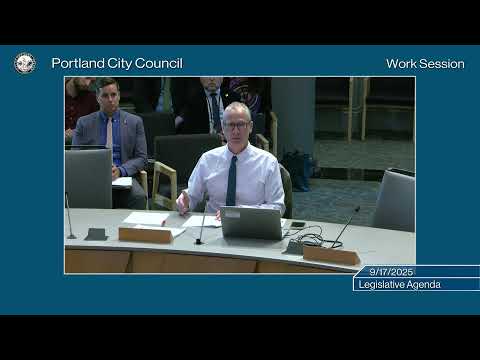
The Portland City Council began a work session Sept. 17 to lay the groundwork for the city’s 2026 legislative agenda, with staff recommending a multi-month vetting process and a final council vote before the winter holidays.
“This is the first of 2 meetings about our legislative agenda that we will be having in a work session format so that we can talk through some of our priorities,” Council President said at the opening of the session. The Office of Government Relations (OGR) explained it will gather input from bureaus, council members and community partners, do additional vetting and return in December with a proposed agenda.
“Given limitations of the short session, we'd like to get to a point where we're focused on what is achievable in the short session,” Sam Chase, Director, Office of Government Relations, told the council. Chase and OGR staff outlined an issue-evaluation framework they use to judge items for the legislative agenda and asked council members to weigh in on values such as political viability, city impact, equity and feasibility. Chase said OGR had collected raw ideas from bureaus and individual council offices and had not yet vetted or prioritized that list.
Chase told councilors that the short legislative session imposes strict time constraints for moving bills and that some proposals may be better prepared over multiple sessions: “Short sessions are very challenging things to get anything big done in. ... Ideas can be matured over multiple sessions sometimes.” Council members pressed staff on how to balance short-term, achievable asks with longer-term “maturation” of major reforms.
OGR staff described a continuing engagement plan: regular briefings through the fall, a December work session to finalize a draft agenda and a council vote before the holidays, followed by active outreach to state and federal lawmakers. Chase said OGR would maintain weekly communications leading into session and more frequent updates once session begins.
Councilors asked for clarity about how items are collected and labeled in OGR materials, and several urged clearer connections between council-approved resolutions and OGR’s priorities list. OGR encouraged council offices to submit issue sheets early and to engage bureau experts to improve the “political viability” and technical readiness of proposals.
The work session produced no formal votes or directives beyond scheduling the next steps: OGR will continue vetting items, return in December with a recommended agenda, and prepare materials for a council vote before the winter holidays.