Get Full Government Meeting Transcripts, Videos, & Alerts Forever!
Get email alerts on the Central Business Improvement District topic
No spam. Unsubscribe anytime.
Gallatin information session outlines how a central business improvement district could fund local projects
Summary
At a public information session at the Palace Theater in Gallatin City, city staff and an outside attorney laid out how a central business improvement district, or CBID, could be formed to fund beautification, parking, marketing and other improvements in focused parts of the city.
At a public information session at the Palace Theater in Gallatin City, city staff and an outside attorney laid out how a central business improvement district, or CBID, could be formed to fund beautification, parking, marketing and other improvements in focused parts of the city.
Rosemary Bates, the city’s economic development director, opened the meeting and described city interest in tools that could funnel money into concentrated commercial areas. Bates said the discussion was prompted in part by a recent City Council decision to give a developer of a proposed Target store $1,500,000. Bates said that decision led council members and city staff to ask whether there are other ways to help small commercial areas around Gallatin.
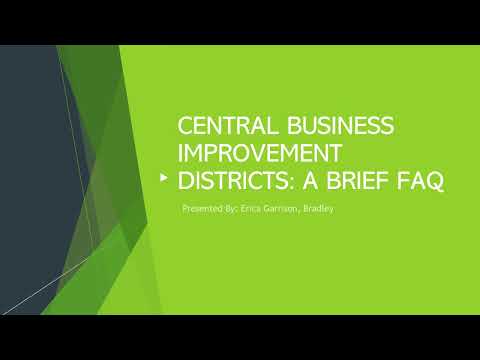
Erica Garrison, an attorney with Bradley Law Firm, explained the CBID under state law and emphasized that it is a landowner-initiated, locally managed mechanism. "A CBID is really a self help entity that allows you to drive money and funds for a common purpose or a common good that you want to achieve within that district," Garrison said. She described the common uses allowed by the statute — marketing, design, planning, sanitation and security, parking or even daycare facilities and acquisition of property for public improvements — and said members must specify permitted uses in the ordinance that creates the district.
Garrison said the usual funding mechanism is an added assessment on property tax bills, although the assessment can be structured by frontage, business type or other metrics, or collected via a business license fee. "CBID is another tax that you're essentially putting on yourself or a fee," she said, adding that jurisdictions commonly set CBIDs for a fixed term (often 10 or 20 years) and may extend them under the same legislative process used to create them.
She described the basic formation steps: landowners circulate a petition with a boundary map and a budgeted plan for improvements; the statute requires that a petition be signed by at least 51% of property owners representing two-thirds of the assessed value in the proposed district; the city publishes notice, holds a public hearing, and the council then adopts an ordinance if the statutory thresholds and public process are satisfied. Garrison said that an alternative initiation route is for the city to file a resolution, but she prefers the petition approach because it demonstrates owner support before the ordinance process.
On governance and administration, Garrison said the city can administer funds but the 1990 CBID act allows formation of a district management corporation — typically a nonprofit made up of property owners and other representatives — to manage day-to-day operations and budgets, reporting annually to the city. Bates and Garrison both noted that CBID funds must be spent only for the purposes set out in the ordinance and that the assessment rate cannot be increased except through the ordinance process.
Attendees raised questions about residential inclusion, whether homeowners could be exempted, and whether a property owner who signs a petition can later withdraw. Garrison said districts with residential parcels exist in some downtown areas but are less common; she said the petition thresholds and the public hearing give the council and the public opportunities to carve out properties or amend boundaries if there is opposition. She also said CBID assessments "run with the land," meaning the obligation typically remains for the duration set in the ordinance unless the council and petition process formally change it.
Audience members asked how a CBID differs from other tools and whether the city could instead target existing grants or the $1.5 million that the council committed to the Target developer toward small-business needs. Bates noted the Target grant was approved by the City Council and administered through the Industrial Development Board (IDB) as a nonprofit entity; she said that money will be released only if the developer meets the grant conditions. She further explained that general city tax dollars cannot be used to improve private property except through statutory vehicles such as a CBID or grants to an eligible nonprofit.
No formal actions or votes on a CBID took place at the session; Garrison and Bates encouraged property owners and business leaders who are interested to form a local steering group, do cost estimates for desired improvements, and begin a petition process if there is sufficient consensus. Attendees were told the presentation was being recorded and that they could contact Bates or Garrison for follow-up questions.
Three City Council members were present and identified during the presentation: Council Member Paul Jones (District 1), Council Member Todd Alexander (District 3), and Council Member Pascal Javon (City Council member, district not specified in the session remarks). Several residents and business owners asked questions during the presentation and the Q&A.