
Lake Havasu schools report early DIBELS results, MTSS actions as district seeks to reverse achievement stagnation
Get AI-powered insights, summaries, and transcripts
Subscribe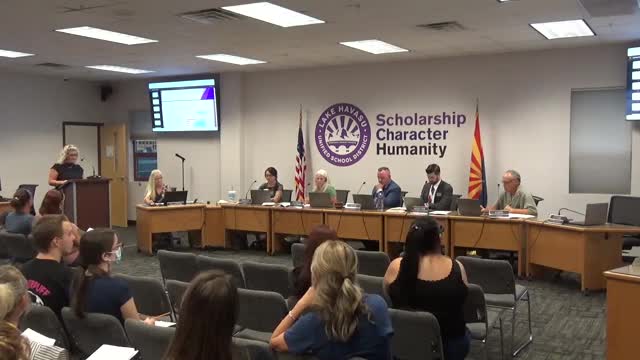
Summary
District staff presented site-by-site action plans, reported a 98% DIBELS completion rate and described multi-tiered supports and alignment work at the high school; presenters said stagnating achievement is a systemic issue requiring coordinated action.
District student achievement staff updated the Lake Havasu Unified School District governing board on Sept. 11 about beginning‑of‑year literacy screening, Multi‑Tiered System of Supports (MTSS) implementation and high‑school standards alignment.
The presenter said the elementary beginning‑of‑year DIBELS benchmark had 98 percent completion, giving leaders "an early look at how our students are entering the school year," and that principals submitted spreadsheets summarizing site goals and action steps. "By putting all the goals in one place, we can look for alignment and gaps," the presenter said.
District staff described the MTSS tiers: tier 1 (high‑quality classroom instruction), tier 2 (targeted interventions and progress monitoring about every 10 days) and tier 3 (intensive individualized support). Presenters emphasized that being in tier 2 or tier 3 should be temporary and that a high share of students needing intervention signals a tier‑1 curriculum problem.
Principals' action plans described school‑level priorities. Examples given at the meeting included data‑driven instruction at Havasupai, an MTSS framework building at Jamaica, specialists pushed into classrooms at Nautilus, expectation‑raising at Smoke Tree, Leader in Me strategies at Starline, and a new homeroom program at Thunderbolt Middle School to provide targeted supports.
High‑school departments are working separately on math, English and science to align instruction and assessments to state standards and accountability measures such as the ACT. Math focuses on sequencing and formative assessments; English is emphasizing differentiation; science is aligning formative and summative assessments across classrooms.
District presenters said recent stagnation in achievement is "not a teacher problem. It is a system problem," and called for collective responsibility from directors, principals and instructional coaches to identify barriers and sustain improvements.
Board members praised the detailed site spreadsheets and asked for continued monthly updates.