Get Full Government Meeting Transcripts, Videos, & Alerts Forever!
Get email alerts on the Corporate Subsidies topic
No spam. Unsubscribe anytime.
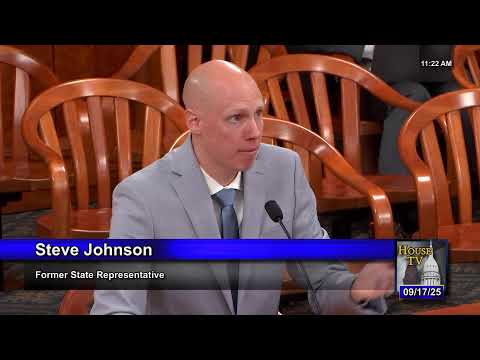
Former state lawmaker urges Michigan to curb corporate subsidies, cites Foxconn, MEDC transparency concerns
Summary
Former state Representative Steve Johnson told the House Oversight Subcommittee that corporate subsidies routinely fail to deliver promised jobs and undermine public trust; he urged stronger oversight, interstate compacts and limiting state-directed handouts.
Steve Johnson, a former state representative and a fellow at the Center for Practical Federalism, told the Michigan House Oversight Subcommittee on Corporate Subsidies and State Investments on Sept. 17 that the state should sharply restrict corporate subsidies and improve oversight of programs such as those administered through the Michigan Economic Development Corporation (MEDC).
Johnson told the committee that corporate subsidies pose moral and practical problems. “Corporate subsidies at its very core is you’re taking some money that isn’t yours,” he said, adding that the practice often amounts to “stealing from Peter to pay Paul.” He said most headline-grabbing subsidy deals do not produce the jobs promised, pointing to a Mackinac Center analysis that found roughly 9% of announced projects delivered the advertised outcomes.
The testimony centered on three arguments Johnson said justify limiting subsidies: the morality of redistributing taxpayer dollars to large private firms, the poor record of subsidy programs in producing net new jobs, and constitutional limits on appropriating public money for private purposes. Reading language from the Michigan Constitution, he cited Article IV, Section 30: “the assent of two thirds of the members elected to and serving in each house of the legislature shall be required for the appropriation of public money or property for local or private purposes.” Johnson said some budget line items appear tailored to single recipients and may be used to evade that two-thirds requirement.
Johnson walked the panel through historical episodes he said demonstrate the limits of subsidy-based economic development. He described the 2017 effort to recruit Foxconn, which promised roughly 13,000 jobs, and said Michigan’s offer was in the “about $3.8 billion” range while Wisconsin’s offer was about $3 billion; he said Wisconsin’s project ultimately fell far short of original projections. “No one even talks about Foxconn now,” Johnson said, arguing the episode shows the state risk of treating one company as transformational.
Johnson also criticized the MEDC’s transparency and legal status, urging the committee to pursue retrospective oversight of past deals rather than focus only on the most recent projects. He said the MEDC “operates as if they’re a government agency but also not a government agency” and cited outstanding public-record disputes.
Committee members pressed Johnson on remedies. He recommended two primary reforms: (1) broader oversight and periodic audits of past subsidy deals so failures are not simply forgotten, and (2) multistate agreements or compacts—particularly among Great Lakes states—to limit interstate bidding wars for projects. “Let’s knock off that arms race,” Johnson said, arguing states should instead compete on fundamentals—low energy costs, a skilled workforce and a predictable tax and regulatory environment—rather than on one-off payments.
During questions, Johnson highlighted examples from recent budgets he said demonstrate targeted allocations that appear designed for single recipients, citing language that requires awards to entities in narrowly defined townships or counties and a separate appropriation that he described as “not less than $2,000,000” to support a woman-owned, minority small business in a city of at least 600,000. He said such specificity raises concerns about both fairness and compliance with the two-thirds constitutional threshold.
Committee members who participated in the discussion included Chair Cara; Representative Bierlein, who opened the meeting and moved routine motions on minutes and adjournment; Minority Vice Chair Wigela, who asked about program changes and the expanded use of brownfield tax credits; and Representative Beierlein, who asked whether constitutional challenges had been pursued in court. Johnson noted that the Mackinac Center has litigation pending challenging some uses of subsidies and that bipartisan support for the practice historically has limited earlier legal challenges.
No policy vote followed Johnson’s testimony. The committee approved the minutes from its Sept. 10 meeting and later moved to excuse absent members by unanimous consent; those procedural actions were the only formal motions recorded. The committee adjourned after the testimony and member questions.
Why it matters: Johnson’s testimony provides the subcommittee a policy and constitutional framing for continued oversight of state economic-development incentives. His recommendations—longer-term retrospective review of past deals, tighter statutory definitions for targeted awards, interstate compacts to reduce bidding wars, and greater transparency at the MEDC—map directly to tools the legislature could use without adopting new, large-scale subsidy programs.
Votes at a glance: Representative Bierlein moved to approve the Sept. 10 minutes; the motion carried without objection. Representative Bierlein later moved to excuse absent members; the motion prevailed by unanimous consent.