Get Full Government Meeting Transcripts, Videos, & Alerts Forever!
Get email alerts on the Blue Water Bridge Plaza Expansion topic
No spam. Unsubscribe anytime.
House subcommittee hears Blue Water Bridge expansion plan, funding needs and operational pressures
Summary
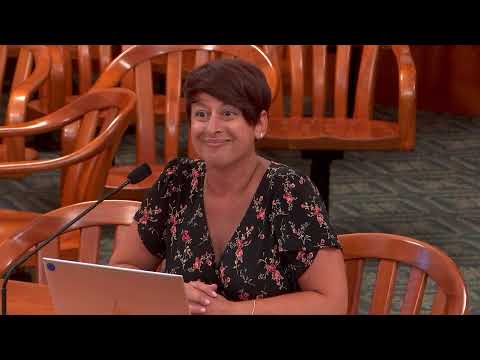
Members of the Michigan House Appropriations Subcommittee on State and Local Transportation heard a briefing on the Blue Water Bridge plaza expansion, operations and funding from Blue Water Bridge Administrator Amy Wynne and House Fiscal Agency staff.
Members of the Michigan House Appropriations Subcommittee on State and Local Transportation heard a briefing on the Blue Water Bridge plaza expansion, operations and funding from Blue Water Bridge Administrator Amy Wynne and House Fiscal Agency staff on May 2025 (meeting date not specified in transcript).
Wynne told the committee the bridge — an MDOT entity that shares its spans with Federal Bridge Corporation Limited on the Canadian side — is self-funded through tolls, duty‑free lease revenue and facility leases to federal agencies. "We are about a 60% commercial crossing," Wynne said, adding that commercial traffic generates the majority of toll revenue and that the bridge is currently the busiest commercial crossing between the U.S. and Canada.
The committee was presented budget and capital figures for current and planned work. House Fiscal Agency staff highlighted several line items that include Blue Water Bridge funding in the current-year budget packet, including debt service for prior bonds, an ongoing operations appropriation paid from a state‑restricted Blue Water Bridge fund and a one‑time appropriation for equipment and facilities.
Wynne outlined the multi‑component plaza expansion. Component 1 is funded and under construction; it includes intersection reconfiguration, relocation of the Pine Grove connector ramp, noise wall installation and alterations to the I‑94 connection, with most work expected to finish during the current construction season and remaining noise‑wall work extending into 2026. Component 1 is budgeted in the low tens of millions: Wynne cited a roughly $40 million construction price tag for component 1 and later said the plaza component 1 budgeted amount is $46,000,000 with $11,600,000 spent to date. She said a $25,000,000 INFRA grant is being applied to component 1.
Component 2, which Wynne described as the larger funded phase of the plaza expansion, will move MDOT tolling operations and the duty‑free store inside the plaza, create a plaza loop to improve commercial traffic flow, build a maintenance cold‑storage area, realign local access, and add outbound inspection booths and a CBP facility. Wynne said the expected cost for component 2 is approximately $300,000,000; procurement had been advertised in May 2025 with technical proposals expected to be evaluated in January 2026 and a contract award projected for March 2026. Substantial construction, Wynne said, would likely begin in 2027 and could last two to three years depending on the design‑build team's schedule.
Components 3 and 4 are contingent on federal tenant commitments. Wynne said those later components are primarily federal CBP/Homeland Security infrastructure; GSA and CBP have not yet committed to leases or funding that would permit MDOT to build those spaces. Wynne provided a cost range for components 3 and 4 (not including tenant furniture, fixtures and equipment) of $379,000,000 to $714,000,000 and described a most‑likely midpoint estimate of about $562,000,000. She said the estimates were derived from a cost schedule risk analysis workshop with FHWA and subject matter experts and warned that later phases will escalate in cost if delayed.
Wynne reviewed recent capital spending and operations: she said the bridge collected roughly $21,976,000 in FY2024 revenue; reported capital expenditures of about $69,600,000 between Oct. 1, 2022 and April 30, 2025; cited a $35,000,000 Blue Water Bridge contribution toward relocating a DTE substation (a total DTE substation project cost Wynne placed at about $115,000,000); and said FY2024 operating expenses as presented in the packet. She also said the bridge will implement a $1 toll increase in December 2025 that is expected to generate about $6,000,000 in additional annual revenue.
Committee members questioned financing choices, bond plans and staffing. Wynne said the bridge has remortgaged bonds in the past, that a bond tied to component‑2 work would likely be issued by the Blue Water Bridge entity (not MDOT), and that borrowings for component 2 are not expected to be needed until around 2027. She described a long‑range asset management plan for maintenance needs and said the Blue Water Bridge maintains a capital “savings” account used for recent capital work.
Members also raised traffic backups on I‑69 and asked whether traffic will shift to the Gordie Howe International Bridge when it opens. Wynne said planners expect only a small diversion — about 6% — and noted that the Gordie Howe crossing will carry hazardous material loads that currently pass through other crossings. She said that many observed backups stem from federal passenger‑processing capacity at CBP/CBSA and from periodic lane closures tied to staff rotations and construction, not from MDOT tolling operations alone. "We have 24‑7 operation centers, and we are constantly communicating" with U.S. and Canadian partners, Wynne said.
Committee members pressed on tolling policy and the bridge's cashless operation. When asked whether the plaza accepts cash, Wynne replied, "We do not." She said the bridge's legal counsel and the attorney general's office reviewed the move to cashless operations and determined it was permissible; she added that most tolling facilities are moving to cashless systems. Wynne described the Edge Pass prepaid program (about 12,000 accounts) that provides a $0.50 discount and an unmanned dedicated lane for frequent crossings.
Members also asked about the effect of proposed budget reductions on Blue Water Bridge staffing and operations. Wynne said the bridge's appropriation reflects projected self‑generated revenue and that a proposed reduction of staff and funds could affect the bridge's ability to maintain current service and condition because the operation runs with about 47 full‑time equivalent positions.
The committee formally adopted the minutes of its Sept. 10 meeting by unanimous consent before the Blue Water Bridge briefing. There were no further formal actions recorded in the transcript.
The hearing closed after a short question period; Wynne and staff said they would continue coordinating with federal partners on tenant commitments and operations.