Get Full Government Meeting Transcripts, Videos, & Alerts Forever!
Get email alerts on the Retirement Health Insurance topic
No spam. Unsubscribe anytime.
TRS staff outline TRIP and TRAIL enrollment steps, premiums and new Medicare "family split"
Summary
Teachers' Retirement System staff explained eligibility, enrollment timelines, premium amounts and a new "Medicare family split" that allows some dependents to remain on TRIP while Medicare-eligible members move to TRAIL, and clarified roles of TRS, Illinois Central Management Services and MyBenefits Service Center.
The Teachers' Retirement System (TRS) provided retirees and beneficiaries detailed guidance on enrolling in TRIP and TRAIL, explaining eligibility, timelines and premiums during a virtual webinar. TRS staff also described a change, effective July 1, 2025, that allows some family members to remain on TRIP while a Medicare-eligible person moves to TRAIL.
The information matters because the programs determine retirees' primary health coverage, out-of-pocket costs and the administrative steps retirees must take with Social Security, TRS and the state's plan administrator. TRS said the change to allow mixed TRIP/TRAIL coverage could alter monthly premiums for households with mixed Medicare eligibility.
TRIP, TRS said, is the Teacher's Retirement Insurance Program that provides medical, prescription drug, vision and dental coverage for TRS retirees before they are Medicare-eligible. TRIP open enrollment generally occurs in May with coverage effective July 1. TRAIL (Total Retiree Advantage Illinois) is the Medicare Advantage option available once a retiree enrolls in Medicare Parts A and B; its open enrollment aligns with Medicare (roughly Oct. 15–Nov. 15) and is effective Jan. 1.
A TRS staff member identified in the webinar as Sandy (TRS staff member) said, “Trip is the teacher's retirement insurance program, and this is your health insurance, prescription drug, vision, and dental.” She added that TRAIL is a Medicare Advantage PPO through Aetna that also includes prescription drug, dental and vision coverage.
Eligibility and administrative roles TRS staff said a retiree or beneficiary must have at least eight years of TRS service credit to enroll in TRIP or TRAIL; if much of a person's credit is from a reciprocal system, at least eight years must be specifically with TRS. TRS will determine eligibility and withhold monthly premiums from pensions. Illinois Central Management Services (CMS) serves as the state plan administrator and negotiates carriers and pricing. MyBenefits Service Center is the third-party organization that handles enrollments.
New "Medicare family split" TRS staff explained a change effective July 1, 2025: when one covered person becomes Medicare-eligible, that person will move to TRAIL while other covered persons who are not Medicare-eligible may remain on TRIP. As Sandy summarized, “The change is this, when someone becomes Medicare eligible, they will go on trail at that time, and the other person or people... will stay on trip.” This replaces the earlier practice that required all covered persons to remain on TRIP until everyone on the policy became Medicare-eligible.
Premiums and cost responsibilities TRS provided per-person, per-month premium figures on the webinar. For members not yet on Medicare (TRIP): HMO/open access premiums were shown as $3.70 per month for the member, $14.83 for a spouse and $4.84 per dependent child; PPO premiums were shown as $8.57 for the member, $17.26 for a spouse and $6.24 per dependent child. For TRAIL (Medicare Advantage through Aetna), TRS listed a member premium of $7.35 per month and a dependent premium of $27.14 per month; these TRAIL premiums are in addition to any Medicare Part B premium set by the federal Social Security Administration.
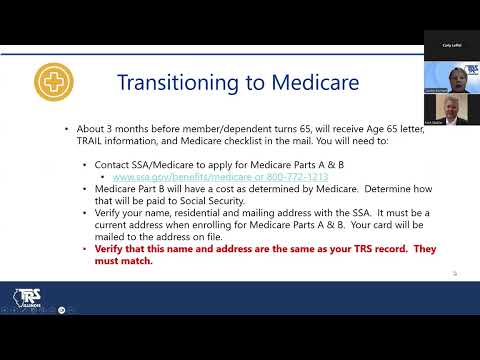
TRS staff emphasized that Medicare Part B carries a separate cost determined by Medicare based on household income and paid to Social Security, not to TRS. As Sandy said, “Medicare Part B does have a cost. ... TRS does not know how much that will be.” If a retiree receives Social Security benefits, Social Security can deduct the Part B premium from that benefit; otherwise, retirees must arrange payment with Social Security.
Enrollment timing and steps TRS staff recommended beginning the Medicare application process about 60–90 days before turning 65. The steps described in the webinar: - Apply for Medicare Parts A and B through the Social Security Administration (SSA) online or by phone; Part A is usually free, Part B has a premium based on income. - Verify that name and address on SSA/Medicare match TRS records; update records with SSA and TRS if needed. - When the retiree receives the Medicare card showing Parts A and B, upload or mail a copy to TRS so TRS can confirm Medicare eligibility. - If not already enrolled in TRIP but wishing to enroll in TRAIL when Medicare is reached, call TRS to request a participation election form and submit it with a copy of the Medicare card. - Contact MyBenefits Service Center (phone given in the webinar as (844) 251-1777) by roughly the 20th–25th of the month prior to the desired effective date to elect TRAIL.
TRS described how coverage transitions happen: TRIP coverage automatically cancels on the last day of the month before Medicare takes effect and TRAIL takes effect the next day, preventing a coverage gap. TRS staff noted an exception for people who never paid into Medicare (rare for current TRS beneficiaries); those individuals would receive a notice from Medicare and would remain on TRIP if not Medicare-eligible.
Questions TRS could not fully answer during the webinar Several participant questions were forwarded for individual follow-up. TRS staff indicated they could not always confirm whether certain deductibles or accumulated amounts (for example, a year-to-date Delta Dental deductible) would carry over into TRAIL and recommended contacting TRS insurance supervisors or carriers for those specifics. On prescription drugs, staff advised participants to review TRAIL materials and the carrier formulary (Aetna) because TRS cannot predict how specialty or specific drugs would be categorized.
Other clarifications from TRS staff - TRAIL is treated as a new program and often issues new ID cards; deductibles and out-of-pocket totals can reset when switching programs because TRIP runs July 1–June 30 while TRAIL uses a calendar year. - While on TRAIL, members do not separately enroll in Medicare Part D; prescription coverage is included in the Medicare Advantage plan. - TRS will automatically terminate TRIP when a covered person becomes Medicare-eligible; retirees do not need to submit a separate TRIP termination letter.
Tapered close TRS encouraged members to attend CMS open-enrollment meetings (state-hosted, sometimes with carrier representatives present) and to begin the Medicare application well before a 65th birthday to allow time for SSA processing. Staff advised calling TRS or MyBenefits Service Center with specific enrollment intentions or carrier questions so staff can guide enrollment and documentation steps.