Get Full Government Meeting Transcripts, Videos, & Alerts Forever!
Get email alerts on the General Government Operations And Appropriations topic
No spam. Unsubscribe anytime.
Guam Legislature advances $40 million for Guam Memorial Hospital with reporting and emergency procurement measures
Summary
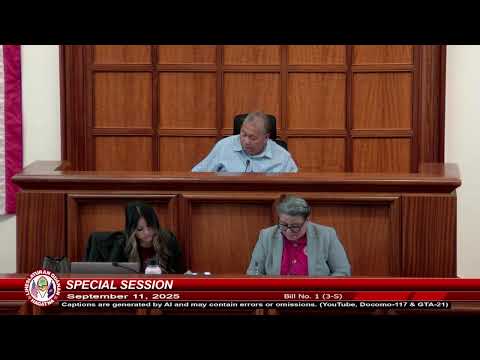
The Guam Legislature’s Committee of the Whole advanced Bill 13‑S, an appropriation of $40 million to the Guam Memorial Hospital Authority (GMHA), and approved amendments to deliver the money directly to GMHA, require quarterly expenditure reports, and allow limited emergency procurement for electrical and IT systems.
The Guam Legislature’s Committee of the Whole advanced Bill 13‑S, which would appropriate $40,000,000 from the general fund to the Guam Memorial Hospital Authority for operational costs and capital improvements. Lawmakers attached amendments that (1) direct the funds straight to GMHA rather than routing them through the Department of Administration, (2) require quarterly reports on receipt and expenditure, and (3) permit limited emergency procurements for electrical and information‑technology systems upon an emergency declaration.
Why it matters: The hospital has reported large accounts receivable and unpaid vendor balances that lawmakers said have affected supply chains and operations. Committee members repeatedly cited procurement bottlenecks and past instances in which delayed or misdirected state payments left vendors unpaid or funds unspent. The package is intended as a stopgap to stabilize hospital operations while further oversight and potential statutory changes are considered.
Committee debate and amendments Senator Borja offered and won an amendment to have the $40 million go directly to the Guam Memorial Hospital Authority rather than routing the appropriation through the Department of Administration. "Give the money straight to GMH rather than funneling ... having it go to DOE and then transferring it," Borja said on the floor, urging that direct delivery would speed vendor payments and reduce duplicated steps.
Senator Barnett and several colleagues supported that amendment, saying routing the money through DOA could create communication gaps or delays. Barnett said colleagues had heard from GMHA that the hospital preferred direct access: "It kind of seemed like it would be duplication of efforts ... let DOA call GMH and say, 'hey, we paid this vendor' — but sometimes it's very, challenging for the left hand to talk to the right." (Sen. Barnett)
Senator Perez’s amendment requiring quarterly allocation and expenditure reports from GMHA also passed. Perez said the reporting requirement was meant to "keep tabs" on progress, ensure solicitations proceed and that payables are addressed so vendors resume supplying the hospital.
Senator Gumitato (spelled in the record as Gomitato/Gumitato) offered an amendment to give the governor authority to prioritize vendor payments and facility repairs under the existing appropriation; members amended the language to strike Department of Administration where necessary to remain consistent with earlier changes, and the amendment passed. Senator Gomitato described the bill as a "stopgap" and urged disciplined oversight of expenditures in FY25.
Senator Tydegui proffered and the committee approved an emergency‑procurement amendment that would, upon an emergency declaration pursuant to the cited provisions of Guam law, authorize GMHA to spend up to $5,000,000 from the appropriation to replace, repair or maintain its electrical system and up to $5,000,000 for information‑technology infrastructure as allowed by the cited procurement statute. Tydegui said procurement bottlenecks had previously contributed to lost federal ARP funding and that limited emergency procurement authority could help avoid similar losses.
An amendment by Senator Saint Augustine to add GMHA to the list of agencies exempted from the Central Accounting Act (allowing GMHA to operate outside DOA accounting controls) was debated and failed on a recorded vote. Opponents warned that fully exempting GMHA without accompanying statutory accounting controls and enabling‑act changes could complicate audits and budget transparency.
Financial status and fiscal context GMHA representatives told the committee that gross accounts receivable stand near $400,000,000, with roughly $225,000,000 in a self‑pay over‑one‑year bucket that the hospital expects will be largely uncollectible. "Right now, our accounts receivable gross aging ... is at 400,000,000. And about 225,000,000 of that is under our self pay over 1 year bucket," a GMHA representative said. The hospital also reported about $5,000,000 in amounts billed to insurance companies that are currently collectible.
Committee staff and executive branch officials briefed senators on lapse funds and transfer authority. A fiscal office report cited a general‑fund bottom line and projected lapses, but staff cautioned that expenditure trends in the final months of the fiscal year could reduce or eliminate anticipated lapses. Director Byrne (Department of Administration) and another executive official answered procedural questions about timing, procurement, and cash flow; the director emphasized the need to ensure cash is available at the time invoices arrive.
Procedural outcome The Committee of the Whole voted to place Bill 13‑S, as amended, into the third reading file. The committee also recorded a roll call on the bill title as read on the floor.
What the bill does not do (yet) The package does not change GMHA’s enabling act to add comprehensive internal accounting policies. Opponents of the Saint Augustine amendment argued the enabling act lacks the required fiscal controls for a full exemption from central accounting, and they urged a separate bill or public hearing to address those statutory details before making a permanent change.
Next steps Committee leaders moved the amended bill to third reading. The Legislature recorded the bill title and a roll call during the session; the bill then moved forward for further legislative processing as the body completed the special session.
Ending note Lawmakers repeatedly framed Friday’s action as an urgent, targeted response to stabilize the island’s only public hospital while reserving broader reforms for additional hearings and statutory changes.