Get Full Government Meeting Transcripts, Videos, & Alerts Forever!
Get email alerts on the Eminent Domain topic
No spam. Unsubscribe anytime.
Senate committee clears bill limiting how long government may hold land taken by eminent domain
Summary
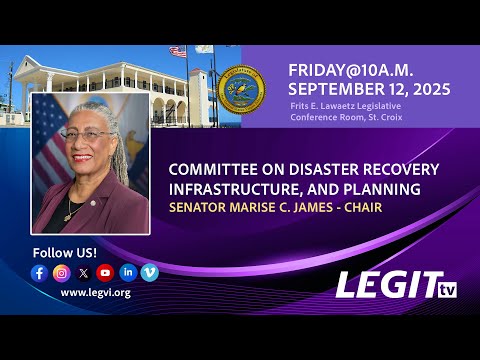
The Senate Committee on Disaster Recovery, Infrastructure and Planning forwarded bill 36‑0070 to Rules after approving an amendment that shortens the additional period the government may keep previously acquired property and tightens the definition of "initiated" construction.
The Committee on Disaster Recovery, Infrastructure and Planning voted to forward bill 36‑0070 — an act to add section 4‑23 to Title 28, Virgin Islands Code (failure to use property acquired through eminent domain) — to the Committee on Rules and Judiciary after approving an amendment changing how previously acquired parcels are handled.
The bill, introduced by Senator Alma Francis Heiliger, would limit how long the government may keep property acquired by eminent domain if it does not put the property to the public use intended at the time of acquisition.
Lawmakers said the change is meant to protect families whose land was taken for public projects but then not used. Senator Alma Francis Heiliger said the bill responds to long delays she has heard about in the territory: “We cannot keep taking people’s properties, and there’s no ramifications to the government,” she said during her presentation. She also described a proposed definition of “initiate” to prevent last‑minute token work: “initiate means that at least 10% of the project has already been started and completed,” she told the committee during the hearing.
Why it matters: Supporters said the measure restores a remedy for owners whose property was taken and then remained unused for decades. Opponents and some fellow senators pressed for stronger accountability and expressed concern about the impact on owners now and the burden of repurchasing property if market values have risen.
What the committee changed: The committee adopted an amendment introduced by Senator Hubert L. Frederick that modified the sponsor’s language. The amendment (36‑519) (a) applies a time limit to newly acquired property (25 years), (b) creates an additional transition period for parcels already in government possession at the time the law takes effect, and (c) tightens the measurable progress threshold the government must show before an owner may seek return of the land. In committee debate Frederick described the measurable‑progress threshold in his amendment as “initiating means at least 25% of the project’s physical construction or build out is completed.” He moved the amendment, and the clerk recorded the roll call on the amendment as 5 yeas and 2 nays (see Actions below).
Procedural outcome: After the amendment passed on the committee floor, the committee voted to forward the amended bill to the Committee on Rules and Judiciary with a favorable recommendation. The roll call on the final motion recorded seven yeas and no nays.
Key implementation details in the amended measure
- New acquisitions: The bill limits newly acquired property by eminent domain to a 25‑year period in which the government must use the land for the public purpose stated at acquisition. - Existing holdings: Parcels that the government already holds when the act becomes law receive an additional, limited extension (the committee amendment added a 5‑year transition period for those pre‑existing parcels). - Measurable progress and reporting: The amendment requires the Commissioner of Property and Procurement to submit a progress report to the Legislature every two years, documenting proposed public use, project planning, funding or permits, and any measurable progress toward initiating the project. - Initiation standard: The committee amendment defines “initiated” as at least 25% of the project’s physical construction or build out completed. If the government fails to initiate the project within the prescribed period the previous owner or heirs may petition the Superior Court for return of the property, subject to repayment of the original compensation the owner received when the land was taken.
What supporters and critics said
Supporters: Senator Alma Francis Heiliger said the bill is meant to balance government needs and private property rights after decades when some parcels were taken and never used. She recounted reported cases in which land taken for “public use” was later leased to private entities.
Critics and concerns: Several senators expressed concern the transition period would delay owners’ ability to reclaim property — calling the additional time an unwelcome extension for families who had expected the 25‑year limit to operate immediately. Senator Angel L. Bocas Jr. said the 25‑year period is already “a long time” and questioned whether the 25% initiation threshold should be higher.
Next steps: The measure, as amended, will go to the Rules and Judiciary Committee for further consideration.
Ending note: The committee also instructed the sponsoring office to consider clarifying language in a future amendment about the amount owners must return to the government if they successfully reclaim property (committee members said the bill should make clear the amount returned is the original compensation paid by the government, not a current market value).