Get Full Government Meeting Transcripts, Videos, & Alerts Forever!
Get email alerts on the Assessment Districts topic
No spam. Unsubscribe anytime.
Vista reviews assessment-district finances after Prop. 218 ballots fail; staff proposes phased subsidy reductions
Summary
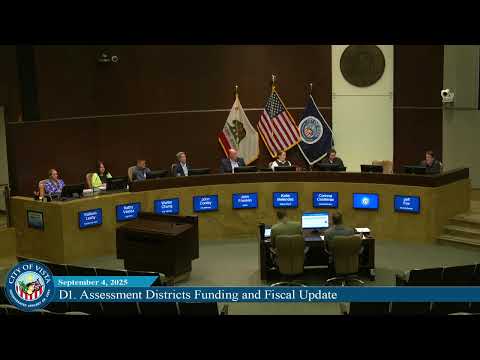
At a special workshop, Vista city staff told the City Council that replacement balloting for two of the city's three assessment districts failed and presented options to address shrinking purchasing power in the districts.
At a special workshop, Vista city staff told the City Council that replacement balloting for two of the city's three assessment districts failed and presented options to address shrinking purchasing power in the districts.
Finance Director Mike Sylvia said the three assessment districts ' Landscape and Lighting Maintenance District (LLMD) No. 1, a citywide street maintenance district, and the South Melrose Landscape and Lighting Maintenance District ' have not increased assessments since Proposition 218 restrictions took effect in the late 1990s. "The ballot did fail, nearly 2 to 1, with almost 64% of the property owners returning ballots saying no and just over 36% saying yes," Sylvia said, summarizing the two-phase outreach and balloting effort in 2023'24 and 2024'25.
The failed ballots, rising costs and limited fund balances mean the city faces tradeoffs between reducing services within the districts, continuing to subsidize them from the general fund, or reballoting. Staff presented three options: (1) run new Proposition 218 ballots, (2) reduce expenditures to match static assessment revenues, or (3) continue a general‑fund subsidy to maintain current service. Staff recommended a phased version of option 2.
Why this matters: LLMD No. 1 and the street maintenance district provide street lighting, traffic signal maintenance, median and parkway landscaping, pothole repair, sweeping and occasional slurry seals. Those services have both safety and public‑facing quality implications; continuing to subsidize static assessments indefinitely would increase pressure on the general fund, staff said.
Key numbers and staff estimates - Current-year assessment revenues (approx.): LLMD No. 1 ' $1,400,000; Street Maintenance District ' $325,000; South Melrose LMD ' $123,000. (Amounts presented by staff.) - Ballot results: South Melrose and LLMD No. 1 replacement ballots each failed by roughly two to one among returned ballots; the street maintenance district was closer but still a majority "no." (Sylvia) - Fund balances: street maintenance shows about $425,000 in the fund but roughly $400,000 is earmarked for a slurry project, leaving about $35,000 in unencumbered balance; South Melrose has about $2,000. (Sylvia) - General‑fund subsidy history and projections: staff said the subsidy to LLMD No. 1 through fiscal 2024 totaled about $4.9 million and with transfers set to occur would reach about $5.2 million through fiscal 2025. To continue subsidizing current service levels staff estimated a 10-year cost of about $6.3 million under conservative escalation assumptions (and as much as about $7.5 million under a higher escalation scenario discussed by staff). Staff identified the current annual LLMD No. 1 subsidy at roughly $527,000.
Staff recommendation and operational examples Sylvia said staff's recommended approach would preserve the current general‑fund subsidy through the current fiscal year, reduce the subsidy to the pre‑2025 level of about $275,000 in fiscal 2026'27, and eliminate the subsidy beginning in fiscal 2027'28 under the proposed biennial operating budget. Sylvia said that phased plan would save roughly $5.5 million over 10 years.
Public Works Director Chris Arcey outlined service cuts that would be required under option 2, including reducing weed abatement contract services, cutting emergency tree maintenance budgets, reducing utilities and operating expenses for electrical cabinets by 20% to 50% over two years, and moving contracted tree trimming from a four‑year cycle to an eight‑year cycle in the second year of cuts.
Council questions and concerns Council Member Contreras said she appreciated the public balloting and the staff work but raised concerns about tree canopy and liability, asking whether reduced pruning frequency could raise safety risks. Arcey said the city currently trims on a four‑year cycle and inspects trees; moving to eight years would likely reduce tree health and increase the risk of falling branches and long‑term costs.
Mayor (not identified by name in the record) spoke strongly against immediate deep reductions. "I can't support any of the reductions that have been offered here in option 2," the mayor said, urging a holistic budget review and proposing the city consider an efficiency study or convene local business leaders to identify savings before cutting landscaping and tree maintenance.
Deputy Mayor Melendez and Council Member Fox voiced a mixture of caution and support for phased changes. Melendez emphasized that voters had declined to increase assessments and said staff should prioritize landscaping where it yields greatest public benefit. Fox urged a gradual, phased tapering instead of abrupt changes, suggesting single‑percentage annual savings or small changes (for example, moving from a four‑year to a five‑year trimming cycle) rather than an immediate change to eight years.
Other technical and capital considerations - Solar streetlight conversion: staff said the city has just under 4,700 streetlights citywide, about 1,000 of which are owned by SDG&E. Staff estimated a systemwide changeover to solar would cost roughly $39 million: about $22 million to retrofit the roughly 3,700 city‑owned fixtures (about $6,000 per fixture for the luminaire only) and about $17 million to replace SDG&E‑owned fixtures and poles. Sylvia noted ongoing CIP work on a solar streetlighting project (originally $1.85 million), about $150,000 of which is spent or encumbered and with a forthcoming phase to install roughly 85 lights that would use nearly $1.5 million of the remaining CIP funding. - Lifecycle and operating costs: staff estimated solar panel and battery replacements at about $80 per light per year (on a 10‑year replacement cycle) versus about $87 per light per year for current electric utility and LED maintenance, yielding modest narrow annual operating savings of roughly $33,000 citywide (about $7 per light per year), exclusive of large up‑front capital costs. Sylvia cautioned future input prices are uncertain. - Traffic signals: the city's electricity budget for the year was shown around $499,000 total, with about $110,000 for traffic signals and about $390,000 for street lighting; a separate traffic signal maintenance contract runs about $214,000 per year. - Median landscaping conversion: staff said contractor bids to convert medians to drought‑tolerant plantings and hardscape had been obtained; one slide cited an aggregate figure of about $7,700,000 to convert medians across the city. Multiple council members discussed phasing conversions and pilot projects; staff said established drought‑tolerant plantings can reduce ongoing median maintenance by about 30% to 35% once established (around two years after installation).
Next steps requested by council Council members asked staff to return with more granular information before directing cuts: GIS mapping of street trees and medians, a liability assessment and inspection frequency analysis for tree maintenance, renderings and maps showing medians that would be affected, pilot designs for drought‑tolerant median conversions, an analysis of replacing signalized intersections with roundabouts (including costs and lifecycle comparisons), and follow-up on whether SDG&E would allow isolated conversion of fixtures when poles are replaced after crashes. Multiple council members also asked management to compile a broad list of potential budget savings across departments to allow council prioritization rather than single‑item cuts.
There was no formal council vote at the workshop. Staff left the meeting with direction to provide additional analyses and materials for future budget deliberations.
The council closed the special workshop after further procedural remarks and brief announcements.