Get Full Government Meeting Transcripts, Videos, & Alerts Forever!
Get email alerts on the Environment Leaf Blowers topic
No spam. Unsubscribe anytime.
Commission weighs gas leaf-blower prohibition rules; majority favor a nine-month enforcement delay and penalties tied to property owners
Summary
City staff presented options to prohibit gas leaf blowers; commissioners generally recommended a phased enforcement window (about nine months), targeted outreach and penalties that can be assessed to property owners, with disagreement about extending limits citywide.
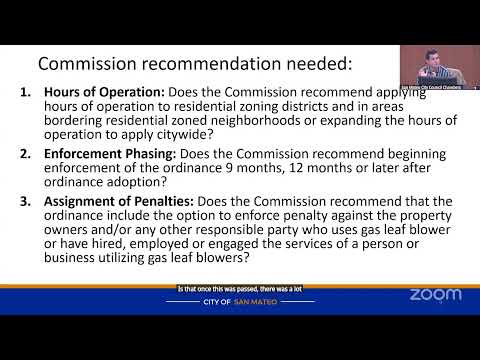
City sustainability staff presented options for updating San Mateo's leaf-blower regulations on Sept. 10, and commissioners provided recommendations on hours, enforcement phasing and penalty assignment ahead of a City Council study session.
Andrea Chow, the citys sustainability analyst, summarized state and local context: state rules prohibit the sale of some new gas-powered landscaping equipment starting with certain model years (the presentation said new 2024+ models must be electric), but existing gas equipment in use is not affected by state sales restrictions. Chow reviewed the citys existing hours for residential-adjacent properties (8 a.m. to 5 p.m. weekdays; 9 a.m. to 5 p.m. Saturdays), the citys rebate program (resident rebates up to $100 and landscaper/business rebates up to $500 with historical averages of about 19 resident and 4 business rebates yearly), and that city operations have transitioned to electric equipment under a Peninsula Clean Energy grant.
Chow told commissioners that enforcement is operationally challenging because leaf-blower use is often brief and requires an on-site witness for a code enforcement citation. She presented sample enforcement delays used in other Bay Area cities (Burlingame used nine months; Menlo Park used 12 months) and explained the citys administrative citation structure (warning(s) followed by escalating fines, typically $100 then $200 then $500 under the citys administrative citation process).
A resident offered public comment describing long-term nuisance and air-quality concerns from nearby gas-powered landscaping crews and told the commission that homeowners should be responsible for who they hire.
Most commissioners favored a nine-month delay between ordinance adoption and active enforcement to allow residents and landscape businesses to transition and to allow rebates and outreach to be used effectively. Commissioners generally opposed applying the residential hours rule citywide because many downtown and commercial properties require early clearing for safety and to avoid conflicts with vehicles; several commissioners said they would defer the final decision on zoning scope to code enforcement staff.
Commissioners largely supported assigning penalties to property owners (the homeowner or business that hires or contracts landscaping services) so that enforcement targets the party that controls hiring decisions. Commissioners discussed graduated warnings and fines and raising rebate uptake through better outreach; one commissioner suggested increasing business-rebate amounts and pairing rebate outreach with business-license outreach for local landscapers.
Commissioners also discussed whether to expand the ban to other small gas-powered equipment (string trimmers) and whether to provide additional enforcement resources. Staff said the City Council will review the ordinance options at a study session scheduled for Oct. 6 and that a fixed implementation date following council direction would be developed; staff estimated a realistic implementation window could be in early 2026 depending on Council direction and the chosen enforcement delay.
No formal vote was taken on the ordinance at this meeting; staff said they would present the commissions recommendations to the City Council at the October study session.