Get Full Government Meeting Transcripts, Videos, & Alerts Forever!
Get email alerts on the Building Maintenance topic
No spam. Unsubscribe anytime.
City consultants warn water intrusion, mortar failure threaten Hilltop building; short-term fixes recommended
Summary
Consultants told the Herington City Commission that water entry—driven by failing mortar on parapet walls, roof ponding and exterior grade issues—is the most urgent problem at the Hilltop building. They recommended repointing, roof drainage improvements and low-cost interim fixes such as dehumidifiers while the city evaluates longer-term options.
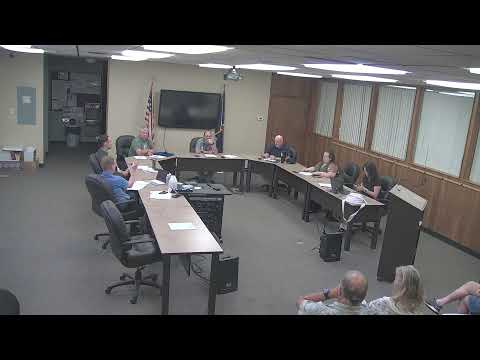
Consultants told the Herington City Commission on Sept. 16 that water intrusion is the most urgent problem at the Hilltop building and auditorium, and recommended repointing brick mortar, improving roof drainage and addressing below-grade drainage before the structure suffers more extensive damage.
The consultants, identified at the meeting only as Julie and John, presented the findings of a recent condition assessment and described a mix of immediate, near-term and long-term needs. “The biggest enemy of an old building is water,” John said, describing how failing mortar and ponding on flat roof areas let moisture enter brick and masonry and accelerate freeze-thaw damage.
The report matters because the structure houses apartments, an auditorium and other public spaces that the city would like to keep in use. City staff said the report gives a “game plan” for prioritizing safety improvements and preserving a useful public venue while the commission evaluates budgets and possible contractors.
Consultants’ findings and recommendations
John and Julie told the commission that repointing — removing loose mortar from exterior joints and replacing it with stronger mortar at the exposed faces — is the priority to limit water entry. They said the worst areas are the unheated parapet walls and upper exterior masonry, where freeze-thaw cycles are already causing mortar and brick deterioration.
John described the repointing process and material recommendation: remove deteriorated mortar to roughly an inch to inch-and-a-half depth, and use a Type S mortar for the exterior face. He warned that once a brick wall begins to lean substantially, the damage is often not economically fixable.
Julie pointed to visible interior signs of wall leakage: bubbling, flaking and cracking of plaster in the auditorium addition and staining in lower-level offices and cafeteria spaces. She told commissioners the inspection found four locations with standing water or clear recent below-grade intrusion; the consultants linked that to exterior concrete and stair grades that direct water toward the building.
Roof and mechanical systems
The consultants said the flat roof performs “good to excellent” overall but identified ponding and isolated leaks that should be addressed to prevent ongoing damage. “The goal on a flat roof is to have any water off the roof within 24 hours,” John said, noting that ponding encourages leaks to worsen and to find the smallest membrane imperfection.
They also flagged the auditorium rooftop HVAC unit as a possible large expense if it cannot be repaired, and recommended first exploring repair options. John offered an order-of-magnitude example used in discussion: replacing a large rooftop unit can be costly (one consultant cited a roughly $67,000 reference figure), so contractors willing to try repairs should be considered before replacement.
Short-term, low-cost measures
The consultants suggested several relatively low-cost measures that city staff could implement promptly. For example, they recommended using portable dehumidifiers in high-humidity rooms such as the kitchen storage area; Julie said quality portable units can be purchased for about $250 each and can mitigate mold and corrosion risks until larger repairs are made. They also recommended sealing gaps in exterior walks and joints with expanding foam and urethane sealant as an interim measure to reduce water entry.
Accessibility and safety items received attention as well. City staff reported buying dehumidifiers immediately after receiving the report and said minor safety upgrades — handrails and covers over exposed wiring — are already being planned. The consultants noted that some upper-level repointing will raise access costs (man lifts or scaffolding) and that masonry specialists can be costly but yield the best long-term results.
Commission and staff response
City staff and commissioners discussed next steps: prioritizing immediate water-control measures, getting contractor bids for repointing and roof repairs, and exploring repair-versus-replace options for the HVAC rooftop unit. Megan, identified in the meeting as city staff, emphasized the building “has the problem of needing repointing,” adding that the city should treat that as a priority to avoid recurring repair costs.
Brad, identified in the meeting as a city staff member involved in facility management, said the report will help shape a capital plan and that staff would seek repair options that balance cost and long-term preservation.
What happens next
Staff said they will gather bids and options and attach recommended work to the city’s capital improvement planning. The consultants offered to assist with HVAC review and with evaluating contractor proposals. Several commissioners said they wanted to preserve the auditorium as a usable community space if feasible.
Until the commission allocates funding for more extensive work, staff will proceed with short-term fixes already begun — purchasing dehumidifiers, installing handrails and addressing obvious safety hazards — while compiling cost estimates and contractor proposals for repointing, targeted roof repairs and exterior grade corrections.
Ending
The condition assessment frames water intrusion control and repointing as the near-term priorities for preserving the Hilltop building. City staff said they will return with bids and a proposed capital plan for the work at a future meeting.