Get Full Government Meeting Transcripts, Videos, & Alerts Forever!
Get email alerts on the Pension Funding topic
No spam. Unsubscribe anytime.
El Paso committee reviews actuarially determined contribution to address roughly $700 million in unfunded pension liabilities
Summary
City staff and an actuarial consultant outlined a proposed actuarially determined contribution (ADAC) that would add automatic, layered contributions to address the City of El Paso’s unfunded pension liabilities for the employee, police and fire pension systems; no formal action was taken.
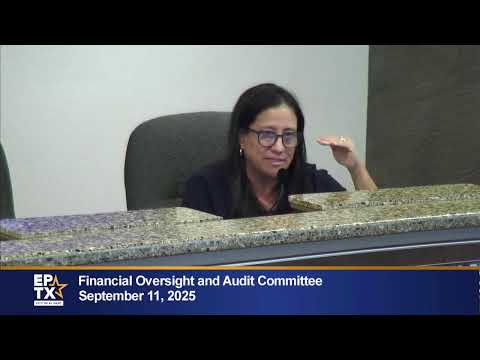
The Financial Oversight and Audit Committee of the City of El Paso heard Sept. 11 a presentation on options to address roughly $700,000,000 in unfunded pension liabilities for the City of El Paso Employees Retirement Trust and the El Paso Police and Fire pension funds and a proposal to add an actuarially determined contribution that would adjust contributions automatically based on market performance and benefit changes.
City officials said the matter matters for retirees, city finances and bond ratings. Margarita Marine, deputy chief financial officer, said the city and the pension funds engaged an actuarial firm and have been developing a pension funding policy to make the funds “more forward looking” and to reduce the unfunded liability within a reasonable time frame.
William Strange, an actuary who presented the proposed policy, described an ADAC that would layer amortization payments and automatically adjust the city’s required contribution when assumptions change. Strange said the ADAC would “produce a similar contribution out of the gate to your, to your current fixed contributions” if assumptions hold, and that new “layers” would be added if there were market losses or benefit increases. He said contributions under the proposal would never fall below the statutory fixed rate and that, when new layers are added, the resulting contribution rate would be limited to no more than a 2% increase in a single year.
Why it matters: City staff said bond raters review unfunded pension liabilities when evaluating municipal credit, and the city has not secured an upgrade because of its pension position. CFO Robert Cortinas said the city has worked with Milliman for about 18 months to customize a funding policy and that recent changes — including a cost-of-living adjustment (COLA) enacted by the police and fire pension fund and a reduction in that fund’s assumed investment return from 7.75% to 7.5% — have increased uncertainty and may raise the unfunded liability and amortization period.
The presentation included plan-level details the consultant described as projections: the presentation showed the combined unfunded liability at just under $700 million as of 2022 and projected declines under the proposed funding approach. Strange summarized projected amortization periods shown in the presentation as roughly 16 years for the employee plan, about 19 years for police and about 20 years for fire.
Committee members asked how triggers would work and whether changes would require bargaining-agreement modifications. Strange said triggers could include COLA changes, formula adjustments or market underperformance and stated his understanding that the ADAC would be a “supplemental contribution, so above what’s already agreed to and set in statute,” and therefore would not require changing collective-bargaining agreements. Cortinas said the city needs additional, specific work with the two pension boards to quantify the financial impact of the recent COLA and the change in investment return assumptions before recommending a definitive ADAC structure.
Next steps: Staff said the ADAC proposal is part of ongoing work. Cortinas and staff said they will continue to meet with the police and fire pension boards and Milliman to refine assumptions and incorporate the pension funds’ changes into final projections. Committee members were told the ADAC would be evaluated annually and that any formal adoption would follow further analysis and interboard discussions.
The item did not include a committee vote or formal action.