Get Full Government Meeting Transcripts, Videos, & Alerts Forever!
Get email alerts on the Police Drones topic
No spam. Unsubscribe anytime.
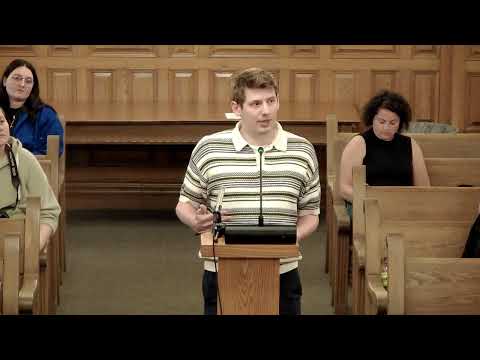
Public raises privacy and data-sharing concerns at Syracuse hearing on police drone program
Summary
City residents urged the Syracuse Common Council to delay or reject a proposed expansion of remote-operated drone use by the Syracuse Police Department, citing gaps in procedures, potential data-sharing under the Axon contract, and civil‑liberties risks.
Syracuse residents urged the Syracuse Common Council on an item described by the clerk as "an agreement with ACT corporation" related to police drones, saying the Syracuse Police Department's proposed expansion to remotely operated drones lacks sufficient procedural safeguards and could put sensitive data at risk.
At a public hearing, Barry Gewanter, a Syracuse resident, said the proposal was premature. "For this reason and others, this program is not ready for approval, and I urge you to delay consideration until a new procedure document is draft," Gewanter said, adding that existing procedure document 602 (from 2020) limits drone operations to line‑of‑sight and has not been updated.
The concern about procedures and oversight was echoed by Lee Cridland of the Syracuse Peace Council. "Unrestricted use of drones by the police is not acceptable," Cridland said, noting the group has pushed for limits on domestic drone use since 2013 and asking the council to "abide by that resolution." Cridland and others said the current rewrite of policy 6‑0‑6 removed previous, more detailed limits and that the public and councilors have not seen the program protocols that a department coordinator would use.
Aaron Burnside, a graduate student and Syracuse resident, focused on data‑sharing risks in the vendor contract and the volume of data the program would create. "Does the SPD plan to share this data as well? Is there anything in the Axon contract that requires them to share this?" Burnside asked, saying that video from the DFR program could include "video of people, their private property and public gatherings." He warned that relaxed FAA rules allowing drones to fly up to 400 feet out of sight could enable broad citywide surveillance.
Davis Goldstein, another resident, warned that the city's past experience with surveillance programs undermines trust. Goldstein said the city's prior camera program resulted in "nearly 4,400,000 searches of Syracuse's data by officers nationwide since June 2024," including "2,000 searches labeled as immigration related," and called that a sign the city has not been a consistently secure custodian of sensitive information.
A speaker identified only as Mary said the rewritten policy removed section 6‑0‑6.7, which previously listed authorized uses of unmanned aerial vehicles, and removed 6‑0‑6.9 on retention of recorded images. She said the updated policy does not identify who in SPD can authorize remote flights or the criteria for approving a request, and she urged the council not to approve remote operation without explicit limits and publicly available protocols.
Speakers offered a range of suggested limits and next steps: delay final approval until a new procedure document is drafted and published for public review; clarify who may authorize deployments and on what criteria; specify retention and external‑request handling for recorded images; and add contractual protections to prevent third‑party data sharing.
The hearing closed with the clerk noting the legislation "will be considered during the regular order of business." No formal council votes or motions on the item were recorded during the hearing portion captured in the transcript.
Because commenters referenced specific department policies, contract language, and prior city surveillance programs, speakers repeatedly framed the issue as a combination of technical data‑security risks and civil‑liberties concerns, and urged the council to provide clearer procedural guardrails before allowing remote operation of drones.