Get Full Government Meeting Transcripts, Videos, & Alerts Forever!
Get email alerts on the Public Safety Police Capital topic
No spam. Unsubscribe anytime.
City council reviews $3.2M vehicle buy, radios, command post and camera funding as part of police capital and tech package
Summary
Councilors discussed bond ordinances and procurement for police vehicles, portable radios, a replacement command post, records-management software and camera infrastructure, and raised questions about bonding vs. cash capital and data privacy for surveillance systems.
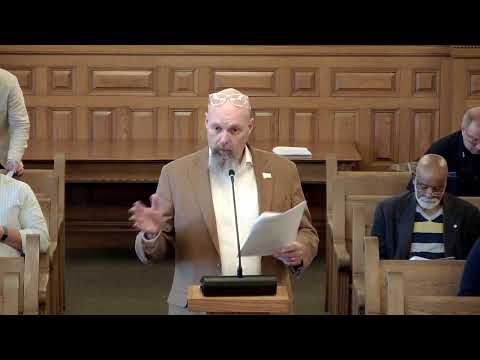
Deputy Chief Rich Hart and other city officials briefed the Syracuse City Common Council on a package of capital and technology items for the Police Department, including a proposed $3,241,000 vehicle replacement plan and separate bond ordinances to replace radios, a command post and other equipment.
Councilors pressed for detail on procurement, lifecycle costs and data protections for city surveillance cameras. Councilor Williams asked why the city shifted plans from using cash capital to bonding for many police capital items; Mike Enser, Commissioner of Finance, and Chief Administrative Officer Corey Dunham said the city had confirmed with bond counsel that vehicles can be financed and that cash capital would be reserved for items that must be paid from cash.
The council heard that the vehicle replacement request is part of a larger Police capital program of roughly $7 million and that the city will buy police-package vehicles when possible, though supply limitations can restrict quantities. Officials said older vehicles often have more than 100,000 miles and that a garage team determines which units are retired, auctioned or redeployed. Hart said auction proceeds go to the city’s general fund.
On radios and communications, councilors reviewed a $500,000 plan to replace portable radios after prior upgrades to mobile radios in patrol cars. Hart said mobile radios were upgraded last year and portables are now at “end of life.” Separately, ordinances were introduced to bond up to $750,000 for a departmental command post replacement and to fund server, firewall and switch upgrades totaling about $100,000 for information technology improvements tied to the department’s move to a new police-public-safety building.
Hart described ongoing camera operations and pushed back on privacy concerns. “They are used daily to solve crimes,” Hart said, adding that cameras have helped investigators in everything “from homicide to larcenies to criminal mischiefs.” He said the city’s early camera installations were funded by state grants and by requests from neighborhood groups working with state representatives, and that grant rules historically paid for installation but not maintenance or replacement. Hart said the city has since obtained replacement funding through a grant secured by a former state legislator.
The council also discussed a proposed move to a new records management system (vendor Niche was discussed) intended to consolidate multiple systems for police reports, property management and state reporting. Hart said the county and some neighboring agencies are evaluating the same systems and that consolidation could improve data sharing and reduce duplicate entry.
Councilors asked for follow-up data: the council requested a list of vehicles planned for replacement with model years and mileages; a breakdown of financing choices; and clarity about camera data ownership and any third-party access rules. Officials said the city is the owner of camera data and that New York State’s demonstration program includes strict limits on sharing data captured by cameras, which must be requested from the city rather than directly from the vendor.
No formal votes were recorded in the public transcript for these items during the meeting; several ordinances and bond authorizations were presented and described as “ready.”