Get Full Government Meeting Transcripts, Videos, & Alerts Forever!
Get email alerts on the Brownfields topic
No spam. Unsubscribe anytime.
MassDEP, EPA and MassDevelopment outline Brownfields funding, free technical help; North Brookfield cited as model
Summary
State and federal agencies and a technical‑assistance provider presented Brownfields assessment, cleanup and financing programs at a Sept. 9 virtual roundtable, and cited North Brookfield's Aztec Industries cleanup and conversion to a police station as a multiagency success.
BOSTON (Sept. 9, 2025) — The Massachusetts Department of Environmental Protection hosted a virtual Brownfields Roundtable to explain state and federal assessment, cleanup and financing resources for underused or potentially contaminated properties and to highlight technical assistance that is available at no cost.
MassDEP's statewide Brownfields coordinator (MassDEP Statewide Brownfields Coordinator) opened the session and defined a brownfield as “a property that's underutilized, has great has potential for reuse, and that underutilization is because the site is complicated,” noting that complications can include known contamination or data gaps that deter buyers and lenders.
The roundtable focused on why the programs matter: cleanup and assessment funding, technical assistance and tax incentives reduce uncertainty that otherwise blocks reuse, and they can unlock housing, commercial redevelopment and other economic activity.
MassDEP and legal framework
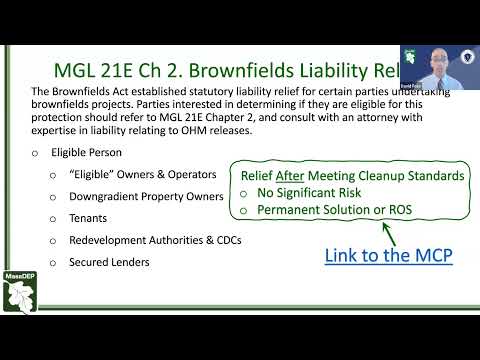
The presentation explained that cleanup in Massachusetts is governed by the Massachusetts Contingency Plan (MCP) and the Brownfields provisions in Massachusetts General Laws Chapter 21E. Under Chapter 21E, an "eligible person" who did not cause the contamination can conduct response actions and pursue liability relief if the site reaches a permanent solution under the MCP.
Speakers urged anyone buying commercial property to obtain an ASTM Phase I environmental site assessment within 180 days of acquisition to satisfy the EPA's all appropriate inquiries requirements and to establish baseline conditions that protect buyers and lenders.
State and federal funding and incentives
MassDEP described two statewide funding streams it is operating: a community-wide assessment grant that the agency obtained from EPA (the states-and-tribes assessment award can reach up to $2,000,000) and EPA 128(a) funding that MassDEP is using for flexible, site‑specific cleanup work. MassDEP encouraged municipalities and small towns with limited staff to use a short online Brownfields assistance request form to seek help or funding.
The Department of Revenue's Brownfields tax credit was explained as a distinct program administered by DOR: if a site is closed with no activity‑and‑use limitation (AUL) the tax credit can cover up to 50% of eligible permanent‑solution costs; if closure relies on an AUL the credit can be up to 25% of eligible costs. MassDEP clarified that DOR controls the tax‑credit program and eligibility follows the MCP definitions of eligible person and permanent solution.
DOER and the Attorney General
The Department of Energy Resources's Solar Massachusetts Renewable Target (SMART) incentives were flagged as a benefit for placing solar on previously developed land, including brownfields, where applicants that meet DOER criteria can access higher compensation rates. The Massachusetts Attorney General's Office was described as a potential source of a Brownfields covenant not to sue for very large or complex projects; the covenant can provide liability protections earlier in the cleanup and redevelopment process than a permanent solution under Chapter 21E.
MassDevelopment Brownfields programs
David Bancroft, senior vice president for community development at MassDevelopment, outlined two MassDevelopment Brownfields funding tracks. The Commonwealth's "One Stop for Growth" (municipalities only) can provide up to $100,000 for site assessment and up to $250,000 for remediation for municipally owned parcels where the municipality does not yet have an identified developer. The Rolling Round (available to municipalities, certified CDCs and certain nonprofits) is a noncompetitive grant stream that can provide up to $250,000 for site assessment and up to $750,000 for remediation per site; applicants must demonstrate public benefit and explain why a grant (not a loan) is required. MassDevelopment noted that demolition and interior building issues such as lead paint and asbestos abatement are not eligible under its Brownfields grants, and that the program does not fund projects whose end use is a nontaxable municipal facility (for example, schools or police stations).
EPA programs and TAB technical assistance
Jim Byrne, EPA Region 1 Brownfields coordinator, summarized EPA grant programs available to eligible entities (cities, towns, regional planning organizations and nonprofits) including assessment grants, cleanup grants, revolving loan funds and multipurpose grants. He highlighted EPA job training grants that support workforce development tied to remediation and construction. Byrne said EPA's targeted Brownfields assessment (TBA) is a grant-of-services model in which EPA contractors perform assessments for communities that lack local resources.
Randy Mendez, director of the Technical Assistance to Brownfields (TAB) program at the University of Connecticut, outlined free assistance that TAB provides across New England: document review, grant proposal review, procurement support, site reuse planning and community engagement. Mendez emphasized that "all of our services are completely free" and described a Municipal Assistance Program that pairs UConn students and staff with communities for inventories, grant preparation and visual site renderings to support developer outreach.
North Brookfield case study
Carrie Salwa, regional planner at the Central Massachusetts Regional Planning Commission, presented a multiagency success story in North Brookfield involving the former Aztec Industries parcel. The town acquired the property by tax foreclosure in 2000 after decades of industrial use; cleanup and redevelopment for a new police station were completed through a mix of state and federal funding. Salwa reported that cleanup removed approximately 1,900 bags of asbestos, 68 drums of hazardous material and more than 2,500 gallons of oil and solvents, and that the combined cleanup and redevelopment awards for the site totaled about $833,000. The police station now serves as a community hub; adjacent parcels remain under assessment and planning for additional trail connections, parking and recreation features.
Program distinctions and next steps
Speakers repeatedly advised participants to contact the agency that best matches their need: MassDevelopment for grant financing and site‑readiness work (with limits on eligible activities), MassDEP for MCP questions and assessment or 128(a) cleanup support, EPA for grants and TBA services, and TAB for no‑cost technical help including renderings and grant reviews. MassDEP said slide decks and the meeting recording would be posted on MassDEP's website and encouraged use of the Brownfields assistance request form for site‑specific requests.
Ending
Panelists closed by stressing partnerships and the leverage available when state, federal and local resources are combined: Byrne noted EPA's historical leverage of roughly $4.5 billion in redevelopment investment in New England since the program's inception, and speakers encouraged municipalities and community groups to pursue assessment grants, tax credits or technical assistance to move stalled properties into productive reuse.