Get Full Government Meeting Transcripts, Videos, & Alerts Forever!
Get email alerts on the Teacher Social Media Free Speech topic
No spam. Unsubscribe anytime.
Oshkosh community sharply divided over teacher’s social media post; dozens speak at school board meeting
Summary
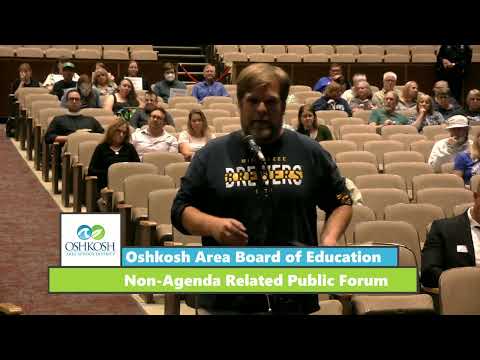
More than two dozen residents urged the Oshkosh Area School District Board of Education on Sept. 24 either to defend a teacher’s right to speak on private social media or to hold that teacher accountable after a widely circulated Facebook post about the murder of commentator Charlie Kirk.
More than two dozen residents urged the Oshkosh Area School District Board of Education on Sept. 24 either to defend a teacher’s right to speak on private social media or to hold that teacher accountable after a widely circulated Facebook post about the murder of commentator Charlie Kirk.
The dispute drew 28 public-comment speakers, including current students, alumni, parents, district employees and clergy, many of whom described personal experiences with the teacher they said show either his professionalism or the need for discipline.
The issue matters because the board oversees district employment decisions and could set a precedent for how the district treats employees’ private speech. Speakers repeatedly invoked the First Amendment, district policy language and state certification rules while urging the board to weigh legal protections, classroom conduct and student safety.
Justin Opperman, an Oshkosh parent and former district student, opened public comment by saying, "I'm really concerned about a Facebook post made by somebody who works in the district." He said the post—calling Kirk “morally evil” and asserting “the world is a better place without his voice and ideas”—made him worry about whether the teacher had expressed the same views around students.
Other public commentators described the teacher as a mentor and safe presence. Amberlynn Gilbertson, who said she was taught by the teacher in creative writing, told the board the teacher "never brought politics into the classroom" and "encouraged us to find our own voice." Multiple former students and current parents gave similar testimony about the teacher’s classroom conduct and the “safe space” he provided.
Several speakers pushed the opposite view. Nicholas Greezy, an alumnus, compared the Kirk case to a local example and asked rhetorically whether similar remarks praising violence toward a law enforcement officer would be tolerated. Sarah Scherzer, citing Wisconsin Administrative Code chapter PI 34, argued the teacher’s social media use constituted sanctionable conduct and said the teacher’s certification should be revoked.
Others urged the board to treat this incident the same way it treated previous conduct by elected board members, arguing that a standard of consistency requires protecting personal speech made off duty. Mallory Schneider Burschbach and others pointed to prior incidents in which board members used pseudonymous accounts and were not disciplined.
Clergy and legal professionals also spoke. Father Chris Corbin urged the board not to use employment actions to “short circuit debate,” saying punishment could send a message that dissenting voices must be anonymous. Attorney Gary Yates urged the board to honor the Constitution and warned against taking action that would conflict with federal free‑speech protections.
Several students described classroom experiences with the teacher and said the post was made on the teacher’s personal account outside school hours. A student speaker said: “He did not push or express his political opinion on or in front of anyone.” Another student said the teacher had helped them develop writing and critical thinking skills.
Board members did not respond during the public comment portion, a restriction the presiding officer read at the start of the forum. After public comment, the meeting proceeded through its agenda; later, the board voted to adjourn to executive session to consider personnel matters (see separate meeting action list).
What the record shows and what it does not: members of the public repeatedly invoked district policies and state rules during comment, and many asked the board to take or refrain from personnel action. The board did not make a public personnel decision during the open session recorded in the transcript. The meeting concluded with a motion to enter executive session to discuss "employment promotion compensation or performance evaluation data for public employees," but the transcript does not specify whether that motion was made in direct response to the social media controversy.
The meeting’s public comment period lasted the better part of the evening and included 28 speakers, reflecting high community engagement on the question of how the district should balance staff free-speech rights, district conduct rules and student safety. The board’s next public meeting will be the next opportunity for further public updates; the transcript shows administrators later offering separate written and verbal reports on other agenda items.