Get Full Government Meeting Transcripts, Videos, & Alerts Forever!
Get email alerts on the Land Use Rezoning topic
No spam. Unsubscribe anytime.
Dawsonville council hears debate over 120‑unit Maple Street rezoning; no final vote
Summary
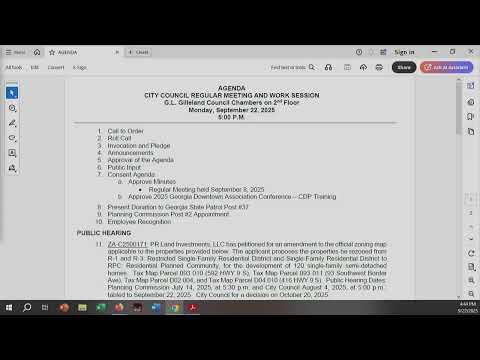
Dawsonville — The Dawsonville City Council on Sept. 22 heard more than an hour of testimony, questions and public comment about a developer’s request to rezone property now zoned R‑1 and R‑3 to a Residential Planned Community (RPC) for a proposed 120‑unit subdivision that would include an extension of Maple Street and a proposed donation of about 10 acres of land to the city. No final decision was recorded during the meeting.
Dawsonville — The Dawsonville City Council on Sept. 22 heard more than an hour of testimony, questions and public comment about a developer’s request to rezone property now zoned R‑1 and R‑3 to a Residential Planned Community (RPC) for a proposed 120‑unit subdivision that would include an extension of Maple Street and a proposed donation of about 10 acres of land to the city. No final decision was recorded during the meeting.
City planning staff told council members they recommended denial because staff judged the developer’s homes did not meet the city’s definition of a “semi‑detached” product and therefore the parcel should be limited to a density roughly equal to 1 dwelling unit per acre rather than the higher density the applicant seeks. “We do not feel it qualifies as a semi detached product. So we feel like it should have a density of 1 dwelling unit per acre,” said a planning staff member during the hearing.
The applicant and its attorney said the project would support the city’s strategic downtown plan, provide a new Maple Street connection to Highway 9, and include a traffic circle and a 10‑acre parcel the developer proposes to dedicate to the city. “We will provide that as part of this project,” developer Michael Miller said, referring to the traffic circle and associated public improvements. Attorney Steven Jones told council that whether components of the project meet the undefined term “semi‑detached” is a matter for council discretion: “The question is not whether there is a semi detached development here, it’s which 1 of the proposed products do you as mayor and council deem to be semi detached?”
Residents who live near the proposed site spoke against rezoning, citing traffic and scale. “I just wanna go on record that I’m opposed to this rezoning,” said Jack Hunt, a resident who described concerns about nearby intersections and traffic volumes. Kim Holt, another nearby resident, said she and neighbors collected signatures opposing the change and urged the council to keep the existing R‑1/R‑3 designations.
Council members pressed the applicant and staff on how the proposal aligns with the city’s comprehensive plan and on density math. Staff and the applicant gave different characterizations of acreage used to calculate density; applicants said a prior packet had miscounted park acreage and that the 10‑acre dedication should count toward the overall site area, but a council member noted that excluding the donated 10 acres would raise the effective density on the remaining land. Council members also asked whether the donated 10 acres would require ongoing maintenance by public works; the city manager said current public works capacity would not maintain an additional 10 acres without added staffing.
The council opened and later closed the public hearing by formal motions during the meeting but did not vote on the rezoning application itself. The public hearing was opened by motion from Councilmember Mark French and later closed by motion from Councilmember Phillips; both motions passed. No final approval or denial of the rezoning was recorded in the meeting minutes provided.
The application packet filed with the city included a letter of intent and draft proffered conditions from the applicant; the updated materials addressed park acreage and proffered public improvements but did not include a new, final site plan. Staff also noted a portion of the proposed Maple Street extension would traverse low‑lying, swampy ground that could be prone to flooding and would be subject to permitting if the project proceeds.
Because the council did not take a final vote on the rezoning during the Sept. 22 meeting, the request remains under consideration. Any future formal action would be recorded in a subsequent council agenda and minutes.